Diamond, graphite, graphene and fullerenes are all carbon
Allotrope
One of two or more different forms of the same element in the same physical state.
Giant covalent structure
A structure in which atoms are joined by strong covalent bonds in a large continuous network.
- All four are made only of carbon atoms joined by covalent bonds.
- They have very different properties because the atoms are bonded differently and arranged in different shapes.
- Diamond, graphite and graphene are giant covalent structures.
- Fullerenes are molecules, such as buckminsterfullerene, C60\text{C}_{60}C60, which is shaped like a hollow football.
Every property of these substances can be explained from how many bonds each carbon atom forms and how the atoms are arranged.
Four covalent bonds per atom make diamond hard
- In diamond, each carbon atom is covalently bonded to four others in a rigid three-dimensional network.
- Melting diamond means breaking many strong covalent bonds, which needs a huge amount of energy, so its melting point is very high.
- The rigid network makes diamond extremely hard, which is why it is used on the tips of cutting tools and drills.
- Diamond does not conduct electricity, because all four outer electrons of each atom are in bonds, leaving no delocalised electrons.
Do not mention intermolecular forces for diamond or graphite, because these are giant covalent structures with no separate molecules.
Layers and delocalised electrons explain graphite's properties
Delocalised electron
An electron that is not attached to one particular atom or ion and can move through a structure.
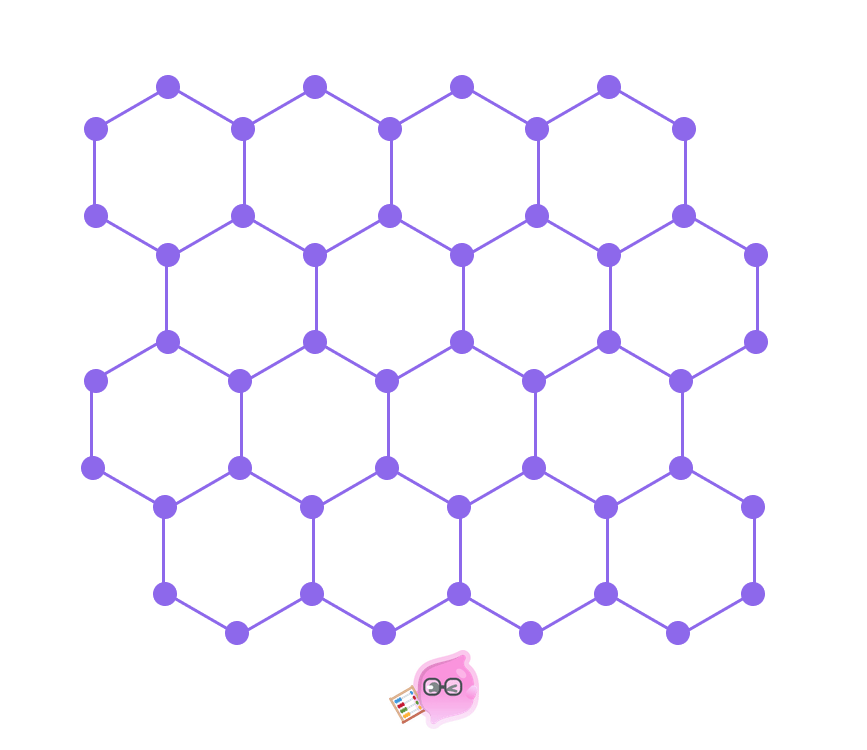
- In graphite, each carbon atom forms three covalent bonds, making flat layers of hexagonal rings.
- The fourth outer electron from each atom is delocalised, so graphite conducts electricity along the layers.
- The layers are held together only by weak forces, so they slide over each other easily.
- This makes graphite soft and slippery, which is why it is used in pencils and as a lubricant.
- Graphite still has a very high melting point, because melting breaks the strong covalent bonds within the layers.
Graphite is used for the electrodes in electrolysis because it conducts electricity and has a very high melting point.
Graphene sheets and hollow fullerene molecules
Graphene
A single layer of carbon atoms, with each carbon atom covalently bonded to three others in a hexagonal arrangement.
Fullerene
A molecular form of carbon in which carbon atoms form a hollow cage, such as a sphere or tube.
- Graphene is one atom thick, so it is very light and almost transparent.
- Its strong covalent bonds make it extremely strong for its mass.
- Each carbon atom in graphene has a delocalised electron, so graphene conducts electricity very well and could be used in flexible electronics.
- Fullerenes such as C60\text{C}_{60}C60 are separate molecules, so the weak intermolecular forces between them give much lower melting points than diamond.
- Carbon nanotubes are fullerenes shaped as cylinders, which are very strong and conduct electricity, so they can reinforce materials.
- The hollow shape of fullerenes lets them carry drug molecules into the body.
When comparing diamond and graphite, compare the number of bonds each carbon atom forms and whether any electrons are delocalised, because those two facts explain most of the differences.
- Why does diamond have a very high melting point?
- Why does graphite conduct electricity but diamond does not?
- Why is graphite soft and slippery?
- What is graphene, and why does it conduct electricity?
- Why does C60\text{C}_{60}C60 have a much lower melting point than diamond?
