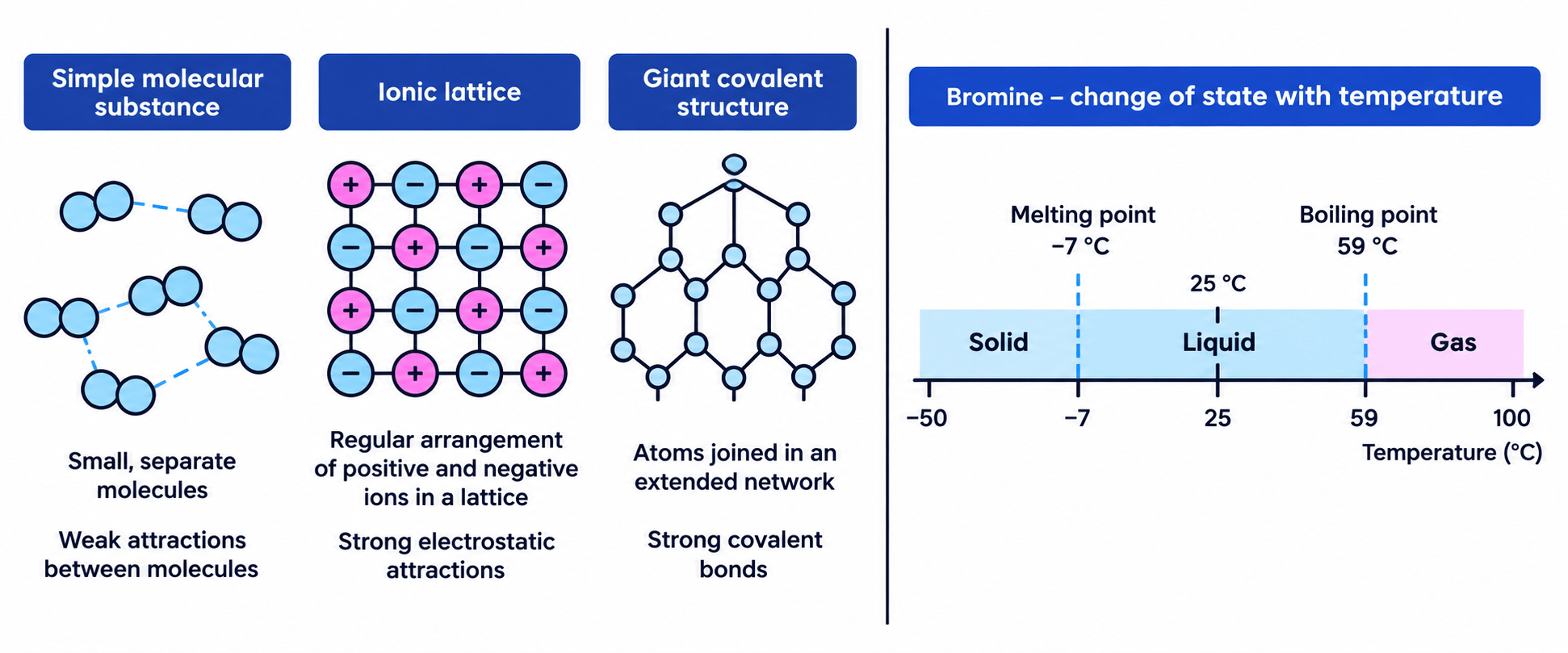
Changing state means overcoming forces between particles
Intermolecular force
An attraction between separate molecules.
Boiling point
The temperature at which a liquid changes to a gas at a stated pressure.
- Melting and boiling need energy to be transferred to the substance to overcome the attractions holding its particles together.
- The stronger the attractions, the more energy is needed and the higher the melting and boiling points.
- Freezing and condensing release energy as the attractions form again.
- What has to be overcome depends on the type of structure, which is why melting points range from −210 ∘C-210\ ^{\circ}\text{C}−210 ∘C for nitrogen to over 3500 ∘C3500\ ^{\circ}\text{C}3500 ∘C for diamond.
To explain a melting or boiling point, name what is overcome and say how strong it is.
Simple molecular substances have low melting and boiling points
Simple molecular substance
A substance made of separate small molecules, such as water, oxygen or methane.
- Inside each molecule, the atoms are held by strong covalent bonds.
- Between the molecules there are only weak intermolecular forces.
- Melting or boiling separates the molecules, so only the intermolecular forces are overcome and the covalent bonds stay intact.
- Little energy is needed, so these substances are often gases or liquids at room temperature.
- Larger molecules have stronger intermolecular forces, so they have higher boiling points.
- This is why pentane boils at 36 ∘C36\ ^{\circ}\text{C}36 ∘C, while methane boils at −162 ∘C-162\ ^{\circ}\text{C}−162 ∘C.
Do not say that covalent bonds break when a simple molecular substance boils, because boiling water still gives H2O\text{H}_2\text{O}H2O molecules.
Giant structures have high melting points
- In an ionic lattice, melting means overcoming strong electrostatic attractions between huge numbers of oppositely charged ions.
- Magnesium oxide, with 2+2+2+ and 2−2-2− ions, has stronger attractions than sodium chloride and melts at about 2850 ∘C2850\ ^{\circ}\text{C}2850 ∘C.
- In a giant covalent structure, melting breaks many strong covalent bonds, so diamond and silicon dioxide melt at very high temperatures.
- In a metal, the strong attraction between positive ions and delocalised electrons means most metals need a lot of energy to melt.
- Boiling points of giant structures are even higher, because the particles must be separated completely.
Sodium chloride melts at 801 ∘C801\ ^{\circ}\text{C}801 ∘C but chlorine boils at −34 ∘C-34\ ^{\circ}\text{C}−34 ∘C, because salt's ions are held in a strong lattice while chlorine molecules are held only by weak intermolecular forces.
Predicting state from melting and boiling points
Melting point
The temperature at which a solid changes to a liquid at a stated pressure.
- Below its melting point, a substance is a solid.
- Between its melting and boiling points, it is a liquid.
- Above its boiling point, it is a gas.
- Take care with negative values, since −50 ∘C-50\ ^{\circ}\text{C}−50 ∘C is colder than −20 ∘C-20\ ^{\circ}\text{C}−20 ∘C.
- At its melting point, a substance can be present as both solid and liquid.
- Bromine melts at −7 ∘C-7\ ^{\circ}\text{C}−7 ∘C and boils at 59 ∘C59\ ^{\circ}\text{C}59 ∘C; predict its state at 25 ∘C25\ ^{\circ}\text{C}25 ∘C.
- Compare with the melting point: 25 ∘C25\ ^{\circ}\text{C}25 ∘C is above −7 ∘C-7\ ^{\circ}\text{C}−7 ∘C, so bromine is not a solid.
- Compare with the boiling point: 25 ∘C25\ ^{\circ}\text{C}25 ∘C is below 59 ∘C59\ ^{\circ}\text{C}59 ∘C, so bromine has not boiled.
- Bromine is a liquid at 25 ∘C25\ ^{\circ}\text{C}25 ∘C.
- Why does a substance with stronger forces between its particles have a higher boiling point?
- What is overcome when water boils?
- Why does magnesium oxide have a higher melting point than sodium chloride?
- Why does pentane boil at a higher temperature than methane?
- Ethanol melts at −114 ∘C-114\ ^{\circ}\text{C}−114 ∘C and boils at 78 ∘C78\ ^{\circ}\text{C}78 ∘C; what is its state at 100 ∘C100\ ^{\circ}\text{C}100 ∘C?