Question 5
HA student adds excess magnesium carbonate powder to 50 cm3\mathrm{cm^{3}}cm3 of dilute hydrochloric acid.
MgCO3+2HCl→MgCl2+H2O+CO2 \mathrm{MgCO_{3}} + 2\mathrm{HCl} \rightarrow \mathrm{MgCl_{2}} + \mathrm{H_{2}O} + \mathrm{CO_{2}} MgCO3+2HCl→MgCl2+H2O+CO2The student measures the volume of carbon dioxide every 20 seconds.
The table shows the results.
| Time (s) | Volume of carbon dioxide (cm3\mathrm{cm^{3}}cm3) |
|---|---|
| 0 | 0 |
| 20 | 30 |
| 40 | 52 |
| 60 | 68 |
| 80 | 79 |
| 100 | 86 |
| 120 | 90 |
| 140 | 92 |
| 160 | 92 |
| 180 | 92 |
a.[3]
Calculate the mean rate of reaction between 0 and 60 seconds.
Give the units.
b.[2]
The student plots a graph of the results and draws a smooth curve. The student then draws a tangent to the curve at 40 seconds.
The graph shows the student's curve and tangent.
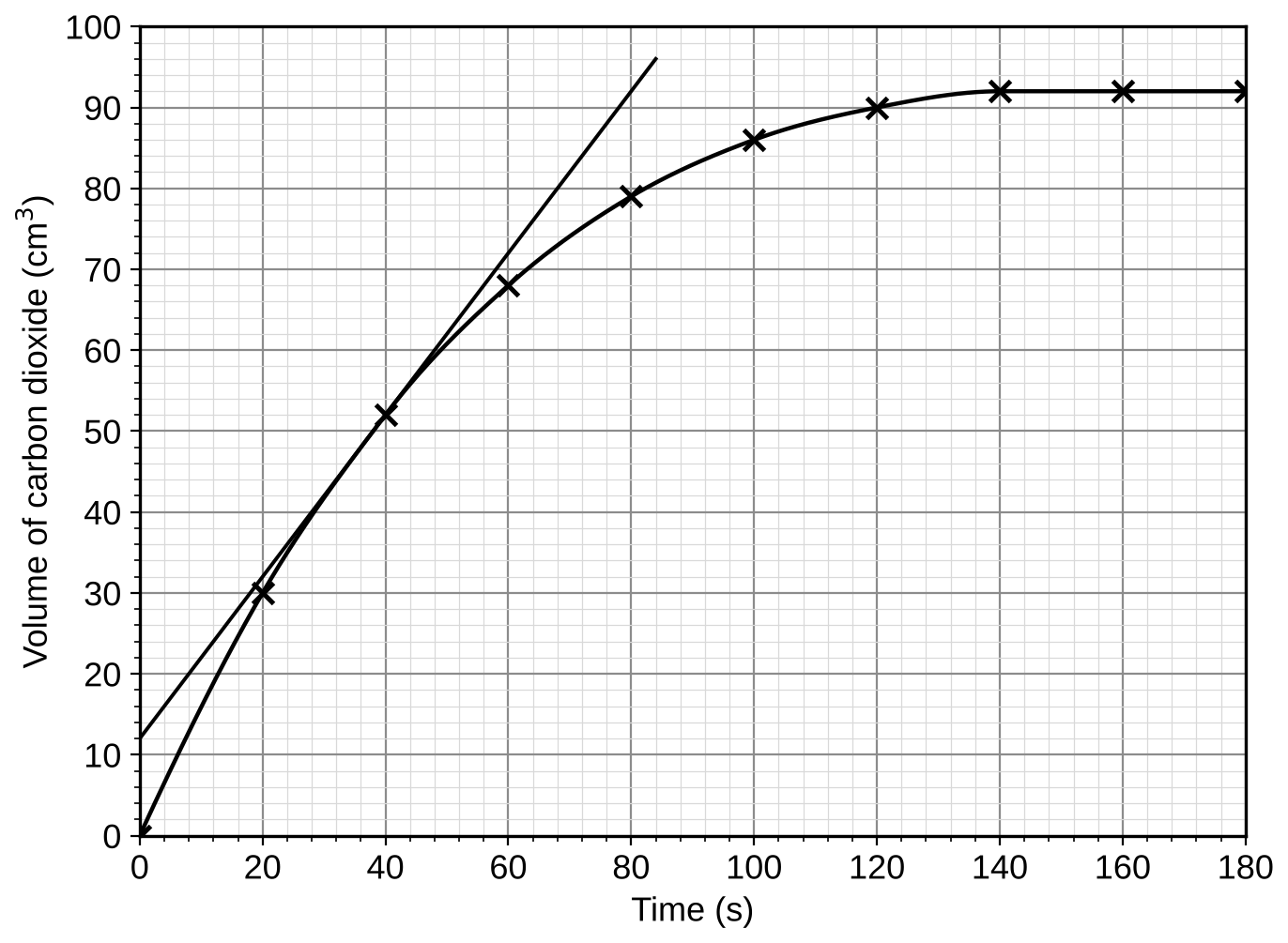
Use the tangent to calculate the rate of reaction at 40 seconds.
Rate = ...... cm3/s\mathrm{cm^{3}/s}cm3/s
c.[2]
Explain why the rate of reaction decreases between 40 seconds and 140 seconds. Use the reacting particle model.
d.[2]
The student repeats the experiment with 50 cm3\mathrm{cm^{3}}cm3 of hydrochloric acid of half the concentration. Everything else stays the same.
Predict the final volume of carbon dioxide. Explain your answer.
e.[2]
The student says, "The reaction finished at 160 seconds."
Evaluate this statement. Use the results.
5.2 Controlling reactions Questions
56 exam-style questions on OCR GCSE Chemistry 5.2 Controlling reactions, covering 5.2.1 Measuring and interpreting rate of reaction, 5.2.2 Factors affecting rate and collision theory, and 5.2.3 Catalysts, activation energy and enzymes. Each one has a worked solution and a mark scheme showing where the marks go.