Bulk properties come from bonding and structure
Bulk property
A property of a large amount of a material, such as its melting point, hardness or electrical conductivity.
- A single atom or molecule has no melting point and cannot conduct, because these are properties of the whole material.
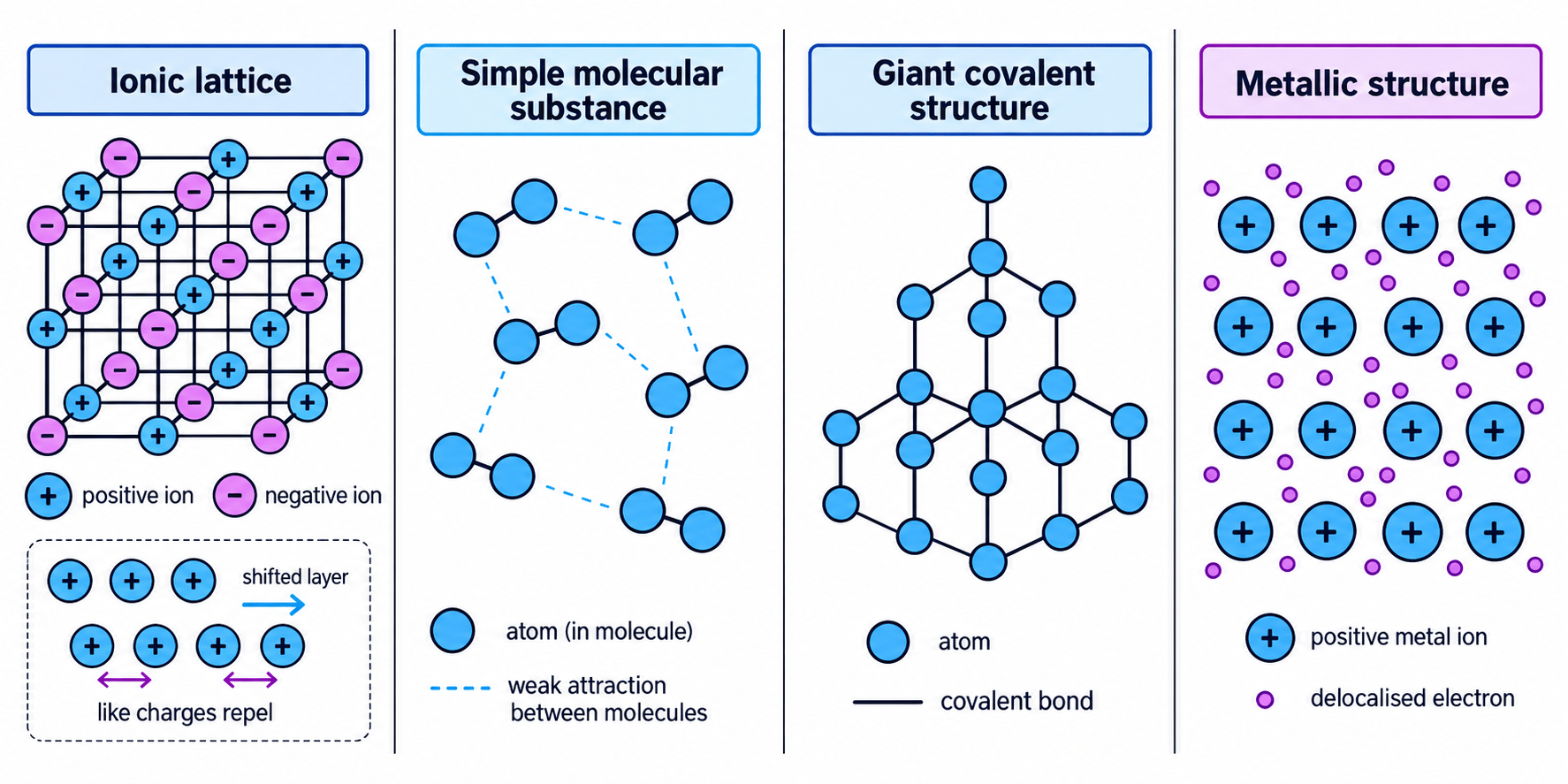
- Bulk properties depend on the type of bond, how strong it is compared with any intermolecular forces, and how the bonds are arranged.
- Electrical conductivity needs charged particles that are free to move, either ions or delocalised electrons.
- Hardness and brittleness depend on whether layers of particles can move past each other without the bonding breaking.
For any material, ask which particles are present, what holds them together and whether anything charged can move.
Hard, brittle ionic compounds conduct when molten or dissolved
Ionic lattice
A regular, repeating three-dimensional arrangement of oppositely charged ions.
- Strong attractions between ions give ionic compounds high melting points.
- Solid ionic compounds do not conduct, because their ions are fixed in the lattice.
- When molten or dissolved in water, the ions can move, so the compound conducts electricity.
- Ionic crystals are brittle, because a sharp blow shifts a layer so that ions with the same charge line up and repel.
- Many ionic compounds, such as sodium chloride, dissolve in water.
Do not say molten ionic compounds conduct because electrons move, because the charge is carried by moving ions.
Simple molecular substances melt easily and do not conduct
Simple molecular substance
A substance made of separate small molecules, such as water, oxygen or methane.
- Only weak intermolecular forces act between the molecules, so melting and boiling points are low.
- Simple molecular substances do not conduct electricity, because the molecules have no overall charge and there are no free electrons.
- Their solids are usually soft, because little force is needed to push the molecules apart.
- Many do not dissolve in water, although some, such as sugar, do.
Candle wax melts in a flame and does not conduct, because it is made of molecules held together by weak intermolecular forces.
Giant covalent structures are hard, while polymers are flexible
Polymer
A substance made of very long molecules built from many repeating units joined by covalent bonds.
- Giant covalent substances such as diamond and silicon dioxide have very high melting points, because many strong covalent bonds must break.
- They are hard, because the rigid network of bonds resists being pushed out of shape.
- Most do not conduct electricity, because all their outer electrons are in bonds, with graphite the exception.
- In a polymer, strong covalent bonds run along each chain, while weaker intermolecular forces hold neighbouring chains together.
- The chains can slide past each other, so many polymers are flexible and soften when heated.
- Polymers melt at higher temperatures than small molecules, because their long chains have stronger intermolecular forces.
A poly(ethene) carrier bag stretches and softens when warmed because its chains slide past one another, but it holds together because each chain is joined by covalent bonds.
Delocalised electrons and layers of ions explain metal properties
Delocalised electron
An electron that is not attached to one particular atom or ion and can move through a structure.
- Metals conduct electricity, because their delocalised electrons can move through the structure.
- Metals also conduct heat well, because the delocalised electrons carry energy through the metal.
- Metals are malleable and ductile, because layers of ions can slide over each other without the metallic bonding breaking.
- Most metals have high melting points, because of the strong attraction between the ions and the delocalised electrons.
- In an alloy, atoms of different sizes disrupt the layers, so the layers slide less easily and the alloy is harder.
When explaining conductivity, always say what moves: ions in a molten or dissolved ionic compound, and delocalised electrons in a metal or graphite.
- Why does solid sodium chloride not conduct electricity when molten sodium chloride does?
- Why are ionic crystals brittle?
- Why do simple molecular substances not conduct electricity?
- Why are many polymers flexible?
- Why can metals be hammered into shape without breaking?