Mendeleev arranged the elements in his early periodic table in order of increasing relative atomic mass, but had to swap some elements to group those with similar properties together.
Explain why arranging elements by relative atomic mass does not always correspond to the correct order of elements.
Identify one pair of elements in the modern Periodic Table that are not in order of increasing relative atomic mass. Write down their chemical symbols.
The diagram below shows a simplified version of the modern periodic table. The letters A, B, C, and D are temporary labels and do not represent the actual chemical symbols of the elements.
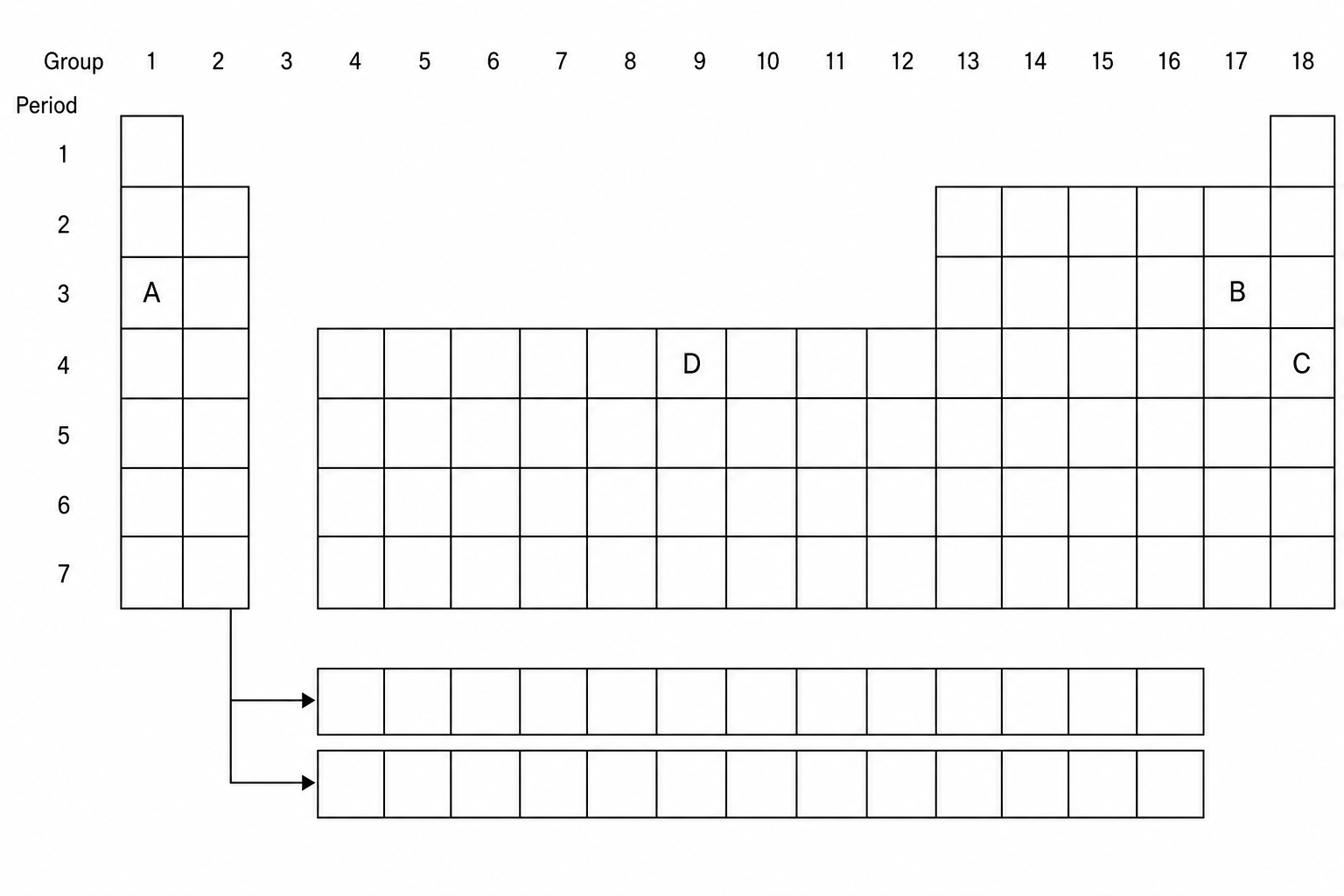
Which element (A, B, C, or D) is a highly reactive non-metal that forms ions with a 1−1-1−. charge? Explain your answer.
The diagram below shows a simplified version of the modern periodic table. The letters A, B, C, and D are temporary labels and do not represent the actual chemical symbols of the elements.
Which element (A, B, C, or D) is a highly reactive metal that reacts vigorously with water to form an alkaline solution? Explain your answer.