Silicon is a solid at room temperature.
The diagrams show three different particle models.
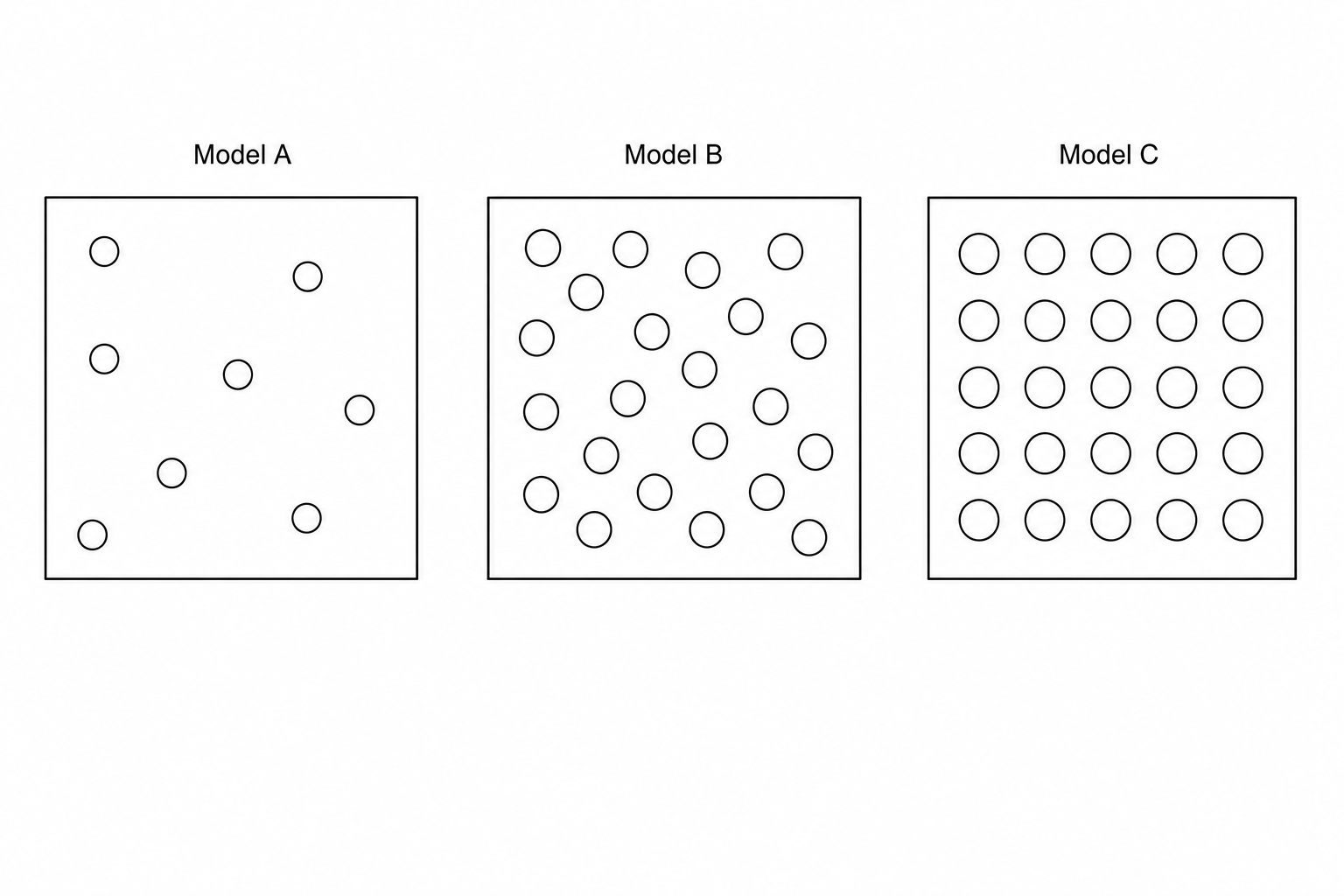
Which particle model represents a solid?
Choose Model A, Model B, or Model C.
Silicon has a melting point of 1414∘C1414^\circ\text{C}1414∘C and a boiling point of 3265∘C3265^\circ\text{C}3265∘C.
State a temperature at which silicon will be a liquid.
Complete the sentences about the particle models using words from this list: condensing, freezing, less, melting, more.
- A solid becoming a liquid is called ________.
- In a liquid, the particles move ________ than in a solid.
- In a liquid, the arrangement of particles is ________ random than in a solid.
Match each particle with its correct description:
- Particles: proton, electron, neutron
- Descriptions:
- relative charge of 000 (no charge) and relative mass of 111
- relative charge of −1-1−1 and very small relative mass
- relative charge of +1+1+1 and relative mass of 111
The element silicon has three different isotopes:
- Isotope 1: 1428Si{}^{28}_{14}\text{Si}1428Si
- Isotope 2: 1429Si{}^{29}_{14}\text{Si}1429Si
- Isotope 3: 1430Si{}^{30}_{14}\text{Si}1430Si
Which isotope has the highest mass?
Which isotope has the same number of protons and neutrons?
Atoms of each isotope have the same number of electrons. How many electrons do these atoms have?
A sample of silicon contains all three isotopes. It contains 92.23%92.23\%92.23% of isotope 1 and 4.68%4.68\%4.68% of isotope 2.
Calculate the percentage of isotope 3 in the sample of silicon.