Particle arrangement, movement and energy separate the three states
- Every substance is made of particles, and those particles are always moving.
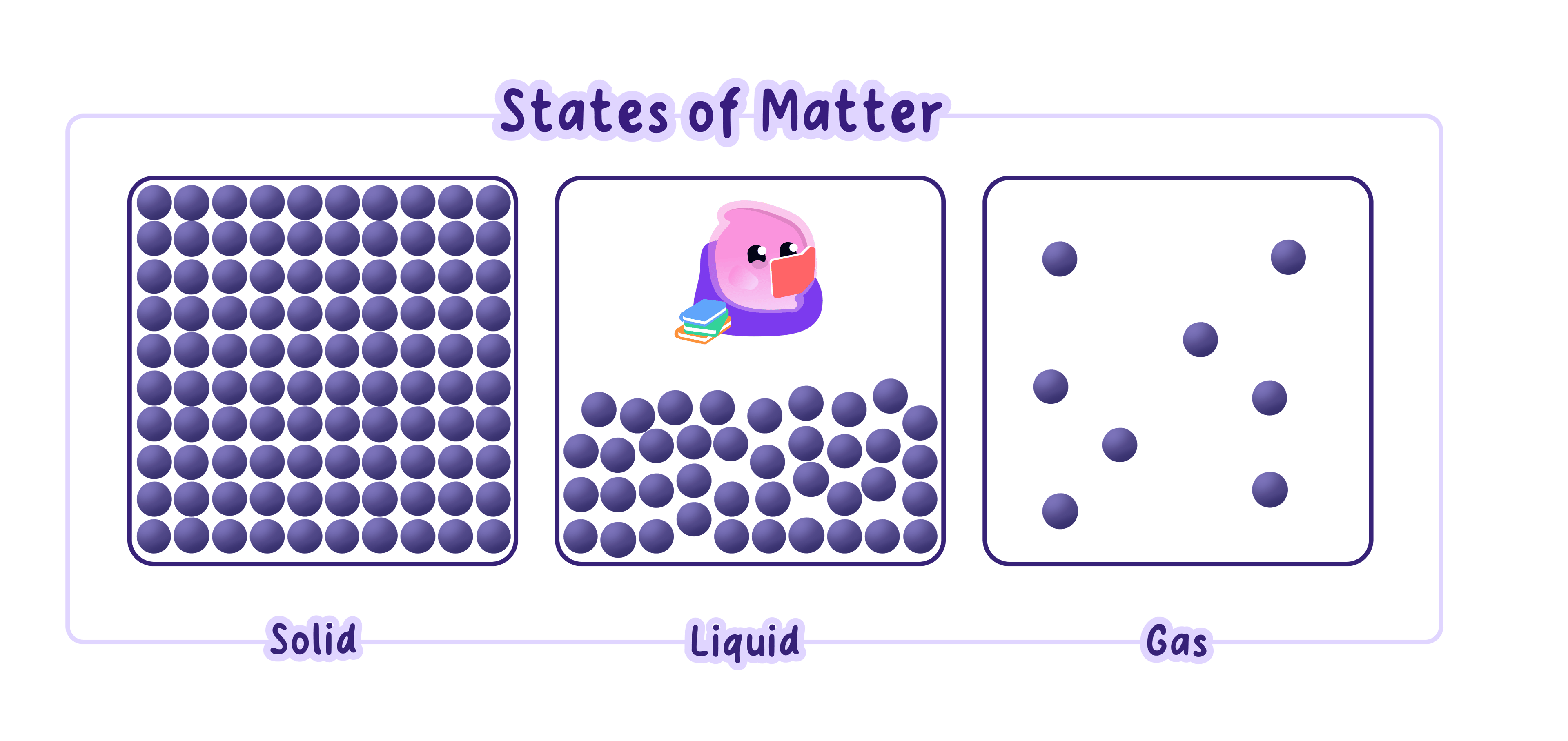
- In a solid the particles sit very close together in a fixed, regular arrangement.
- Solid particles vibrate about fixed positions and cannot move from place to place.
- In a liquid the particles are still close together, but their arrangement is irregular.
- Liquid particles slide past one another, so a liquid flows and takes the shape of its container.
- In a gas the particles are far apart and arranged randomly.
- Gas particles move quickly in all directions, so a gas spreads out to fill its container.
- For one substance, the particles hold the least energy as a solid and the most as a gas.
Key Idea
- Energy rises from solid to liquid to gas, so the particles move more freely and spread further apart.
- The substance itself is unchanged, because only the arrangement and the movement differ.
Each change of state has its own name
Definition
Physical change
A change in which no new substance is formed, so the substances present keep their chemical identity.
Definition
Evaporation
A change from liquid to gas that takes place only at the surface of a liquid, below its boiling point.
Definition
Sublimation
A change of state in which a solid becomes a gas directly, without passing through the liquid state.
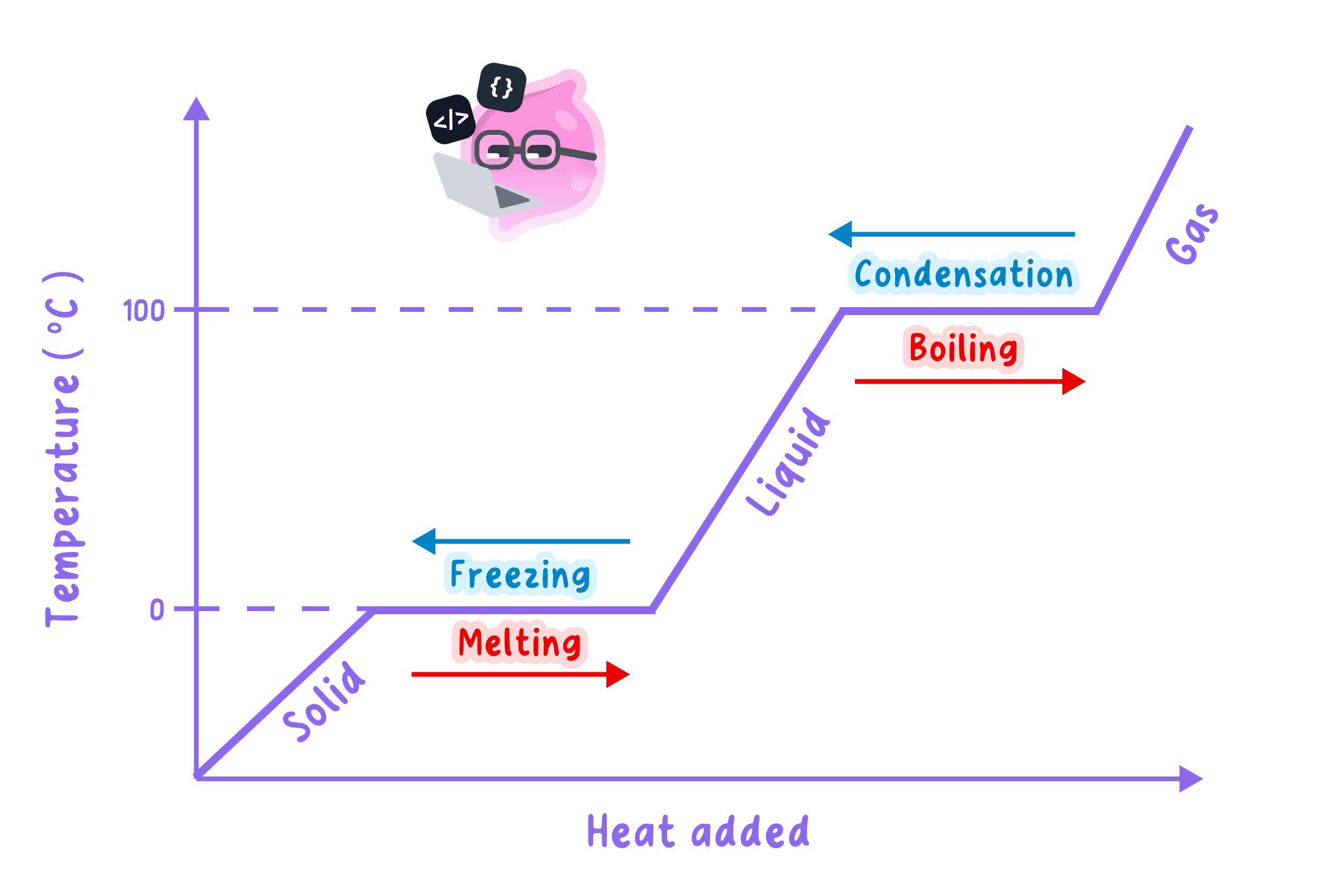
- Melting turns a solid into a liquid, and freezing turns a liquid back into a solid.
- Boiling turns a liquid into a gas throughout the liquid.
- Evaporation also turns a liquid into a gas, but only at the surface and below the boiling point.
- Condensing turns a gas into a liquid.
- Subliming turns a solid straight into a gas, and the reverse change turns a gas straight into a solid.
- None of these forms a new substance, so every one of them is a physical change.
- A chemical change does form one or more new substances, with different properties from the starting materials.
Common Mistake
- Melting is not a chemical reaction, because the substance is the same before and after.
- Evaporation is not boiling, because it happens at the surface and below the boiling point.
Heating and cooling change the energy the particles hold
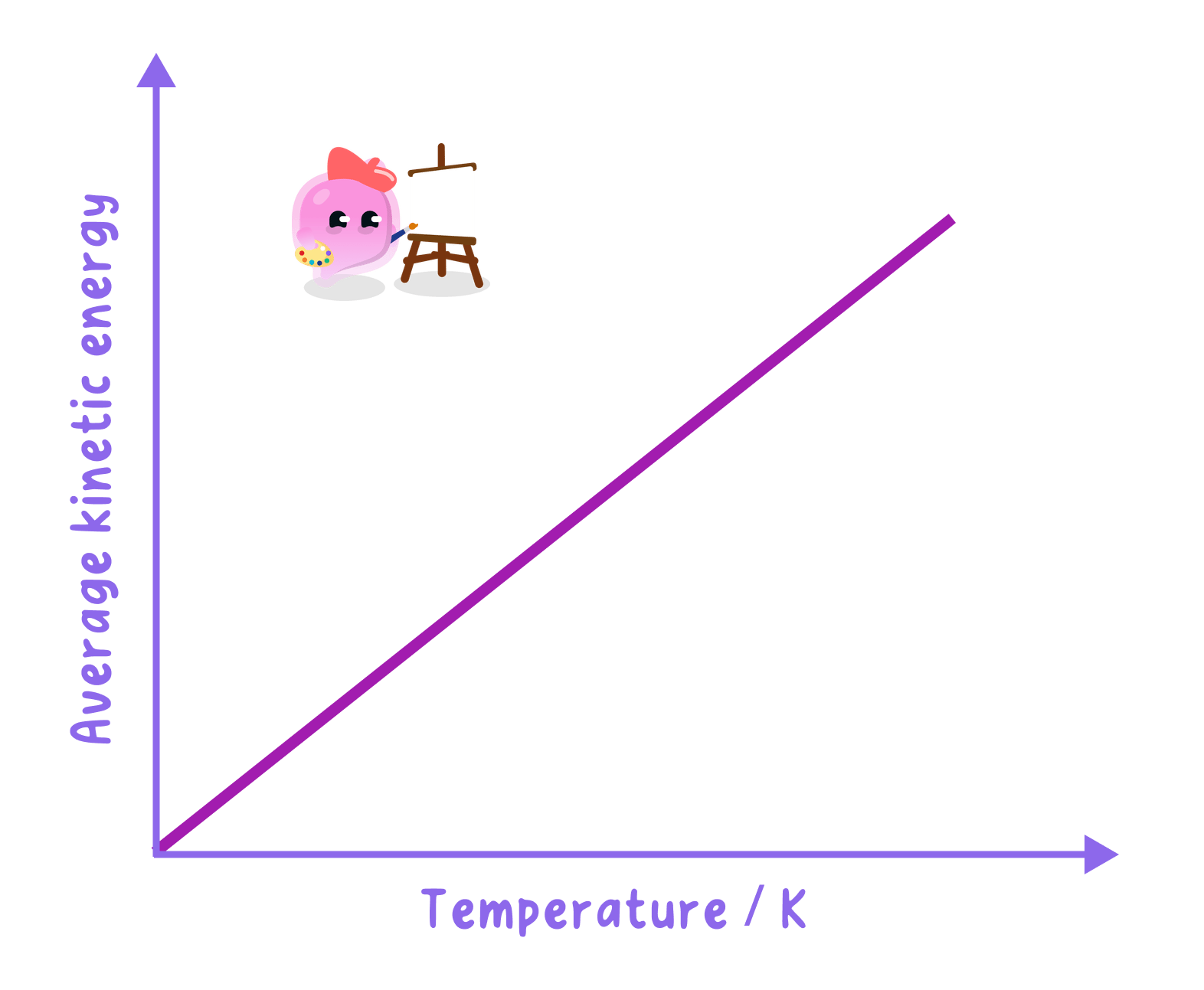
- Heating a solid transfers energy to its particles, which vibrate faster about their fixed positions.
- Melting happens once those particles hold enough energy to break out of their fixed positions.
- Heating a liquid gives its particles more energy still, so they move faster.
- Boiling happens once particles throughout the liquid hold enough energy to separate completely.
- Evaporation happens when the fastest particles at the surface escape, which is why it works below the boiling point.
- Cooling a gas takes energy away, so its particles slow down and come closer together.
- Condensing happens once gas particles have lost enough energy to stay close together as a liquid.
- Freezing happens once liquid particles have lost enough energy to settle into fixed positions.
Example
- A puddle drying up: the fastest particles escape from the surface, so the water evaporates well below 100 ∘C100\ ^{\circ}\text{C}100 ∘C.
- A kettle boiling: particles gain enough energy throughout the liquid, which is why bubbles of gas form below the surface and not only at it.
Comparing the temperature with the melting and boiling points gives the state
Definition
Melting point
The temperature at which a substance changes from a solid into a liquid, at a stated pressure.
Definition
Boiling point
The temperature at which a liquid changes into a gas throughout the liquid, at a stated pressure.
- Below the melting point the substance is a solid.
- Between the melting point and the boiling point it is a liquid.
- Above the boiling point it is a gas.
- Water melts at 0 ∘C0\ ^{\circ}\text{C}0 ∘C and boils at 100 ∘C100\ ^{\circ}\text{C}100 ∘C, so at 20 ∘C20\ ^{\circ}\text{C}20 ∘C it is a liquid.
- Oxygen melts at −219 ∘C-219\ ^{\circ}\text{C}−219 ∘C and boils at −183 ∘C-183\ ^{\circ}\text{C}−183 ∘C, so at room temperature it is a gas.
- At exactly the melting point, solid and liquid can both be present at once.
- At exactly the boiling point, liquid and gas can both be present at once.
- Compare values measured at the same pressure, because both shift when the pressure changes.
Note
- Both values are needed, because a temperature above the melting point could still give a liquid or a gas.
- Check the signs, since many boiling points are negative numbers.
Reading a table of melting and boiling points
- Find the substance's melting point and its boiling point in the table.
- Set the given temperature against those two numbers.
- Lower than both means solid, between them means liquid, higher than both means gas.
- Negative values are easy to misread, so remember that −40 ∘C-40\ ^{\circ}\text{C}−40 ∘C is lower than −10 ∘C-10\ ^{\circ}\text{C}−10 ∘C.
- Quote both values in the answer, because the comparison is the reasoning.
Exam technique
- A state question is settled by comparing the temperature with both values, never with the melting point alone.
- Writing the comparison out, such as 202020 lying between 000 and 100100100, shows the reasoning rather than only the conclusion.
- Negative boiling points catch people out, so the sign is worth checking before the comparison.
Self review
- How are the particles arranged and how do they move in a solid?
- Why does evaporation happen below the boiling point?
- Why is melting a physical change rather than a chemical one?
- What is the state at 20 ∘C20\ ^{\circ}\text{C}20 ∘C of a substance melting at 25 ∘C25\ ^{\circ}\text{C}25 ∘C and boiling at 80 ∘C80\ ^{\circ}\text{C}80 ∘C?
- What happens to the particles when a gas condenses?
