In chemistry, pure means one substance and nothing else
Definition
Pure substance
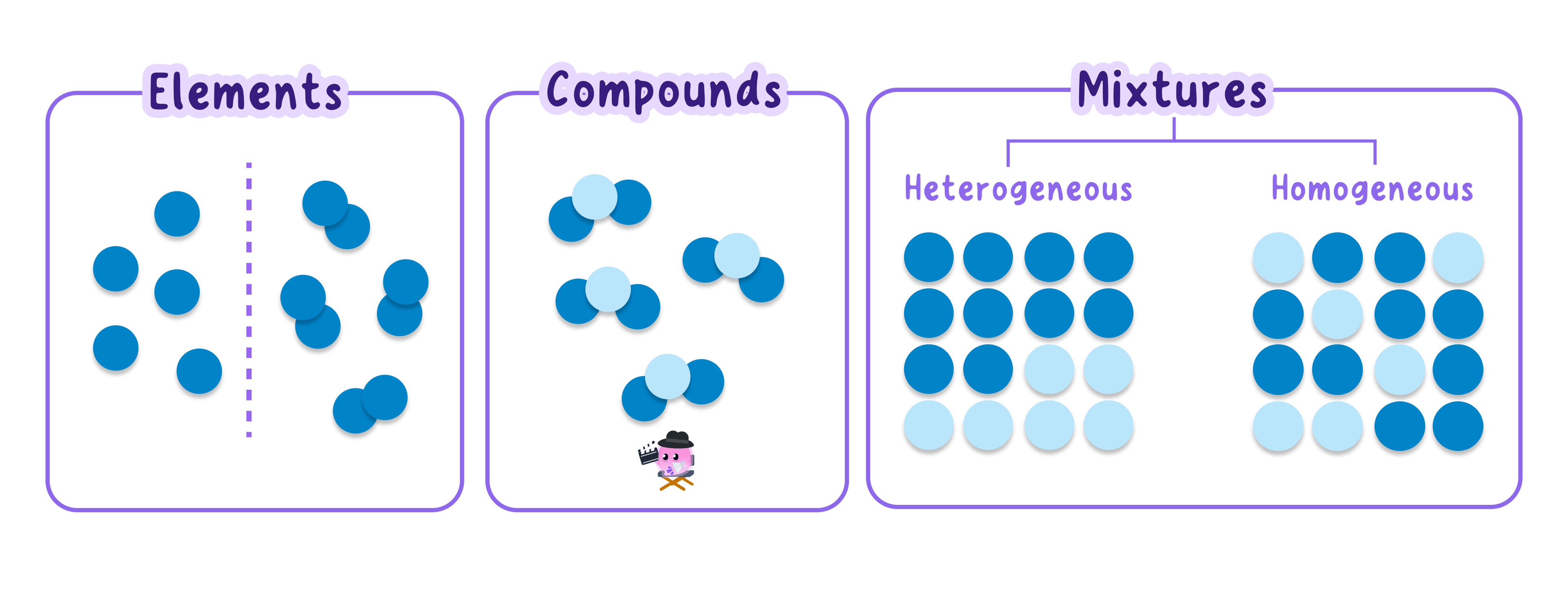
A single element or a single compound, with the same fixed composition throughout.
Definition
Mixture
Two or more substances present together but not chemically bonded to each other.
- In everyday use, pure usually means clean, natural or with nothing added.
- Pure orange juice has nothing added to it, yet it still contains water, sugars and acids.
- Chemistry uses the word far more strictly, allowing only one element or one compound.
- Every sample of a pure substance therefore has the same fixed composition.
- The substances in a mixture are not chemically bonded to each other, so each keeps its own properties.
- The proportions in a mixture can vary from one sample to the next.
- A mixture can be separated by physical methods, with no chemical reaction involved.
Common Mistake
- The everyday meaning is not the chemical one, so a natural product is very often a mixture.
- A mixture is not a compound, because nothing is chemically bonded between its substances.
A pure substance melts at one sharp temperature
Definition
Melting point
The temperature at which a substance changes from a solid into a liquid, at a stated pressure.
- A pure solid melts at a single temperature, giving the same start and finish reading.
- That single value is described as a sharp melting point.
- A mixture melts over a range, beginning at one temperature and finishing at a higher one.
- The range appears because the substances in the mixture melt at different temperatures.
- Recording both the start and the finish temperature is what makes the comparison possible.
- A measured melting point well away from the accepted value is itself evidence of impurity.
Example
- Pure: melting starts and finishes at 153 ∘C153\ ^{\circ}\text{C}153 ∘C, so the sample has a sharp melting point.
- Mixture: melting starts at 78 ∘C78\ ^{\circ}\text{C}78 ∘C and finishes at 84 ∘C84\ ^{\circ}\text{C}84 ∘C, a range of 6 ∘C6\ ^{\circ}\text{C}6 ∘C.
Boiling point data tells the same story
Definition
Boiling point
The temperature at which a liquid changes into a gas throughout the liquid, at a stated pressure.
- A pure liquid boils at a single temperature, which holds steady while it boils.
- A mixture boils over a range, and its temperature keeps climbing as boiling goes on.
- Pure water boils at 100 ∘C100\ ^{\circ}\text{C}100 ∘C at normal pressure.
- Salt water boils above 100 ∘C100\ ^{\circ}\text{C}100 ∘C, and the temperature rises further as water leaves.
- Melting and boiling data are read the same way: one fixed temperature points to a pure substance and a range points to a mixture.
Note
- A fixed temperature is evidence, not proof, because a few mixtures also melt sharply.
- Compare against the accepted value for the substance expected, since a shifted value is a clue in itself.
Reading purity from a set of data
- Read the temperature at which melting or boiling begins.
- Read the temperature at which it finishes.
- Two equal values point to a pure substance.
- A finish higher than the start points to a mixture.
- Quote both figures in the conclusion, because those numbers are the evidence.
Self review
- What does pure mean in chemistry, and how does that differ from everyday use?
- What is the difference between an element and a compound?
- What does a sharp melting point suggest about a sample?
- How would you tell a mixture from a pure substance using melting data?
- How does the temperature behave while a mixture boils?
