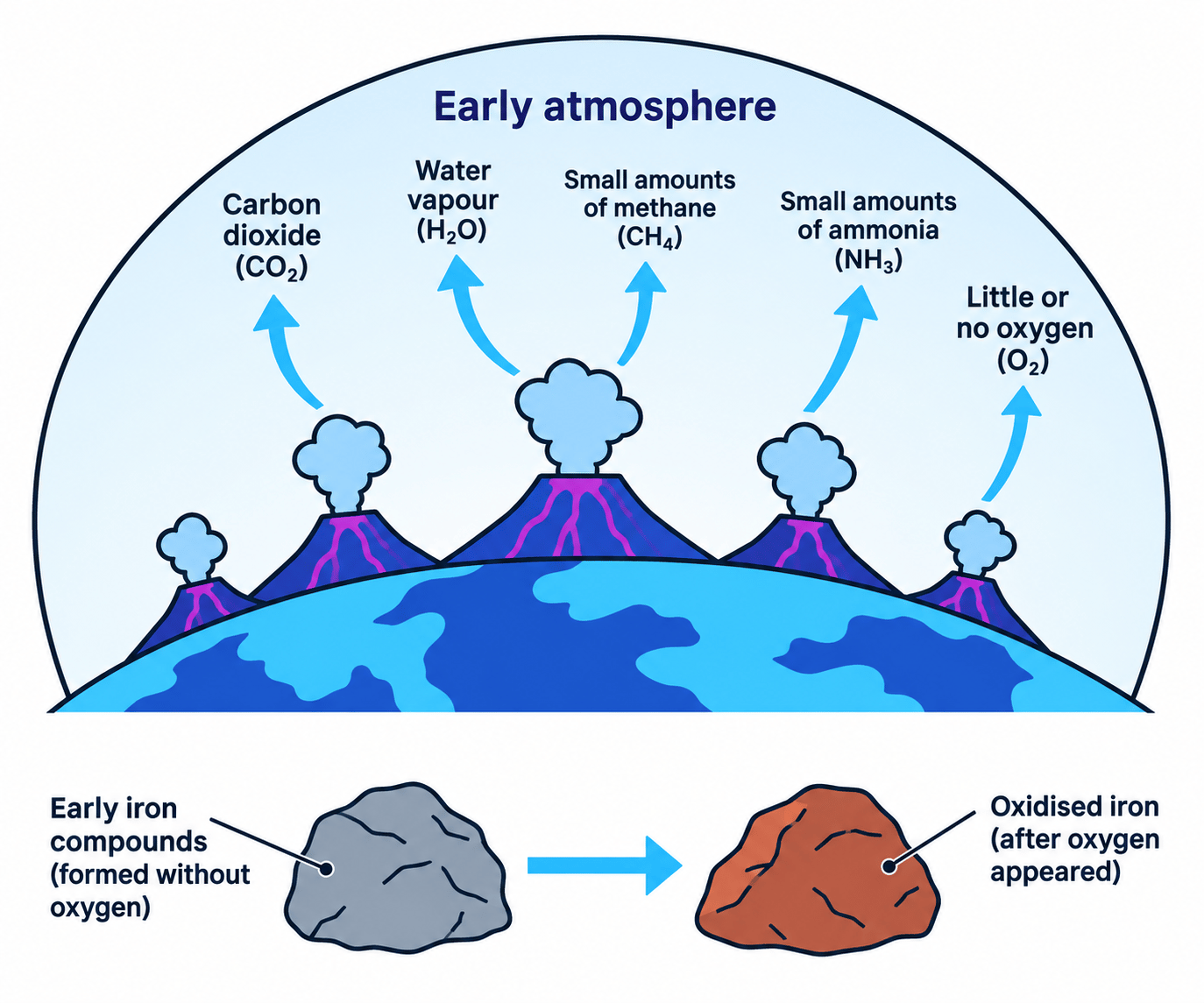
Volcanoes released the gases of the early atmosphere
- The young Earth was volcanically active on a scale unlike anything today.
- Eruptions released large volumes of gas from inside the Earth.
- Those gases collected around the planet and became its first atmosphere.
- The process lasted for hundreds of millions of years.
- Nothing was alive at this stage, so no gas came from living things.
Key Idea
The early atmosphere came from inside the Earth, not from anything living on it.
What that atmosphere is thought to have contained
- There was little or no oxygen, which is the largest difference from today.
- There was a large amount of carbon dioxide.
- There was water vapour, released as steam from the eruptions.
- Small amounts of other gases were present, including ammonia and methane.
- This composition resembles the atmospheres of Mars and Venus today.
Note
The wording thought to have contained matters, because nobody measured it at the time.
The evidence, and why it is uncertain
- Gases released by volcanoes today are used as a guide to what was released then.
- Rocks that formed in the earliest period contain iron compounds that only form without oxygen.
- Later rocks contain oxidised iron, which shows oxygen had appeared by then.
- The evidence is indirect, because no sample of the early atmosphere survives.
- Different lines of evidence can point to slightly different pictures, so theories are revised.
Example
- Volcanic gases now: mostly carbon dioxide and water vapour, with little oxygen.
- Banded iron rocks: formed when oxygen first appeared and reacted with dissolved iron.
Reading a claim about the early atmosphere
- A claim is judged on the evidence offered for it, not on how confidently it is stated.
- Evidence from today's volcanoes assumes the Earth's interior has not changed much.
- Evidence from rocks depends on dating them correctly.
- Two pieces of evidence pointing the same way make a conclusion stronger.
- An honest answer says what is known and what remains uncertain.
Self review
- Where did the gases of the Earth's early atmosphere come from?
- Name the four things the early atmosphere is thought to have contained.
- Give one piece of evidence about the early atmosphere.
- Why is that evidence described as indirect?
- Why do scientists say the atmosphere is thought to have had this composition?