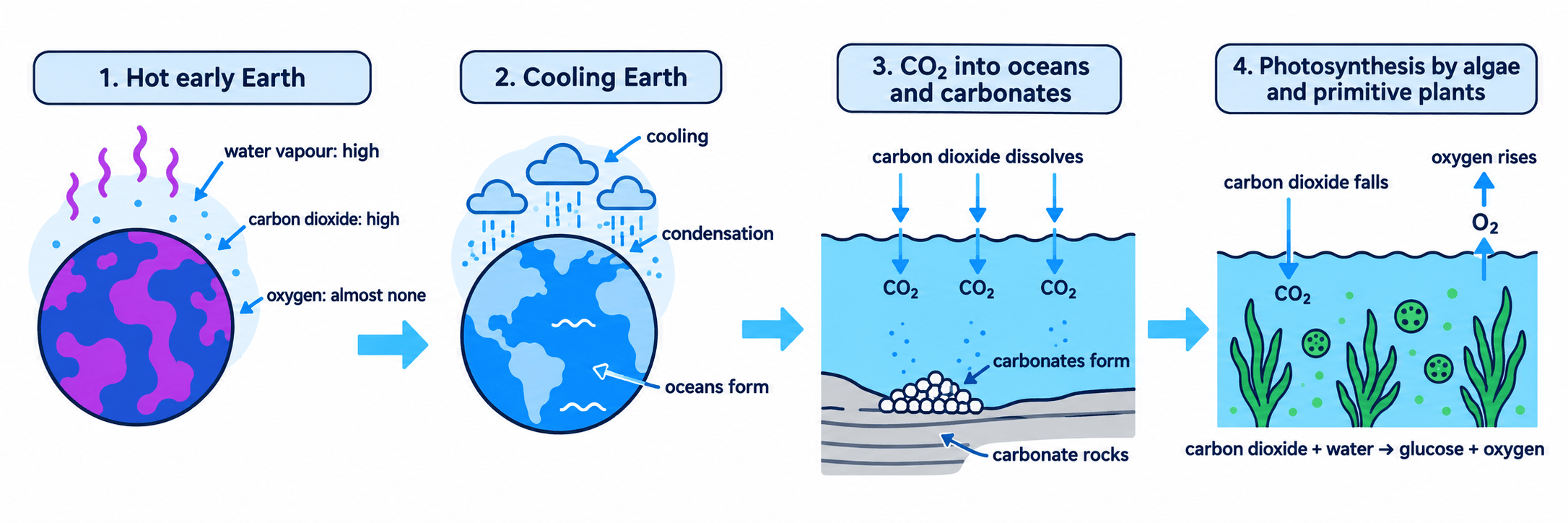
Water vapour condensed to form the oceans
- The early atmosphere held a great deal of water vapour.
- As the Earth cooled, that vapour could no longer stay as a gas.
- It condensed into liquid water, which fell as rain.
- The water collected in hollows on the surface and formed the oceans.
- Condensation removed most of the water vapour from the atmosphere itself.
Key Idea
Cooling is what drove the change: condensation happens when a vapour is cooled below its boiling point.
Carbon dioxide dissolved in the new oceans
- Carbon dioxide is soluble in water.
- As the oceans formed, large amounts of it dissolved out of the atmosphere.
- Once dissolved, it reacted to form carbonates.
- Those carbonates were deposited as sediment on the sea floor.
- The amount of carbon dioxide in the atmosphere therefore decreased.
Note
The carbon was not destroyed but locked away, first in the oceans and then in rock.
Photosynthesis added oxygen
- Primitive plants and algae appeared in the oceans.
- They carried out photosynthesis: carbon dioxide+water→glucose+oxygen\text{carbon dioxide} + \text{water} \rightarrow \text{glucose} + \text{oxygen}carbon dioxide+water→glucose+oxygen
- Photosynthesis used up carbon dioxide and released oxygen.
- As these organisms spread, the amount of oxygen gradually increased.
- The increase took a very long time, because it depended on how fast the organisms spread.
Example
- Carbon dioxide: high at the start, falling as it dissolved and as plants used it.
- Oxygen: almost none at the start, rising as photosynthesis spread.
Two processes acting on carbon dioxide at once
- Dissolving in the oceans removed carbon dioxide from the atmosphere.
- Photosynthesis removed it as well, and added oxygen in its place.
- The two together explain why carbon dioxide fell so far from its early level.
- Only photosynthesis explains the rise in oxygen, since dissolving adds none.
- An account of the change names both processes and says what each one did.
Self review
- How did the oceans form?
- What happened to the carbon dioxide as the oceans formed?
- Write the word equation for photosynthesis.
- Which process added oxygen to the atmosphere?
- Name the two processes that reduced the amount of carbon dioxide.