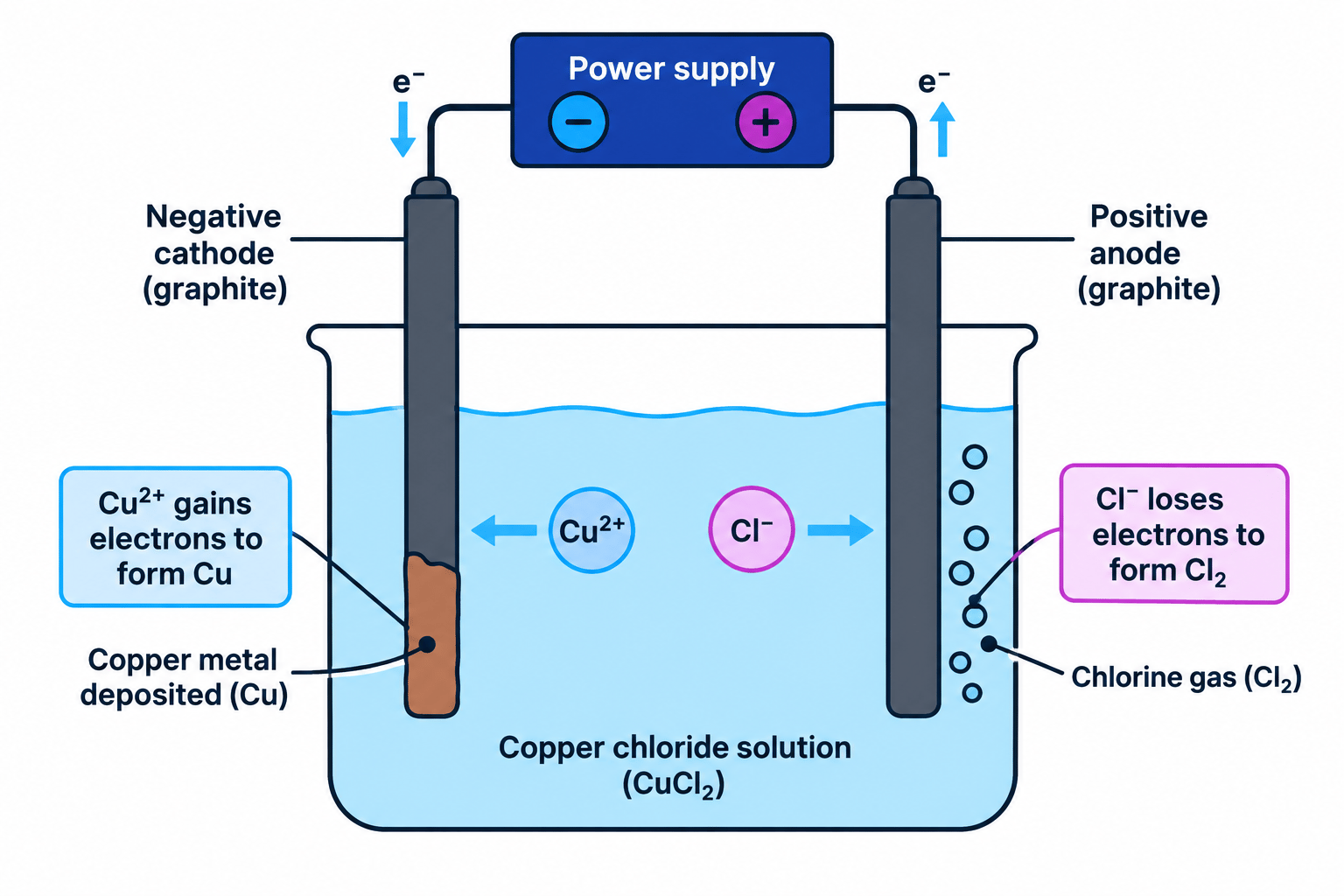
Inert electrodes take no part in the reaction
Definition
Inert electrode
An electrode that conducts but does not react with the electrolyte or with the products, such as graphite or platinum.
- An inert electrode conducts but takes no part in the reaction, either with the electrolyte or with the products.
- Graphite and platinum are the usual choices.
- Using inert electrodes means every product comes out of the electrolyte itself.
- At the negative cathode, positive ions gain electrons.
- At the positive anode, negative ions lose electrons.
- Each ion becomes a neutral atom or molecule, and that is the product collected there.
Key Idea
- Cathode products come from positive ions, which gain electrons there.
- Anode products come from negative ions, which lose electrons there.
A molten compound gives its metal and its non-metal
- A molten binary ionic compound contains only its own two ions, with no water present.
- The metal ions travel to the cathode and form the metal.
- The non-metal ions travel to the anode and form the non-metal.
- Molten lead bromide gives lead at the cathode and bromine at the anode.
- The lead appears as a silvery liquid, because the electrolyte is hot enough to keep it molten.
- The bromine appears as an orange-brown vapour above the anode.
- Molten magnesium chloride gives magnesium and chlorine by exactly the same rule.
- Chlorine, bromine and oxygen come off as diatomic molecules, Cl2\text{Cl}_2Cl2, Br2\text{Br}_2Br2 and O2\text{O}_2O2.
Example
- Molten lead bromide: lead at the cathode, bromine at the anode.
- Molten magnesium chloride: magnesium at the cathode, chlorine at the anode.
In solution, water competes with the dissolved compound
- Water itself supplies small numbers of H+\text{H}^{+}H+ and OH−\text{OH}^{-}OH− ions.
- Those ions can be discharged in place of the ions from the dissolved compound.
- At the cathode, hydrogen forms unless the metal present is less reactive than hydrogen.
- Copper and silver are less reactive than hydrogen, so those metals are deposited instead.
- Sodium, potassium and the other reactive metals stay in solution, and hydrogen forms in their place.
- At the anode, a halide ion gives its halogen, so chloride gives chlorine and bromide gives bromine.
- With no halide present, oxygen forms at the anode instead.
Common Mistake
- Sodium chloride solution gives no sodium, because sodium is more reactive than hydrogen.
- Sodium sulfate solution gives neither sodium nor sulfur, because water supplies both products.
The four standard solutions
- Copper chloride solution: copper at the cathode, because it is less reactive than hydrogen, and chlorine at the anode.
- Sodium chloride solution: hydrogen at the cathode and chlorine at the anode, leaving sodium hydroxide in the solution.
- Sodium sulfate solution: hydrogen at the cathode and oxygen at the anode, with the sodium sulfate unchanged.
- Acidified water: hydrogen at the cathode and oxygen at the anode, in a 2:12:12:1 ratio by volume.
- The acid in acidified water supplies extra ions to carry the current and is not used up.
- Settling the cathode product first, and the anode product second, keeps the two decisions apart.
Note
- Check the metal's reactivity first at the cathode, then look for a halide at the anode.
- The leftover solution counts too, so sodium chloride solution is left holding sodium hydroxide.
Self review
- What happens to positive ions when they reach the cathode?
- Why is copper rather than hydrogen deposited from copper chloride solution?
- What are the products of electrolysing sodium sulfate solution?
- What are the products of electrolysing molten lead bromide?
- How do you predict the products for a molten binary ionic compound?