An electrolyte is an ionic compound whose ions can move
Definition
Electrolyte
An ionic compound, molten or dissolved in water, whose ions are free to move and carry charge.
Definition
Ionic compound
A compound made of positive and negative ions, whose formula shows the smallest whole-number ratio of ions that gives no overall charge.
- In an ionic compound, positive and negative ions are held together by strong attractions.
- In the solid those ions sit in fixed positions in the lattice and cannot travel.
- A solid ionic compound therefore does not conduct, even though every particle in it is charged.
- Melting breaks the lattice apart, so the ions become free to move through the liquid.
- Dissolving in water separates the ions, so they become free to move through the solution.
- Either way the compound becomes an electrolyte, because its ions can now carry charge.
Common Mistake
- Not every ionic compound is an electrolyte, because the solid holds no mobile ions.
- Molten and dissolved differ: molten means melted with no water, dissolved means mixed into water.
Electrolysis uses a direct current to break the electrolyte down
Definition
Electrolysis
The use of electrical energy from a direct current supply to break down an electrolyte into simpler substances.
- A direct current supply pushes charge in one direction only.
- That supply transfers electrical energy into the electrolyte.
- The energy breaks the compound down into simpler substances, which collect at the electrodes.
- The electrolyte has to be molten or dissolved, because the ions must move for any of this to happen.
- The products are new substances, so electrolysis brings about a chemical change.
Key Idea
- Three things are needed: an electrolyte with mobile ions, two electrodes and a direct current supply.
- Direct current matters, because the ions have to travel consistently towards one electrode.
Ions travel to the electrode of opposite charge
Definition
Electrode
A conductor placed in the electrolyte and connected to the direct current supply.
Definition
Cathode
The negative electrode, which attracts positive ions.
Definition
Anode
The positive electrode, which attracts negative ions.
- The electrodes are conductors dipped into the electrolyte and connected to the supply.
- Of the two, the negative one is the cathode and the positive one is the anode.
- Positive ions are attracted to the negative cathode.
- Negative ions are attracted to the positive anode.
- Opposite charges attract, which is the whole reason the ions separate towards different electrodes.
- Positive ions are also called cations, and negative ions anions.
- Those moving ions carry charge through the electrolyte, which completes the circuit.
Example
- Molten sodium chloride: Na+\text{Na}^{+}Na+ moves to the cathode and Cl−\text{Cl}^{-}Cl− to the anode.
- Copper chloride solution: Cu2+\text{Cu}^{2+}Cu2+ moves to the cathode and Cl−\text{Cl}^{-}Cl− to the anode.
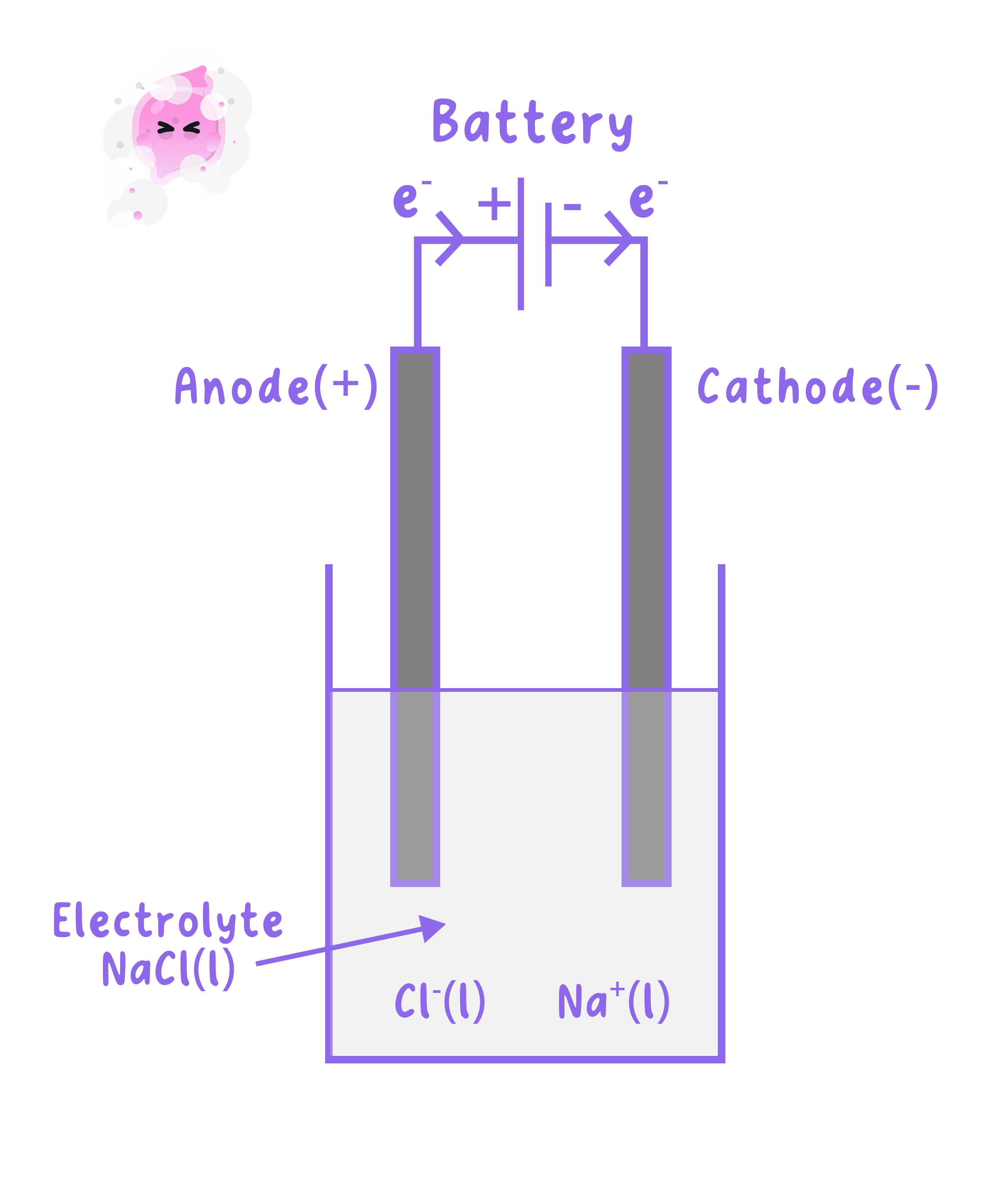
Describing an electrolysis set-up
- Name the electrolyte and say whether it is molten or in solution.
- State that its ions are free to move.
- Name the two electrodes with their charges: negative cathode, positive anode.
- Say which ions travel to which electrode, and why.
- Name the supply as a direct current supply.
Self review
- What is an electrolyte?
- Why does a solid ionic compound not conduct electricity?
- What supplies the energy that decomposes the electrolyte?
- Which electrode attracts positive ions, and what is its charge?
- Why do positive and negative ions move to different electrodes?
