Hydrogen ion concentration sets the pH
Definition
pH scale
A numerical scale that measures how acidic or alkaline a solution is, with 7 as neutral, lower values acidic and higher values alkaline.
Definition
Concentration
The mass or amount of a solute dissolved in a given volume of solution.
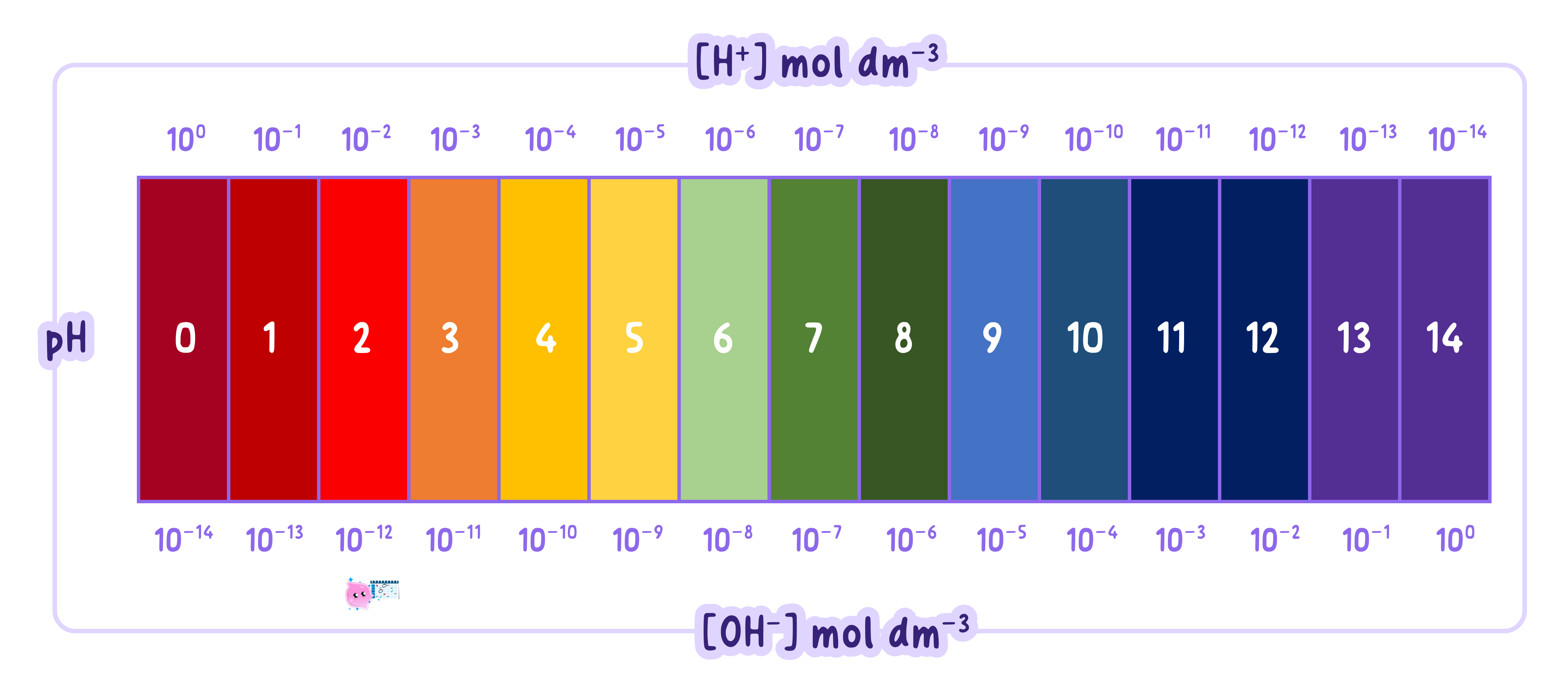
- pH measures the concentration of hydrogen ions, H+\text{H}^{+}H+, in a solution.
- The scale is not a straight one: each step of 111 in pH stands for a tenfold change in that concentration.
- A higher H+\text{H}^{+}H+ concentration gives a lower pH.
- A higher OH−\text{OH}^{-}OH− concentration gives a higher pH.
- A neutral solution at pH 777 holds the two ions in equal concentrations.
Key Idea
- More H+\text{H}^{+}H+ means a lower pH.
- More OH−\text{OH}^{-}OH− means a higher pH.
Each step of one on the scale is a factor of ten
- Multiplying the H+\text{H}^{+}H+ concentration by 101010 lowers the pH by 111.
- Dividing the H+\text{H}^{+}H+ concentration by 101010 raises the pH by 111.
- So a solution at pH 555 moves to pH 444 when its H+\text{H}^{+}H+ concentration is multiplied by 101010.
- A change from pH 444 to pH 333 therefore means the concentration rose ten times.
- A change from pH 333 to pH 111 means it rose 100100100 times, because that is two steps.
- The steps work the same way in reverse, so pH 222 to pH 555 is a thousandfold fall.
Example
- pH 666 to pH 555: the H+\text{H}^{+}H+ concentration has been multiplied by 101010.
- pH 333 to pH 444: the H+\text{H}^{+}H+ concentration has been divided by 101010.
- pH 222 to pH 555: three steps, so the concentration has fallen by a factor of 100010001000.
Hydroxide ions push the pH the other way
- Adding alkali raises the hydroxide ion concentration in the solution.
- A higher OH−\text{OH}^{-}OH− concentration gives a higher pH.
- The two concentrations move in opposite directions, because H+\text{H}^{+}H+ and OH−\text{OH}^{-}OH− react together to form water.
- Multiplying the OH−\text{OH}^{-}OH− concentration by 101010 raises the pH by 111, mirroring the acid case.
- Diluting an alkali lowers its OH−\text{OH}^{-}OH− concentration, so its pH falls back towards 777.
Common Mistake
- Higher OH−\text{OH}^{-}OH− raises the pH, so the direction is the opposite of the acid case.
- Identify which ion changed before applying any factor of ten.
Working out a pH change
- Decide which ion the question changes, H+\text{H}^{+}H+ or OH−\text{OH}^{-}OH−.
- Count how many factors of ten the concentration changes by.
- Each factor of ten is one unit of pH.
- Set the direction: more H+\text{H}^{+}H+ lowers the pH, more OH−\text{OH}^{-}OH− raises it.
- Give the new pH, or the factor, according to what the question asks for.
Exam technique
- Counting the factors of ten first, and fixing the direction afterwards, keeps the two decisions apart.
- A pH change of 222 is a hundredfold change in concentration, not a doubling.
- Saying which ion changed is what makes the direction of the answer defensible.
Self review
- What happens to the pH when the hydrogen ion concentration increases?
- By how much does the pH change when the H+\text{H}^{+}H+ concentration is multiplied by 101010?
- What happens to the pH when the hydroxide ion concentration increases?
- What does a change from pH 555 to pH 444 tell you about the H+\text{H}^{+}H+ concentration?
- By what factor has the concentration changed between pH 222 and pH 555?

