Acids supply hydrogen ions and alkalis supply hydroxide ions
Definition
Acid
A substance that is a source of hydrogen ions when it dissolves in water.
Definition
Alkali
A soluble base, which is a source of hydroxide ions when it dissolves in water.
- An acid dissolved in water is a source of hydrogen ions, H+\text{H}^{+}H+.
- An alkali dissolved in water is a source of hydroxide ions, OH−\text{OH}^{-}OH−.
- Those ions are present because the acid or alkali has dissolved and separated into ions.
- Hydrogen ions make a solution acidic, and hydroxide ions make it alkaline.
- Hydrochloric, sulfuric and nitric acid are the three acids met most often.
- Sodium hydroxide, potassium hydroxide and calcium hydroxide are common alkalis.
Key Idea
- Acids supply H+\text{H}^{+}H+, which is what makes a solution acidic.
- Alkalis supply OH−\text{OH}^{-}OH−, which is what makes a solution alkaline.
The pH scale runs from acidic through neutral to alkaline
Definition
pH scale
A numerical scale that measures how acidic or alkaline a solution is, with 7 as neutral, lower values acidic and higher values alkaline.
- The pH scale runs from 000 to 141414 and shows how acidic or alkaline a solution is.
- A neutral solution has a pH of exactly 777.
- An acidic solution has a pH below 777, and the lower the value the more acidic it is.
- An alkaline solution has a pH above 777, and the higher the value the more alkaline it is.
- So pH 222 is more acidic than pH 555, and pH 121212 is more alkaline than pH 999.
- Universal indicator gives an approximate pH from its colour, while a pH probe gives a number.
- A pH probe is the more precise of the two, because it does not depend on judging a shade by eye.
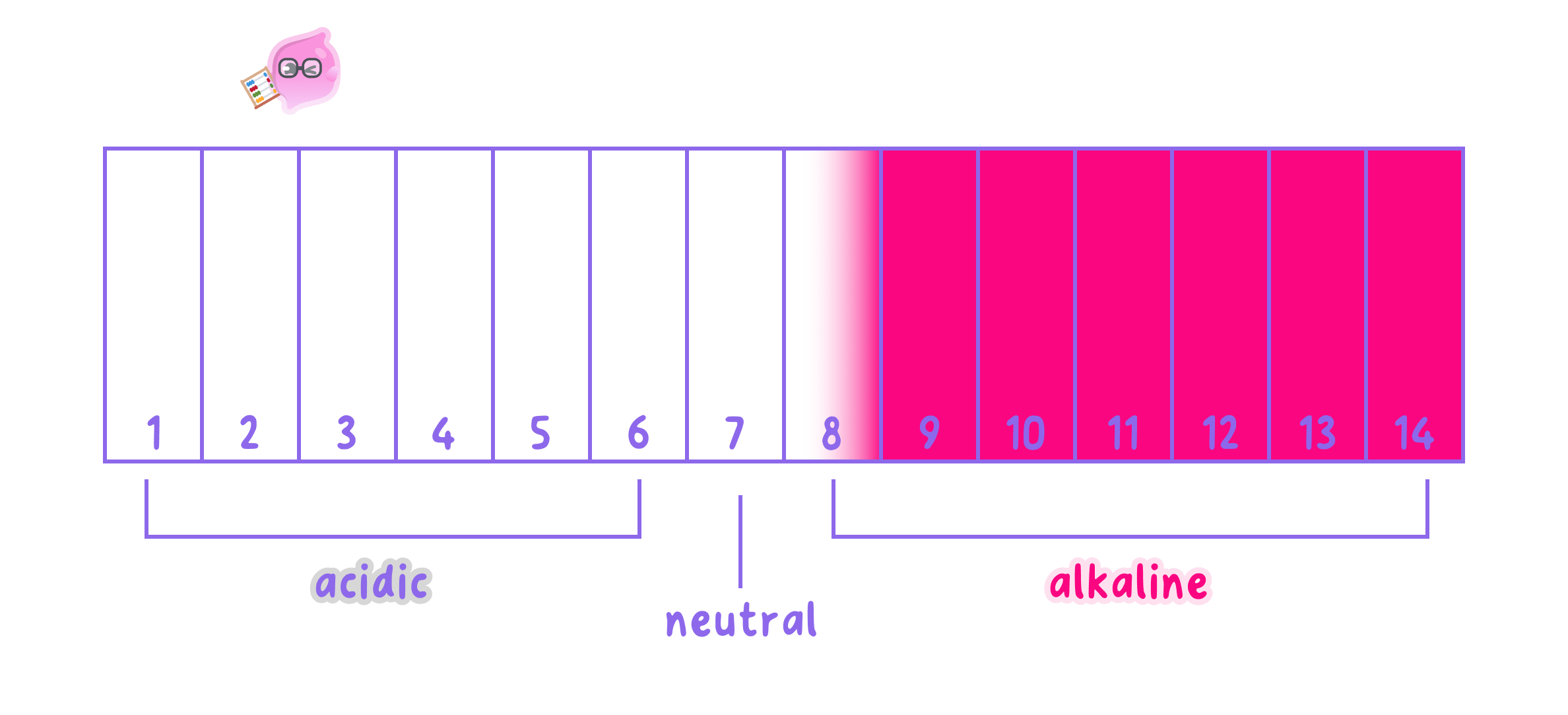
Example
- pH 444: acidic, because it lies below 777.
- pH 777: neutral.
- pH 101010: alkaline, because it lies above 777.
Each indicator has its own set of colours
Definition
Indicator
A substance that changes colour to show whether a solution is acidic, neutral or alkaline.
- An indicator changes colour according to whether a solution is acidic, neutral or alkaline.
- Litmus is red in acid, purple in neutral solution and blue in alkali.
- Methyl orange is red in acid, orange in neutral solution and yellow in alkali.
- Phenolphthalein is colourless in acid, colourless in neutral solution and pink in alkali.
- Phenolphthalein therefore cannot tell an acidic solution from a neutral one.
- A colour only means something once the indicator that produced it has been named.
Common Mistake
- Colours do not carry across indicators, so red litmus and red methyl orange agree only by coincidence.
- Colourless phenolphthalein leaves two options, acidic or neutral, and cannot separate them.
Practical
- Method: measure the pH of a fixed volume of dilute hydrochloric acid, then add powdered calcium hydroxide in small, equal portions, stirring and measuring the pH after each one.
- Result: the pH climbs as the acid is used up, quickly at first and then more slowly, and barely moves once all the acid has reacted.
- Plotting pH against the mass added shows that rise and then the levelling off.
- Stir before each reading, because an unstirred mixture gives a pH that depends on where the probe sits.
- Equal portions matter, since the shape of the graph depends on the additions being comparable.
Reading an indicator or a pH result
- Name the indicator before reading anything into its colour.
- Match that colour against the set of colours belonging to that indicator.
- With a pH value, compare it with 777: below is acidic and above is alkaline.
- A pH of exactly 777 is neutral, not almost acidic.
- Two indicators pointing the same way is a check on the result rather than a contradiction.
Exam technique
- A colour on its own is not an answer, so the indicator has to be named alongside it.
- Comparing a pH with 777 and saying which side it falls on is what turns a number into a conclusion.
- Phenolphthalein cannot separate acidic from neutral, so a second indicator is needed when that distinction matters.
Self review
- Which ions is an acid in solution a source of?
- Which ions is an alkali in solution a source of?
- What is the pH of a neutral solution?
- What colour is methyl orange in an acidic solution and in an alkaline one?
- Why can phenolphthalein not distinguish an acidic solution from a neutral one?
