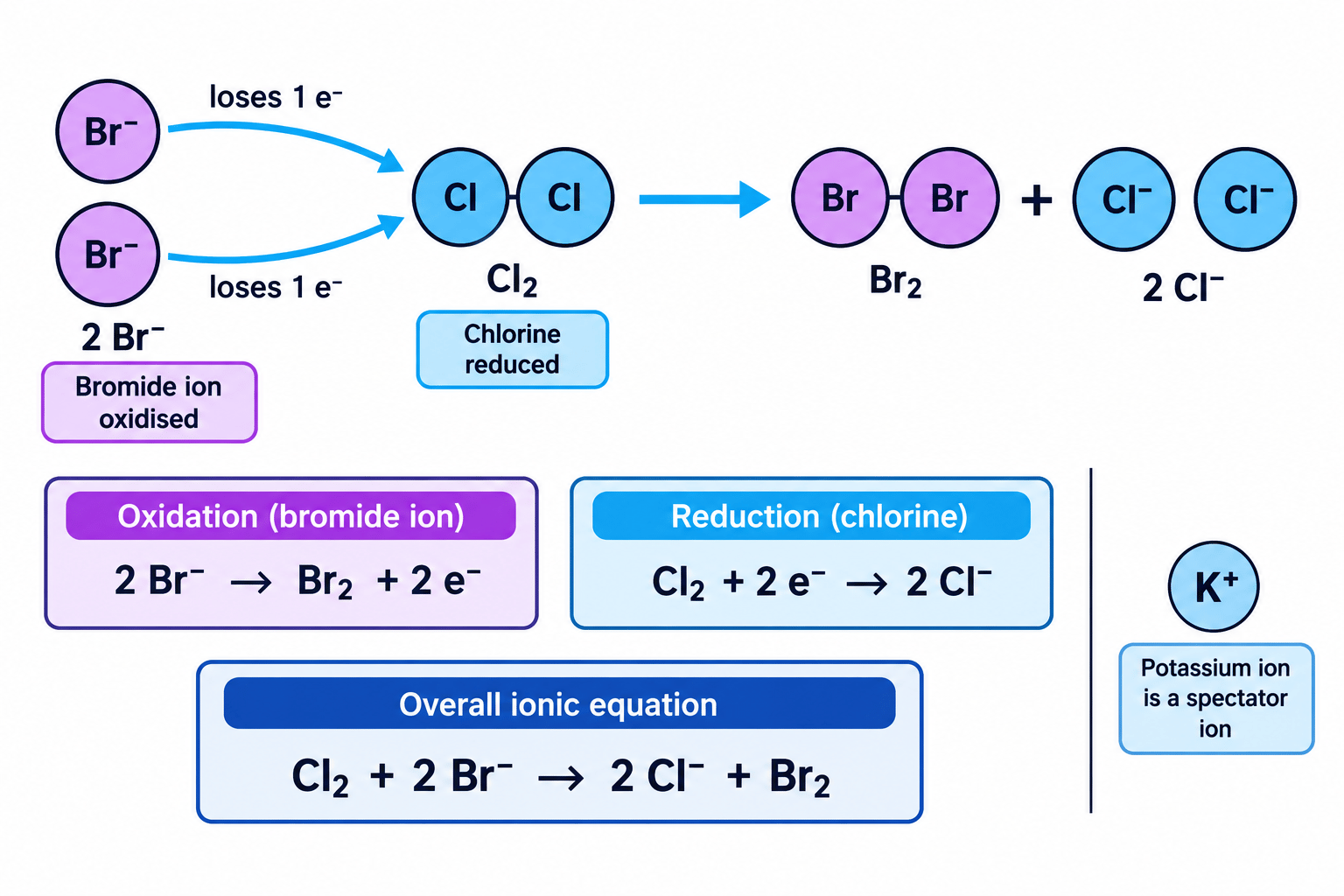
Electrons move from the halide ion to the halogen molecule
Redox reaction
A reaction in which oxidation and reduction happen at the same time.
Halide ion
The negative ion formed when a halogen atom gains one electron.
- A halide ion carries an extra electron, which is what gives it its 1−1-1− charge.
- In a displacement the more reactive halogen takes that electron.
- Loss of electrons is oxidation and gain of electrons is reduction.
- Both happen in the same reaction, which makes the displacement a redox change.
- The electrons pass directly between the two species, with no circuit involved.
The halide ion is oxidised and the free halogen molecule is reduced, in every one of these reactions.
Half equations show each change separately
Half equation
An equation showing the electrons gained or lost by the species reacting at one electrode.
- Bromide ions lose electrons, which is oxidation: 2Br−→Br2+2e−2\text{Br}^{-} \rightarrow \text{Br}_2 + 2\text{e}^{-}2Br−→Br2+2e−
- Chlorine molecules gain electrons, which is reduction: Cl2+2e−→2Cl−\text{Cl}_2 + 2\text{e}^{-} \rightarrow 2\text{Cl}^{-}Cl2+2e−→2Cl−
- Two halide ions are needed in each half equation, because a halogen molecule holds two atoms.
- The electrons lost in one half equation equal the electrons gained in the other.
- Adding the two together cancels the electrons and rebuilds the overall change.
Electrons sit on the right of an oxidation half equation and on the left of a reduction one.
Naming what is oxidised and what is reduced
- The species that loses electrons is the one oxidised, which is the halide ion.
- The species that gains electrons is the one reduced, which is the free halogen.
- Charge is the giveaway: Br−\text{Br}^{-}Br− to Br2\text{Br}_2Br2 is a loss, since the charge rises to zero.
- Cl2\text{Cl}_2Cl2 to Cl−\text{Cl}^{-}Cl− is a gain, since the charge falls from zero to 1−1-1−.
- Naming the substance rather than the element is what makes the answer unambiguous.
- Oxidised: the bromide ion, Br−\text{Br}^{-}Br−, losing an electron each.
- Reduced: chlorine, Cl2\text{Cl}_2Cl2, gaining two electrons in all.
- Spectator: the potassium ion, K+\text{K}^{+}K+, unchanged throughout.
The ionic equation leaves out the spectators
Ionic equation
An equation that shows only the ions and substances that change during a reaction, with the spectator ions left out.
Spectator ion
An ion that is unchanged by the reaction and appears on both sides of the full ionic equation, so it is cancelled out.
- Potassium bromide in solution is present as separate K+\text{K}^{+}K+ and Br−\text{Br}^{-}Br− ions.
- The potassium ions are unchanged on both sides, so they take no part.
- Leaving them out gives the ionic equation: Cl2+2Br−→2Cl−+Br2\text{Cl}_2 + 2\text{Br}^{-} \rightarrow 2\text{Cl}^{-} + \text{Br}_2Cl2+2Br−→2Cl−+Br2
- Only the species whose charge changes remain in the equation.
- The same ionic equation describes the reaction whichever soluble bromide was used.
An ionic equation balances for charge as well as for atoms, which is a quick way to check it.
A worked example: chlorine and potassium iodide
- Chlorine is above iodine, so the iodide ions are the species that lose electrons.
- The oxidation half equation is: 2I−→I2+2e−2\text{I}^{-} \rightarrow \text{I}_2 + 2\text{e}^{-}2I−→I2+2e−
- The reduction half equation is: Cl2+2e−→2Cl−\text{Cl}_2 + 2\text{e}^{-} \rightarrow 2\text{Cl}^{-}Cl2+2e−→2Cl−
- Adding them and cancelling the electrons gives: Cl2+2I−→2Cl−+I2\text{Cl}_2 + 2\text{I}^{-} \rightarrow 2\text{Cl}^{-} + \text{I}_2Cl2+2I−→2Cl−+I2
- The solution turns brown as iodine is released, which is the visible evidence.
- An answer names the substance oxidised and the substance reduced, then says which electrons moved.
- Colour change is evidence of a reaction, not an explanation of the electron transfer.
- Two half equations are added only once the electrons on each side are equal.
- In a halogen displacement, which species is oxidised?
- Write the half equation for iodide ions forming iodine.
- Why do two halide ions appear in each half equation?
- Write the ionic equation for chlorine reacting with bromide ions.
- Why is the potassium ion described as a spectator?