4.2.1 Electrolytes and the process of electrolysis
An electrolyte is an ionic compound whose ions can move
Electrolyte
An ionic compound, molten or dissolved in water, whose ions are free to move and carry charge.
Ionic compound
A compound made of positive and negative ions, whose formula shows the smallest whole-number ratio of ions that gives no overall charge.
- In an ionic compound, positive and negative ions are held together by strong attractions.
- In the solid those ions sit in fixed positions in the lattice and cannot travel.
- A solid ionic compound therefore does not conduct, even though every particle in it is charged.
- Melting breaks the lattice apart, so the ions become free to move through the liquid.
- Dissolving in water separates the ions, so they become free to move through the solution.
- Either way the compound becomes an electrolyte, because its ions can now carry charge.
- Not every ionic compound is an electrolyte, because the solid holds no mobile ions.
- Molten and dissolved differ: molten means melted with no water, dissolved means mixed into water.
Electrolysis uses a direct current to break the electrolyte down
Electrolysis
The use of electrical energy from a direct current supply to break down an electrolyte into simpler substances.
- A direct current supply pushes charge in one direction only.
- That supply transfers electrical energy into the electrolyte.
- The energy breaks the compound down into simpler substances, which collect at the electrodes.
- The electrolyte has to be molten or dissolved, because the ions must move for any of this to happen.
- The products are new substances, so electrolysis brings about a chemical change.
- Three things are needed: an electrolyte with mobile ions, two electrodes and a direct current supply.
- Direct current matters, because the ions have to travel consistently towards one electrode.
Ions travel to the electrode of opposite charge
Electrode
A conductor placed in the electrolyte and connected to the direct current supply.
Cathode
The negative electrode, which attracts positive ions.
Anode
The positive electrode, which attracts negative ions.
- The electrodes are conductors dipped into the electrolyte and connected to the supply.
- Of the two, the negative one is the cathode and the positive one is the anode.
- Positive ions are attracted to the negative cathode.
- Negative ions are attracted to the positive anode.
- Opposite charges attract, which is the whole reason the ions separate towards different electrodes.
- Positive ions are also called cations, and negative ions anions.
- Those moving ions carry charge through the electrolyte, which completes the circuit.
- Molten sodium chloride: Na+\text{Na}^{+}Na+ moves to the cathode and Cl−\text{Cl}^{-}Cl− to the anode.
- Copper chloride solution: Cu2+\text{Cu}^{2+}Cu2+ moves to the cathode and Cl−\text{Cl}^{-}Cl− to the anode.
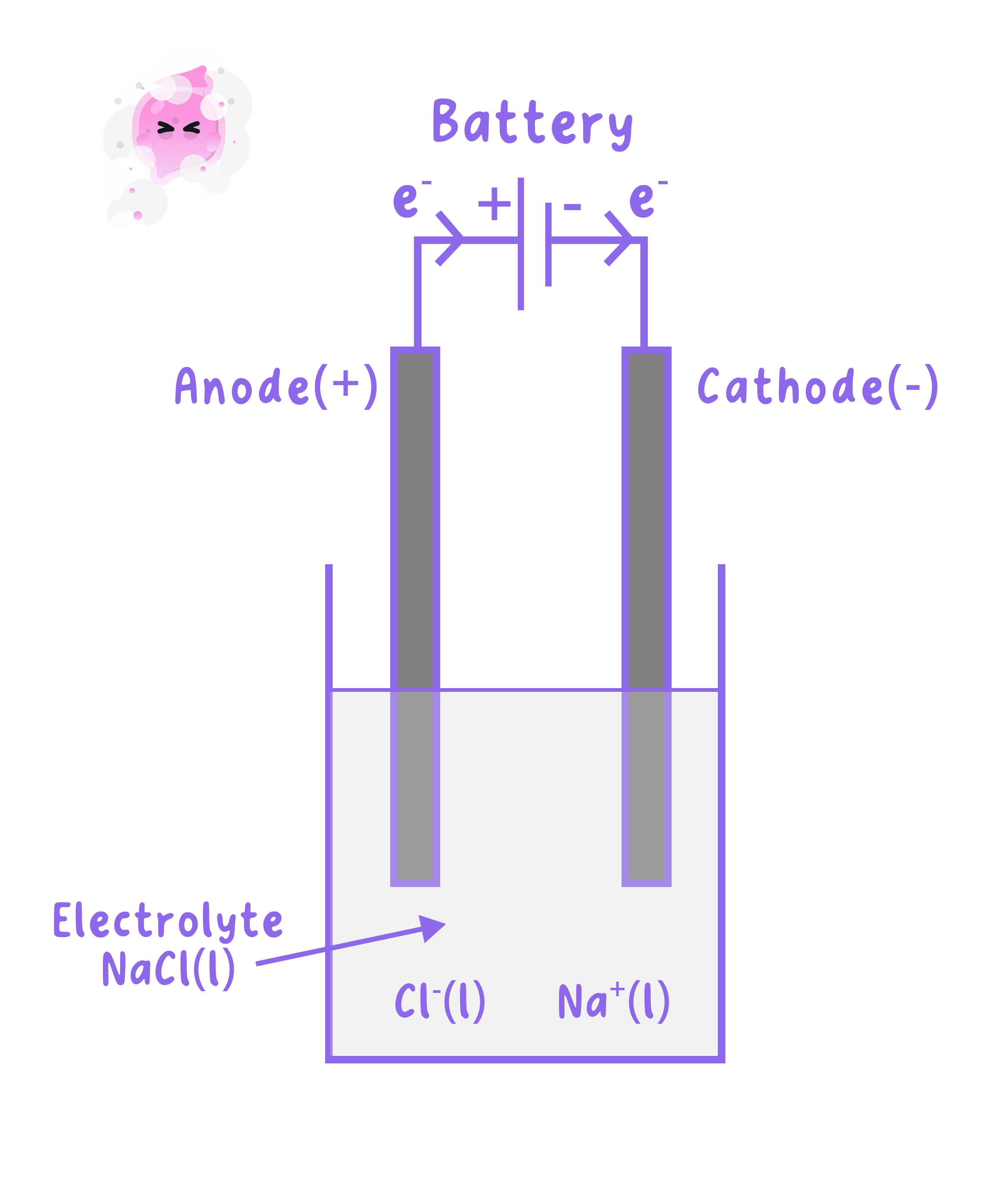
Describing an electrolysis set-up
- Name the electrolyte and say whether it is molten or in solution.
- State that its ions are free to move.
- Name the two electrodes with their charges: negative cathode, positive anode.
- Say which ions travel to which electrode, and why.
- Name the supply as a direct current supply.
- What is an electrolyte?
- Why does a solid ionic compound not conduct electricity?
- What supplies the energy that decomposes the electrolyte?
- Which electrode attracts positive ions, and what is its charge?
- Why do positive and negative ions move to different electrodes?
4.2.2 Products of electrolysis using inert electrodes
Inert electrodes take no part in the reaction
Inert electrode
An electrode that conducts but does not react with the electrolyte or with the products, such as graphite or platinum.
- An inert electrode conducts but takes no part in the reaction, either with the electrolyte or with the products.
- Graphite and platinum are the usual choices.
- Using inert electrodes means every product comes out of the electrolyte itself.
- At the negative cathode, positive ions gain electrons.
- At the positive anode, negative ions lose electrons.
- Each ion becomes a neutral atom or molecule, and that is the product collected there.
- Cathode products come from positive ions, which gain electrons there.
- Anode products come from negative ions, which lose electrons there.
A molten compound gives its metal and its non-metal
- A molten binary ionic compound contains only its own two ions, with no water present.
- The metal ions travel to the cathode and form the metal.
- The non-metal ions travel to the anode and form the non-metal.
- Molten lead bromide gives lead at the cathode and bromine at the anode.
- The lead appears as a silvery liquid, because the electrolyte is hot enough to keep it molten.
- The bromine appears as an orange-brown vapour above the anode.
- Molten magnesium chloride gives magnesium and chlorine by exactly the same rule.
- Chlorine, bromine and oxygen come off as diatomic molecules, Cl2\text{Cl}_2Cl2, Br2\text{Br}_2Br2 and O2\text{O}_2O2.
- Molten lead bromide: lead at the cathode, bromine at the anode.
- Molten magnesium chloride: magnesium at the cathode, chlorine at the anode.
In solution, water competes with the dissolved compound
- Water itself supplies small numbers of H+\text{H}^{+}H+ and OH−\text{OH}^{-}OH− ions.
- Those ions can be discharged in place of the ions from the dissolved compound.
- At the cathode, hydrogen forms unless the metal present is less reactive than hydrogen.
- Copper and silver are less reactive than hydrogen, so those metals are deposited instead.
- Sodium, potassium and the other reactive metals stay in solution, and hydrogen forms in their place.
- At the anode, a halide ion gives its halogen, so chloride gives chlorine and bromide gives bromine.
- With no halide present, oxygen forms at the anode instead.
- Sodium chloride solution gives no sodium, because sodium is more reactive than hydrogen.
- Sodium sulfate solution gives neither sodium nor sulfur, because water supplies both products.
The four standard solutions
- Copper chloride solution: copper at the cathode, because it is less reactive than hydrogen, and chlorine at the anode.
- Sodium chloride solution: hydrogen at the cathode and chlorine at the anode, leaving sodium hydroxide in the solution.
- Sodium sulfate solution: hydrogen at the cathode and oxygen at the anode, with the sodium sulfate unchanged.
- Acidified water: hydrogen at the cathode and oxygen at the anode, in a 2:12:12:1 ratio by volume.
- The acid in acidified water supplies extra ions to carry the current and is not used up.
- Settling the cathode product first, and the anode product second, keeps the two decisions apart.
- Check the metal's reactivity first at the cathode, then look for a halide at the anode.
- The leftover solution counts too, so sodium chloride solution is left holding sodium hydroxide.
- What happens to positive ions when they reach the cathode?
- Why is copper rather than hydrogen deposited from copper chloride solution?
- What are the products of electrolysing sodium sulfate solution?
- What are the products of electrolysing molten lead bromide?
- How do you predict the products for a molten binary ionic compound?
4.2.3 Half equations, oxidation and reduction in electrolysis
A half equation describes what happens at one electrode
Half equation
An equation showing the electrons gained or lost by the species reacting at one electrode.
- Electrolysis runs two different reactions at once, one at each electrode.
- A half equation separates them, describing one electrode on its own.
- The reacting ion goes on one side and the product on the other.
- Electrons are then added to whichever side makes the total charge balance.
- They sit on the left when the ion gains them and on the right when it loses them.
- One equation per electrode, because the two reactions are different.
- Electrons are the currency, gained at one electrode and lost at the other.
Writing and balancing a half equation
- Identify the ion that reacts at that electrode and the product it forms.
- Balance the atoms first, using whole numbers.
- Count the total charge on each side.
- Add electrons until those two totals are equal.
- In Pb2++2e−→Pb\text{Pb}^{2+} + 2\text{e}^{-} \rightarrow \text{Pb}Pb2++2e−→Pb the left side is 2+2+2+ and 2−2-2− together, and the right side is zero.
- In 2Br−→Br2+2e−2\text{Br}^{-} \rightarrow \text{Br}_2 + 2\text{e}^{-}2Br−→Br2+2e− the left side is 2−2-2− and so is the right.
- Check the atoms and the charge before accepting any half equation.
- Cathode: Cu2++2e−→Cu\text{Cu}^{2+} + 2\text{e}^{-} \rightarrow \text{Cu}Cu2++2e−→Cu, atoms balanced and charge zero on both sides.
- Anode: 2Cl−→Cl2+2e−2\text{Cl}^{-} \rightarrow \text{Cl}_2 + 2\text{e}^{-}2Cl−→Cl2+2e−, atoms balanced and charge 2−2-2− on both sides.
Oxidation is loss of electrons and reduction is gain
Oxidation
The loss of electrons by a substance.
Reduction
The gain of electrons by a substance.
- A substance that loses electrons has been oxidised.
- A substance that gains electrons has been reduced.
- OIL RIG is the usual reminder: oxidation is loss, reduction is gain.
- In a reduction half equation the electrons appear among the reactants, on the left.
- In an oxidation half equation the electrons appear among the products, on the right.
- In electrolysis these definitions are about electrons rather than about oxygen.
- Oxidation here is loss of electrons, not gain of oxygen.
- Reduction here is gain of electrons, not loss of oxygen.
Reduction at the cathode, oxidation at the anode
Cathode
The negative electrode, which attracts positive ions.
Anode
The positive electrode, which attracts negative ions.
- Positive ions travel to the cathode and gain electrons there.
- Gaining electrons is reduction, so reduction happens at the cathode.
- Negative ions travel to the anode and lose electrons there.
- Losing electrons is oxidation, so oxidation happens at the anode.
- That pairing holds even though the cathode is the negative electrode and the anode the positive one.
- Molten lead bromide shows both at once: Pb2++2e−→Pb\text{Pb}^{2+} + 2\text{e}^{-} \rightarrow \text{Pb}Pb2++2e−→Pb at the cathode and 2Br−→Br2+2e−2\text{Br}^{-} \rightarrow \text{Br}_2 + 2\text{e}^{-}2Br−→Br2+2e− at the anode.
- Labelling each half equation cathode or anode is what makes the oxidation and reduction clear.
- The electrode charge says where an ion goes; the electron transfer says whether it was oxidised or reduced.
- An unbalanced charge means the wrong number of electrons, so that check comes before anything else.
- What does a half equation show?
- At which electrode does reduction happen?
- What does oxidation mean in terms of electrons?
- Write the cathode half equation for Pb2+\text{Pb}^{2+}Pb2+.
- Write the anode half equation for Br−\text{Br}^{-}Br−.
4.2.4 Electrolysis of copper sulfate and purifying copper
Copper electrodes change what happens at each electrode
Inert electrode
An electrode that conducts but does not react with the electrolyte or with the products, such as graphite or platinum.
- Here both electrodes are made of copper rather than graphite.
- Copper atoms at the anode lose electrons and enter the solution as Cu2+\text{Cu}^{2+}Cu2+.
- Copper ions at the cathode gain electrons and are deposited as solid copper.
- The anode therefore loses mass while the cathode gains very nearly the same amount.
- The blue colour barely changes, because copper ions removed at the cathode are replaced by those dissolving from the anode.
- No oxygen is produced, because the copper anode reacts in place of the sulfate or hydroxide ions.
- At the anode: copper atoms lose electrons and dissolve, so the anode gets thinner.
- At the cathode: copper ions gain electrons and are deposited, so the cathode gets thicker.
- Method: electrolyse copper sulfate solution first with inert graphite electrodes, then with copper electrodes, and compare what happens.
- With inert electrodes copper is deposited on the cathode as a pink-brown layer, and oxygen bubbles off at the anode because sulfate ions are not discharged.
- The blue fades in that run, as copper ions leave the solution and are not replaced.
- With copper electrodes the anode loses mass as copper atoms dissolve, and the cathode gains very nearly the same mass as copper is deposited on it.
- Weighing: clean both electrodes with emery paper, dry and weigh them before and after, then compare the anode's loss with the cathode's gain.
- The blue stays in that run, because the copper ions removed at the cathode are replaced by those dissolving from the anode.
Purifying copper uses an impure anode and a pure cathode
- The anode is a block of impure copper and the cathode a thin sheet of pure copper.
- The electrolyte is copper sulfate solution.
- Copper atoms leave the impure anode as ions and travel through the solution.
- Those ions are deposited as pure copper on the cathode.
- The mass lost by the anode is close to the mass gained by the cathode, with the impurities accounting for the difference.
- Impurities less reactive than copper, such as silver and gold, do not dissolve and collect below the anode as anode sludge.
- Impurities more reactive than copper, such as iron and zinc, do dissolve but stay in solution rather than being deposited.
- The copper on the cathode is therefore far purer than the anode it came from.
- Charge travels the external circuit as electrons, while the copper itself crosses the cell as ions.
- Sulfate ions form nothing here, because the copper anode is easier to oxidise than they are.
Half equations and the electron bookkeeping
Oxidation
The loss of electrons by a substance.
Reduction
The gain of electrons by a substance.
- Anode with copper electrodes: Cu(s)→Cu2+(aq)+2e−\text{Cu}(s) \rightarrow \text{Cu}^{2+}(aq) + 2\text{e}^{-}Cu(s)→Cu2+(aq)+2e−, an oxidation.
- Cathode: Cu2+(aq)+2e−→Cu(s)\text{Cu}^{2+}(aq) + 2\text{e}^{-} \rightarrow \text{Cu}(s)Cu2+(aq)+2e−→Cu(s), a reduction.
- Anode with inert electrodes: 4OH−→O2+2H2O+4e−4\text{OH}^{-} \rightarrow \text{O}_2 + 2\text{H}_2\text{O} + 4\text{e}^{-}4OH−→O2+2H2O+4e−.
- Two electrons leave each copper atom at the anode, and two arrive at each copper ion at the cathode.
- The electrons released at the anode are precisely the ones supplied at the cathode.
- That balance is why the concentration of the solution stays almost constant in the copper-electrode cell.
- Naming the electrode alongside each half equation is what shows which is oxidation and which is reduction.
- The copper-electrode cell transfers copper rather than decomposing the electrolyte, so the solution ends up unchanged.
- Inert and copper electrodes give different anode products, so the electrode material is worth reading carefully.
- Which ion forms the copper deposited at the cathode?
- What happens to the copper atoms at a copper anode?
- Why does the solution's concentration stay nearly constant with copper electrodes?
- Where do the less reactive impurities collect?
- What forms at the anode when inert electrodes are used instead?
