A covalent bond is a shared pair of electrons
Definition
Covalent bond
A shared pair of electrons between two atoms, attracted to the nucleus of each.
Definition
Molecule
A particle made of two or more atoms joined together by covalent bonds.
- Two non-metal atoms can each contribute one electron to a pair that sits between them.
- Both nuclei attract that shared pair, and that shared attraction is what holds the atoms together.
- Neither atom loses an electron outright, so no ions are formed.
- Each atom counts the whole shared pair towards its own outer shell.
- One shared pair makes one covalent bond, and two shared pairs between the same atoms make a double bond.
- Atoms joined this way form particles with a fixed number of atoms, unlike the open-ended ionic lattice.
Key Idea
- One shared pair makes one covalent bond.
- Sharing completes both outer shells at once, which is why the atoms stay joined.
Atoms and small molecules are about 10−10 m10^{-10}\ \text{m}10−10 m across
- A typical atom measures roughly 10−10 m10^{-10}\ \text{m}10−10 m across.
- A small molecule such as H2O\text{H}_2\text{O}H2O is only a few times wider, so it shares the same order of magnitude.
- An order of magnitude is the nearest power of ten, which is all the precision these sizes are quoted to.
- The unit is the metre, so 10−10 cm10^{-10}\ \text{cm}10−10 cm is a hundred times too small.
- That scale is why single molecules cannot be seen through a light microscope.
Note
- 10−10 m10^{-10}\ \text{m}10−10 m is the same as 0.10.10.1 nanometres, which is a useful cross-check on a converted answer.
- A giant covalent structure has no such size, because it is not built from separate molecules.
Dot-and-cross diagrams show shared pairs and lone pairs
Definition
Lone pair
A pair of outer-shell electrons that is not shared between two atoms and so forms no covalent bond.
- A dot-and-cross diagram draws only the outer-shell electrons of each atom.
- Dots mark the electrons of one atom and crosses those of the other, so each shared pair shows one of each.
- A shared pair is drawn in the overlap between the two atoms.
- Outer electrons that are not shared stay on their own atom, drawn as pairs.
- Those unshared pairs form no bond, so they are not counted when the bonds are counted.
- Two shared pairs drawn between the same two atoms represent a double covalent bond.
Common Mistake
- A lone pair is not a bond, so it never counts towards the number of covalent bonds in a molecule.
- Both electrons of a shared pair go in the overlap, one dot and one cross, never both on one side.
Single bonds: H2\text{H}_2H2, HCl\text{HCl}HCl, H2O\text{H}_2\text{O}H2O and CH4\text{CH}_4CH4
- H2\text{H}_2H2: each hydrogen contributes its one electron to a single shared pair, leaving both atoms with two electrons and no lone pairs.
- HCl\text{HCl}HCl: hydrogen and chlorine share one pair, and chlorine's six remaining outer electrons stay as three lone pairs.
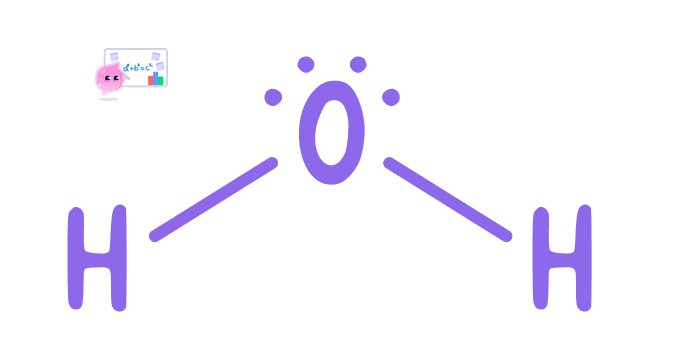
- H2O\text{H}_2\text{O}H2O: oxygen forms a shared pair with each of two hydrogen atoms and keeps four electrons as two lone pairs.
- CH4\text{CH}_4CH4: carbon forms a shared pair with each of four hydrogen atoms and keeps no lone pairs.
- Hydrogen is full at two electrons, while chlorine, oxygen and carbon are full at eight.
- Counting the shared pairs against the formula is the quickest check that a diagram is complete.
Example
- Water: two shared pairs plus two lone pairs give oxygen eight outer electrons, and each hydrogen has two.
- Methane: four shared pairs give carbon eight outer electrons, and each hydrogen has two.
Double bonds: O2\text{O}_2O2 and CO2\text{CO}_2CO2
- O2\text{O}_2O2: the two oxygen atoms share two pairs with each other, which makes one double bond.
- Each oxygen atom in O2\text{O}_2O2 keeps two lone pairs, so each reaches eight outer electrons.
- CO2\text{CO}_2CO2: carbon shares two pairs with each oxygen atom, making two double bonds.
- Carbon dioxide therefore holds four shared pairs altogether, and carbon keeps no lone pairs.
- Each oxygen atom in CO2\text{CO}_2CO2 keeps two lone pairs.
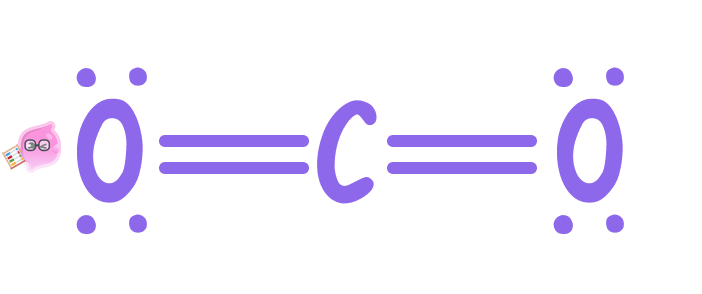
- A double bond is drawn as two separate shared pairs in the overlap, not as one crowded group.
Note
- Counting outer-shell electrons first settles how many pairs each atom has to share.
- Brackets and charges belong to ionic diagrams, so they have no place on a covalent one.
Checking a covalent diagram
- Start from the outer-shell electron counts: hydrogen 111, carbon 444, oxygen 666 and chlorine 777.
- Work out how many electrons each atom has to share to fill its outer shell.
- Draw the shared pairs first, then place the leftover electrons as lone pairs.
- Check the totals: two electrons around each hydrogen and eight around each of the others.
- Check that the number of atom symbols matches the molecular formula.
Self review
- What is formed when two atoms share a pair of electrons?
- What is the typical order of magnitude of the size of an atom or a small molecule?
- How many lone pairs are drawn on the oxygen atom in H2O\text{H}_2\text{O}H2O?
- How many shared pairs lie between carbon and each oxygen atom in CO2\text{CO}_2CO2?
- Why does a lone pair not count as a covalent bond?
