Structure and bonding decide every physical property
- Structure describes how the particles are arranged, and bonding describes what holds them together.
- Four classes cover the substances in this topic: ionic, simple molecular, giant covalent and metallic.
- Each class has its own pattern of melting point, solubility and electrical conductivity.
- Those patterns come from two questions: how strong are the attractions, and can a charged particle move?
- Classifying an unfamiliar substance therefore starts with its particles, then the attraction between them.
- The noble gases sit outside the four classes, because they exist as single unbonded atoms.
Key Idea
- Strength of attraction sets the melting and boiling points.
- Mobility of charge sets the electrical conductivity.
Ionic and metallic: charged particles in a giant structure
Definition
Metallic bond
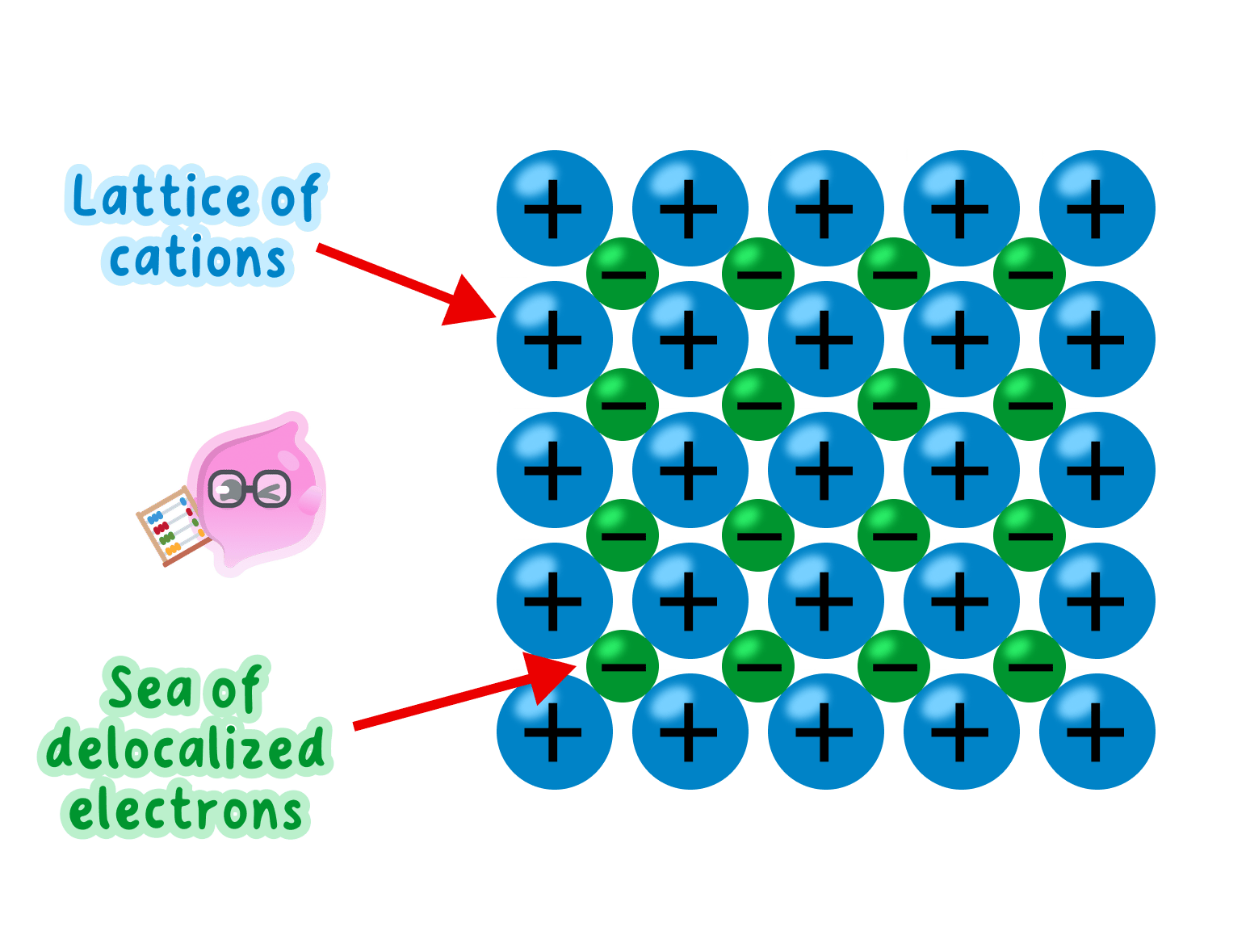
The strong electrostatic attraction between positive metal ions and the delocalised electrons that surround them.
Definition
Delocalised electron
An electron that is free to move through a structure instead of being held between two particular atoms.
- An ionic substance is a giant lattice of positive and negative ions held by strong electrostatic attraction.
- Melting one means overcoming very many of those attractions, so ionic melting and boiling points are high.
- A solid ionic substance does not conduct, because its ions are locked in position.
- Melting it or dissolving it frees the ions, so the liquid and the solution both conduct.
- A metal is a giant lattice of positive metal ions surrounded by a sea of delocalised electrons.
- Metallic melting points are high as well, because the ions and the electrons attract strongly throughout the lattice.
- A metal conducts as a solid and as a liquid, because those electrons move while the ions stay in place.
- Metals do not dissolve in water, although some of them react with it.
Example
- Sodium chloride: a giant ionic lattice that conducts when molten or dissolved, but not as a solid.
- Copper: a giant metallic lattice that conducts as a solid and does not dissolve.
Simple molecular and giant covalent: same bond, opposite behaviour
Definition
Simple molecular substance
A substance made of small separate molecules, with strong covalent bonds inside each molecule and weak intermolecular forces between them.
Definition
Giant covalent structure
A structure in which a very large number of atoms are joined to their neighbours by strong covalent bonds in a continuous network.
Definition
Intermolecular force
A force of attraction between neighbouring molecules, much weaker than the covalent bonds inside a molecule.
- Both classes are built from atoms joined by strong covalent bonds, so the bond is not what separates them.
- A simple molecular substance melts and boils when the weak forces between its molecules give way.
- The covalent bonds inside those molecules survive melting and boiling untouched.
- Simple molecular substances therefore have low melting and boiling points.
- A giant covalent structure contains no separate molecules, so melting it means breaking covalent bonds throughout.
- Giant covalent substances therefore have very high melting and boiling points.
- Neither class normally conducts, because neither has mobile ions and the electrons are held inside bonds.
- Graphite and graphene are the exceptions, because each carbon atom there leaves one electron delocalised.
Common Mistake
- Melting a simple molecular substance overcomes intermolecular forces, and saying that covalent bonds break is the commonest error here.
- Not every form of carbon conducts, because diamond uses all four outer electrons in bonds.
Solubility in water follows the particles too
- Water molecules carry slightly charged regions, which let them pull ions away from a lattice.
- Many ionic compounds dissolve for that reason, although plenty of others do not.
- A simple molecular substance dissolves if its molecules attract water molecules well enough.
- Sugar dissolves but stays as neutral molecules, so the solution does not conduct.
- Hydrogen chloride dissolves and forms ions, so that solution does conduct.
- Giant covalent structures do not dissolve, because water cannot pull atoms out of a covalent network.
- Dissolving and conducting are separate questions, and a substance can do one without the other.
Common Mistake
- Dissolving does not imply conducting, because a sugar solution carries no charge.
- The state changes the answer, since one ionic compound behaves differently as a solid, a liquid and a solution.
Working from an unfamiliar substance to its properties
- Decide first which particles the substance contains: ions, small molecules, a covalent network, or metal ions with delocalised electrons.
- Name the attraction that holds those particles together.
- Predict the melting and boiling points from how strong and how numerous those attractions are.
- Predict the conductivity by asking whether a charged particle can move, and in which state.
- Predict the solubility by asking whether water can separate the particles from the structure.
- State the structure and the bonding in the answer, because the property on its own is only half an explanation.
Exam technique
- A property answer names the structure and the bonding, because the property on its own is only half of it.
- A conductivity answer names the particle that moves: ions in a molten or dissolved ionic compound, delocalised electrons in a metal.
- A melting point answer names what is overcome: intermolecular forces for a simple molecular substance, covalent bonds for a giant covalent one.
Self review
- Which two things have to be identified before a substance's properties can be predicted?
- Why does a solid ionic compound not conduct while its solution does?
- Why do simple molecular substances melt at low temperatures despite their strong covalent bonds?
- Why does graphite conduct electricity when diamond does not?
- Why does a sugar solution not conduct even though the sugar has dissolved?
