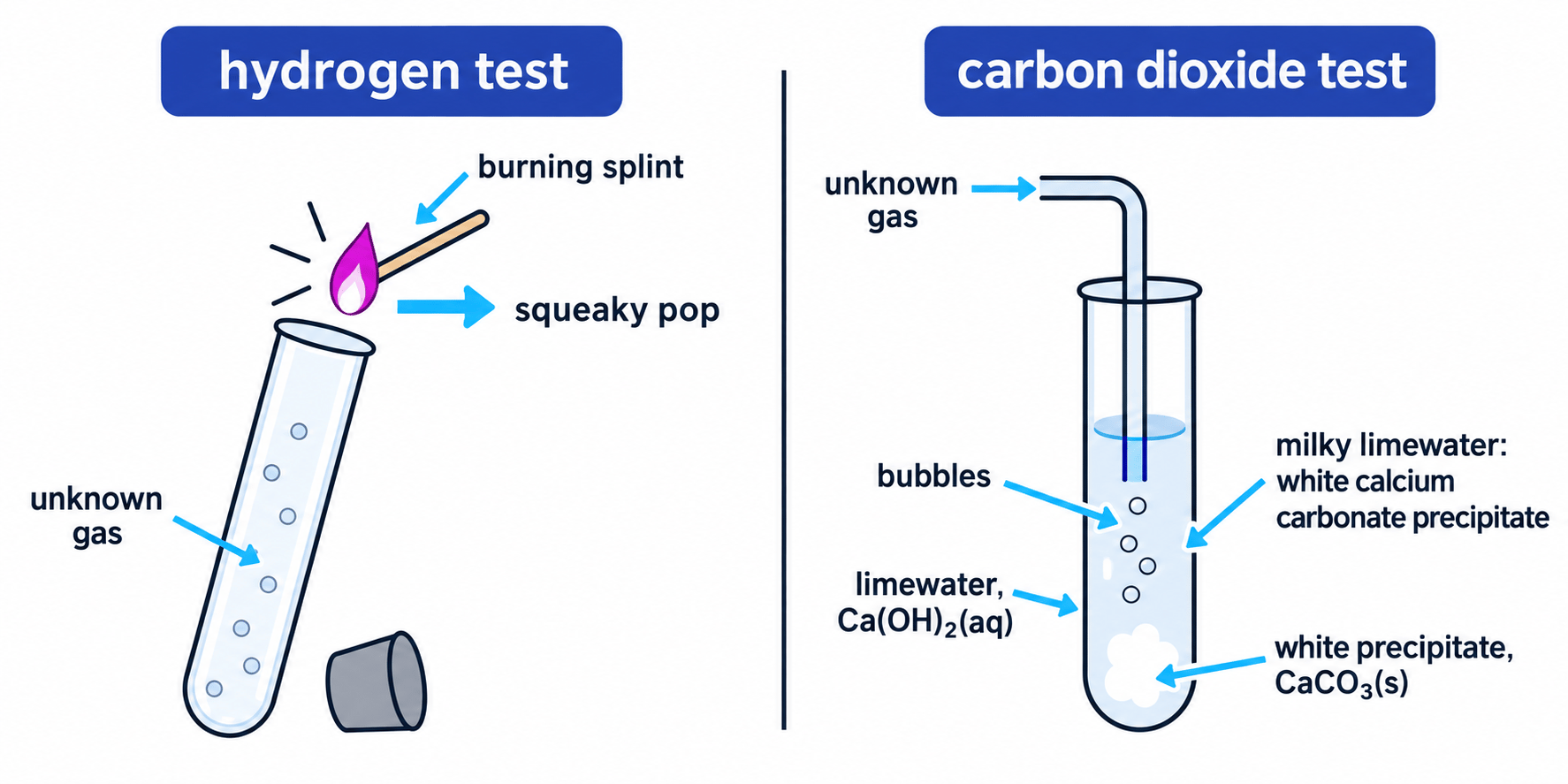
Two gases, two tests
- A chemical test is a stated method together with the observation that counts as a positive result.
- Hydrogen is tested with a burning splint.
- Carbon dioxide is tested with limewater.
- A test is only complete when both the method and the observation have been given.
Key Idea
- Hydrogen gives a squeaky pop with a burning splint.
- Carbon dioxide turns limewater milky, which is a white precipitate forming.
Hydrogen: a burning splint gives a squeaky pop
- Collect the gas in a test tube and keep it stoppered until the moment of the test.
- Hold a burning splint at the open mouth of the tube.
- Hydrogen burns rapidly in the air inside the tube.
- That rapid burning makes a squeaky pop, and the sound is the positive result.
- A splint that simply goes out has identified nothing, because no pop was heard.
Common Mistake
- The pop is the result, so describing the splint going out identifies no gas at all.
- Hydrogen burns rather than relighting a glowing splint, which is the test for oxygen instead.
Carbon dioxide: limewater turns milky
Definition
Precipitate
An insoluble solid that forms when two solutions are mixed.
- Limewater is a solution of calcium hydroxide, Ca(OH)2\text{Ca(OH)}_2Ca(OH)2.
- Bubble the gas being tested through the limewater.
- Carbon dioxide reacts with that calcium hydroxide to give insoluble calcium carbonate: Ca(OH)2(aq)+CO2(g)→CaCO3(s)+H2O(l)\text{Ca(OH)}_2(aq) + \text{CO}_2(g) \rightarrow \text{CaCO}_3(s) + \text{H}_2\text{O}(l)Ca(OH)2(aq)+CO2(g)→CaCO3(s)+H2O(l)
- The tiny solid particles make the limewater look milky, and that is the positive result.
- Limewater that stays clear has not shown carbon dioxide.
Example
- Positive: the limewater turns milky as a white precipitate of calcium carbonate forms.
- Negative: the limewater stays clear, so the gas is not carbon dioxide.
Giving a complete test answer
- Name the reagent or apparatus first.
- Then give the observation that counts as a positive result.
- Hydrogen: burning splint, squeaky pop.
- Carbon dioxide: bubble through limewater, limewater turns milky.
- Do not swap the two observations, because each belongs to one gas only.
Self review
- What is used to test for hydrogen?
- Which observation confirms that a gas is hydrogen?
- How do you test a gas for carbon dioxide?
- Why does limewater turn milky with carbon dioxide?
- What substance is limewater a solution of?