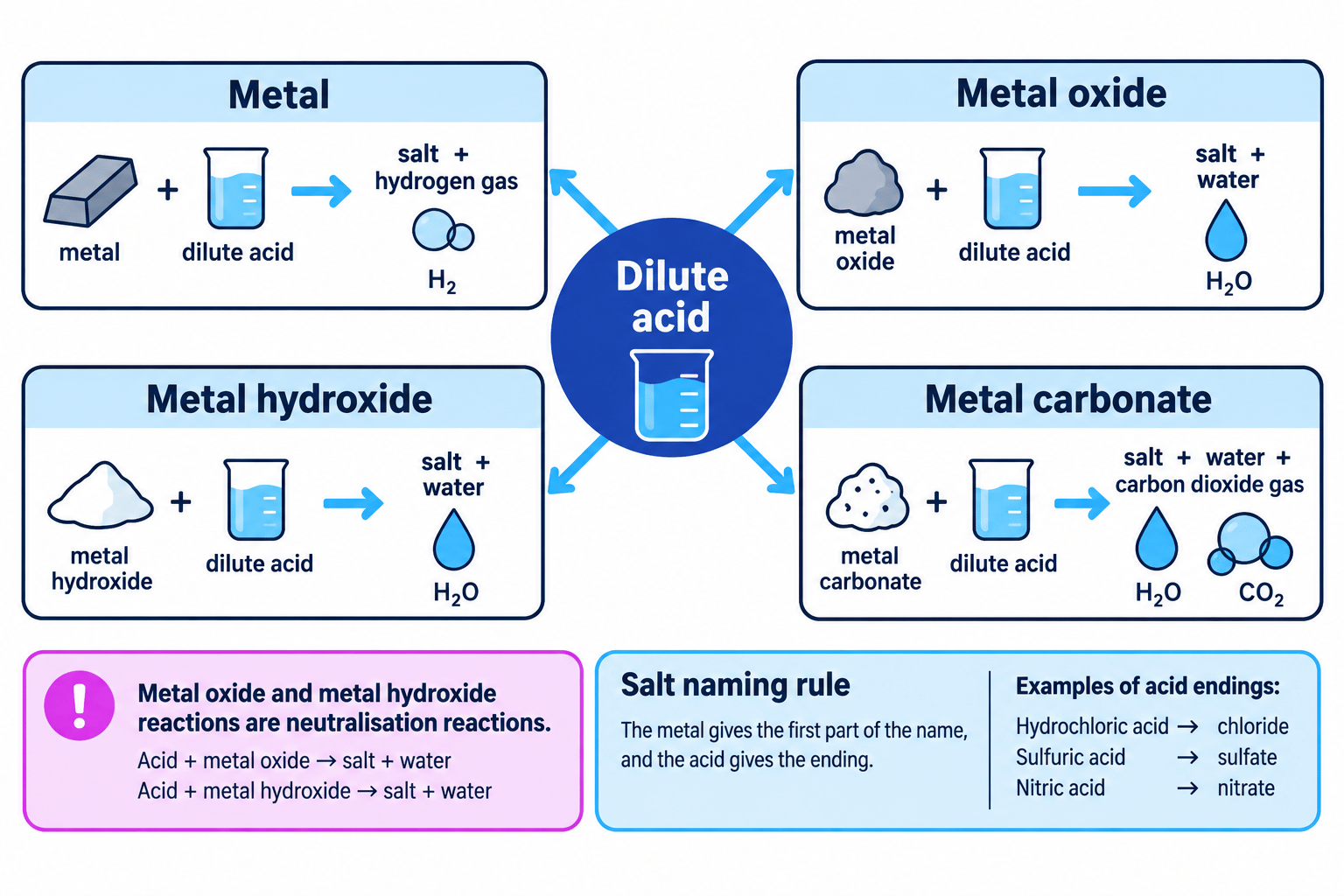
A base reacts with an acid to give a salt and water
Base
A substance that reacts with an acid to form a salt and water only.
Alkali
A soluble base, which is a source of hydroxide ions when it dissolves in water.
Salt
The compound formed when the hydrogen ion of an acid is replaced by a metal ion or an ammonium ion.
- A base reacts with an acid to form a salt and water, and nothing else.
- Metal oxides and metal hydroxides are bases, because those are their only products with an acid.
- A base that dissolves in water is also called an alkali.
- Every alkali is therefore a base, but a base that will not dissolve is not an alkali.
- Metal carbonates also react with acids, but they give carbon dioxide as well, so they fall outside that definition.
- In every case the metal gives the first part of the salt's name and the acid gives the ending.
- Every alkali is a base, though not every base is an alkali.
- Only a salt and water come from an acid and a base, which is what the definition demands.
The acid fixes the ending of the salt's name
Word equation
A way of showing a reaction that uses the names of the reactants and products, with an arrow pointing from reactants to products.
- Hydrochloric acid makes chloride salts.
- Sulfuric acid makes sulfate salts.
- Nitric acid makes nitrate salts.
- The metal supplies the first word, so magnesium with hydrochloric acid gives magnesium chloride.
- A word equation names the substances without formulae, which is enough to get the salt right.
- Copper oxide with sulfuric acid gives copper sulfate and water.
- Zinc and hydrochloric acid: zinc chloride.
- Sodium hydroxide and nitric acid: sodium nitrate.
- Calcium carbonate and sulfuric acid: calcium sulfate.
Acids with metals give a salt and hydrogen
- A suitable metal reacts with a dilute acid to give a salt and hydrogen: acid+metal→salt+hydrogen\text{acid} + \text{metal} \rightarrow \text{salt} + \text{hydrogen}acid+metal→salt+hydrogen
- Magnesium with hydrochloric acid: Mg(s)+2HCl(aq)→MgCl2(aq)+H2(g)\text{Mg}(s) + 2\text{HCl}(aq) \rightarrow \text{MgCl}_2(aq) + \text{H}_2(g)Mg(s)+2HCl(aq)→MgCl2(aq)+H2(g)
- Magnesium with sulfuric acid: Mg(s)+H2SO4(aq)→MgSO4(aq)+H2(g)\text{Mg}(s) + \text{H}_2\text{SO}_4(aq) \rightarrow \text{MgSO}_4(aq) + \text{H}_2(g)Mg(s)+H2SO4(aq)→MgSO4(aq)+H2(g)
- The bubbles seen during the reaction are hydrogen leaving the solution.
- This is not a neutralisation, because hydrogen is a product alongside the salt.
- A metal is not a base, because the reaction gives hydrogen as well as a salt.
- Not every metal reacts, since copper and the metals below hydrogen leave dilute acids alone.
Acids with metal oxides and hydroxides give a salt and water
Neutralisation
The reaction in which hydrogen ions from an acid join with hydroxide ions from an alkali to form water.
-
Both a metal oxide and a metal hydroxide give only a salt and water with an acid:
acid+metal oxide→salt+water\text{acid} + \text{metal oxide} \rightarrow \text{salt} + \text{water}acid+metal oxide→salt+water acid+metal hydroxide→salt+water\text{acid} + \text{metal hydroxide} \rightarrow \text{salt} + \text{water}acid+metal hydroxide→salt+water -
Copper oxide with sulfuric acid: CuO(s)+H2SO4(aq)→CuSO4(aq)+H2O(l)\text{CuO}(s) + \text{H}_2\text{SO}_4(aq) \rightarrow \text{CuSO}_4(aq) + \text{H}_2\text{O}(l)CuO(s)+H2SO4(aq)→CuSO4(aq)+H2O(l).
-
Sodium hydroxide with hydrochloric acid: NaOH(aq)+HCl(aq)→NaCl(aq)+H2O(l)\text{NaOH}(aq) + \text{HCl}(aq) \rightarrow \text{NaCl}(aq) + \text{H}_2\text{O}(l)NaOH(aq)+HCl(aq)→NaCl(aq)+H2O(l).
-
Calcium hydroxide needs two acid molecules: Ca(OH)2(aq)+2HNO3(aq)→Ca(NO3)2(aq)+2H2O(l)\text{Ca(OH)}_2(aq) + 2\text{HNO}_3(aq) \rightarrow \text{Ca(NO}_3)_2(aq) + 2\text{H}_2\text{O}(l)Ca(OH)2(aq)+2HNO3(aq)→Ca(NO3)2(aq)+2H2O(l).
-
Both of these are neutralisations, because a salt and water are the only products.
- A soluble hydroxide is an alkali, so sodium hydroxide counts as both a base and an alkali.
- An insoluble oxide is still a base, even though it cannot make an alkaline solution.
Acids with metal carbonates also give carbon dioxide
- A metal carbonate gives three products with an acid: acid+metal carbonate→salt+water+carbon dioxide\text{acid} + \text{metal carbonate} \rightarrow \text{salt} + \text{water} + \text{carbon dioxide}acid+metal carbonate→salt+water+carbon dioxide
- Calcium carbonate with hydrochloric acid: CaCO3(s)+2HCl(aq)→CaCl2(aq)+H2O(l)+CO2(g)\text{CaCO}_3(s) + 2\text{HCl}(aq) \rightarrow \text{CaCl}_2(aq) + \text{H}_2\text{O}(l) + \text{CO}_2(g)CaCO3(s)+2HCl(aq)→CaCl2(aq)+H2O(l)+CO2(g).
- Sodium carbonate with sulfuric acid: Na2CO3(aq)+H2SO4(aq)→Na2SO4(aq)+H2O(l)+CO2(g)\text{Na}_2\text{CO}_3(aq) + \text{H}_2\text{SO}_4(aq) \rightarrow \text{Na}_2\text{SO}_4(aq) + \text{H}_2\text{O}(l) + \text{CO}_2(g)Na2CO3(aq)+H2SO4(aq)→Na2SO4(aq)+H2O(l)+CO2(g).
- The fizzing is carbon dioxide escaping, and it is the quickest sign that a carbonate is present.
- Hydrogen comes from a metal and carbon dioxide from a carbonate, so the gas identifies which one reacted.
- Naming the gas identifies the reactant, so hydrogen points to a metal and carbon dioxide to a carbonate.
- A salt name is built from two places at once: the metal for the first word and the acid for the second.
- State symbols belong in these equations, and they are the detail most often left out.
- What is a base, in terms of what it produces with an acid?
- What makes a base an alkali?
- What are the products when a metal reacts with a dilute acid?
- What are the products when a metal carbonate reacts with an acid?
- Which salt forms from zinc oxide and sulfuric acid?