Question 5
FA pupil uses the cell arrangement in the diagram to compare metal pairs. The electrolyte and apparatus are otherwise unchanged. The table gives the magnitudes of the initial voltages.
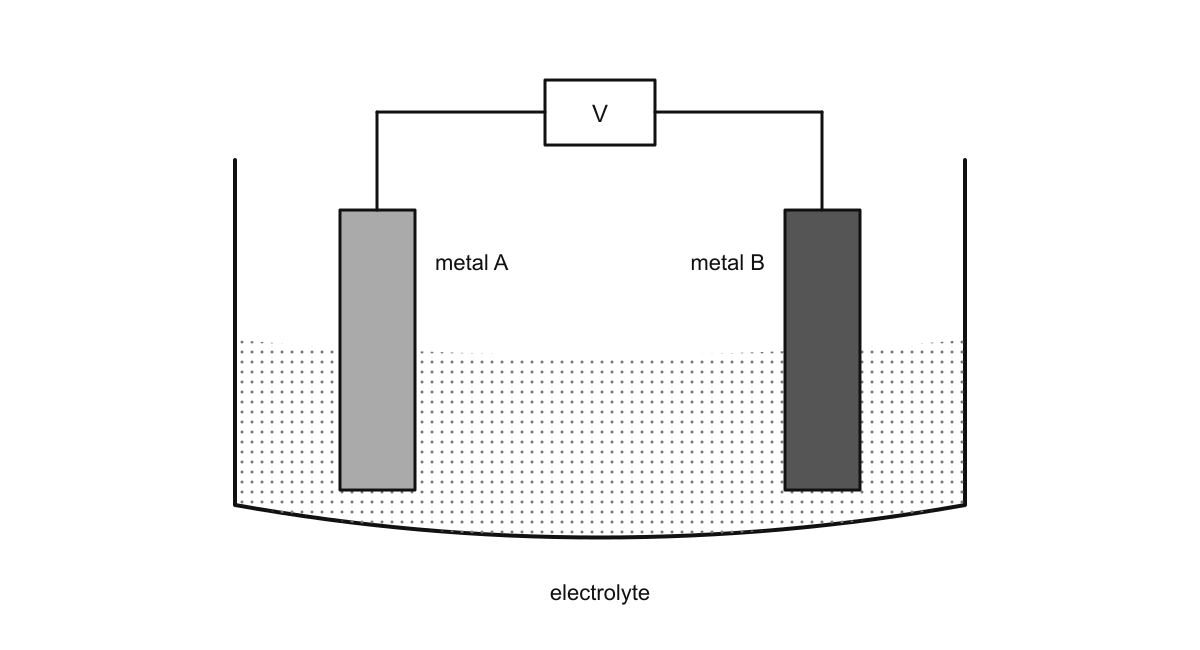
| Metal A | Metal B | Voltage / V\mathrm{V}V |
|---|---|---|
| magnesium | copper | 1.72 |
| zinc | copper | 0.91 |
| copper | copper | 0.00 |
a.[3]
Use the results to evaluate the claim that any two metal strips in an electrolyte produce a voltage. Explain what the results show about changing metal A.
b.[2]
The pupil replaces the electrolyte with a dry plastic block while keeping the metal strips and wires. Explain why this does not produce a working cell.
c.[3]
A hydrogen–oxygen fuel cell is proposed for continuous operation instead. State what must be supplied continuously, give the overall reaction, and explain why calling it "completely pollution-free" needs qualification.
6.4 Chemical cells and fuel cells Questions
38 exam-style questions on Edexcel GCSE Chemistry 6.4 Chemical cells and fuel cells, covering 6.4.1 Chemical cells and fuel cells. Each one has a worked solution and a mark scheme showing where the marks go.