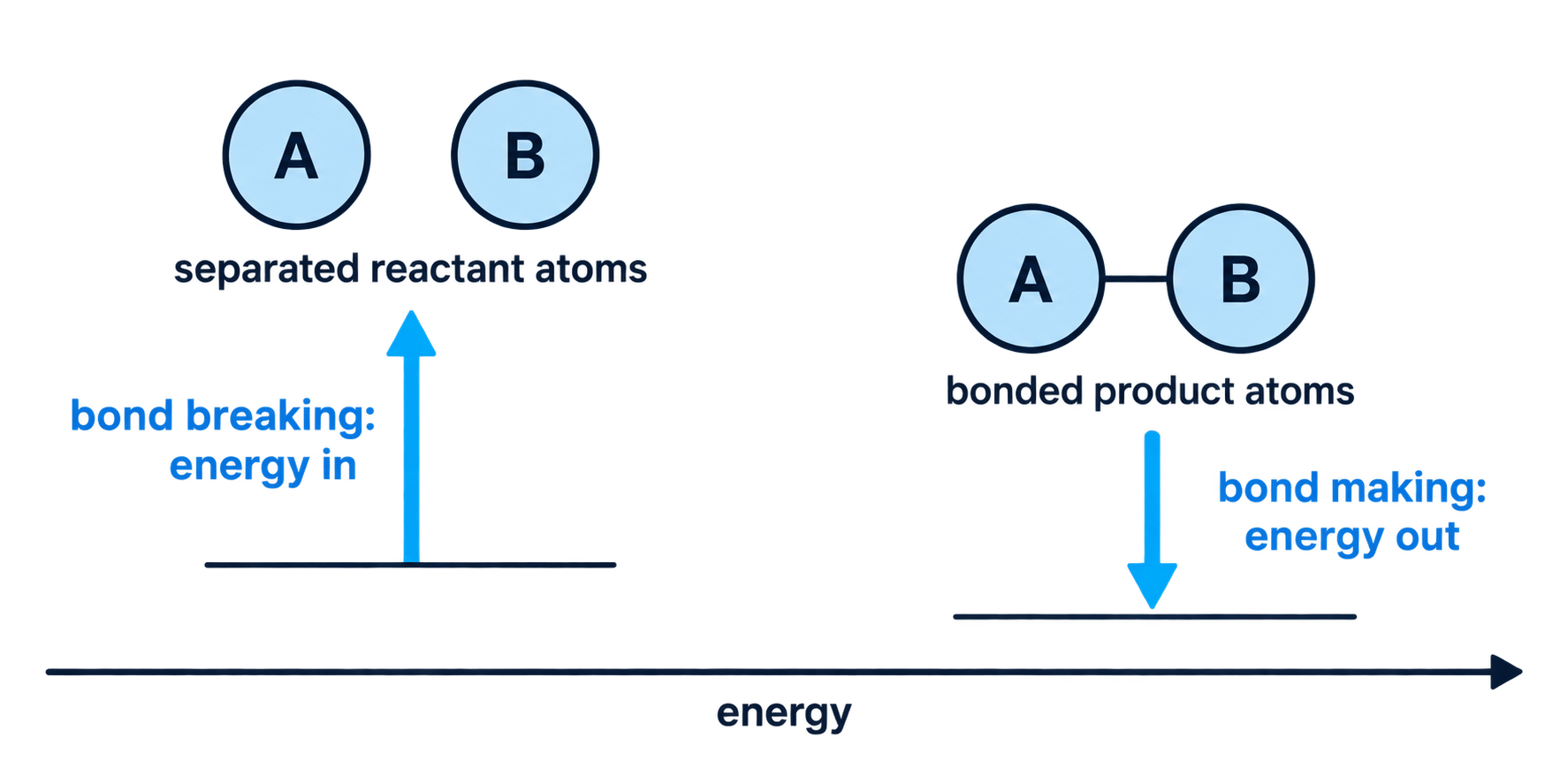
Breaking bonds takes energy in
- A chemical reaction begins by breaking the bonds in the reactants.
- Pulling bonded atoms apart needs energy to be supplied.
- Bond breaking is therefore endothermic, whatever the reaction as a whole turns out to be.
- A stronger bond needs more energy to break it.
- The energy for this comes from the surroundings or from the energy already in the mixture.
Key Idea
Bond breaking is always endothermic and bond making is always exothermic, in every reaction.
Making bonds gives energy out
- The reaction finishes by forming the bonds in the products.
- Atoms coming together into a bond release energy as they do so.
- Bond making is therefore exothermic, whatever the reaction as a whole turns out to be.
- Forming a stronger bond releases more energy.
- That energy passes out into the surroundings.
Note
The same bond takes exactly as much energy to break as it releases when it forms.
The overall change is the balance of the two
Definition
Exothermic reaction
A reaction in which heat energy is given out to the surroundings.
Definition
Endothermic reaction
A reaction in which heat energy is taken in from the surroundings.
- Every reaction involves bonds being broken and bonds being made.
- The overall heat change depends on which of the two involves more energy.
- The comparison is between the energy required to break and the energy released in making.
- Whichever is larger decides the direction of the overall change.
- The two quantities are compared, not added, so the answer is a difference.
Common Mistake
An exothermic reaction still breaks bonds, so energy is taken in at that stage.
Exothermic: more released than required
- If forming the products' bonds releases more energy than breaking the reactants' bonds requires, the reaction is exothermic.
- The surplus energy passes into the surroundings, so the temperature rises.
- This means the products hold less energy than the reactants did.
- Combustion is exothermic, because the bonds in the products are stronger overall.
- Most reactions met in this course are exothermic.
Example
Burning methane: the bonds formed in carbon dioxide and water release more than the methane and oxygen bonds required.
Endothermic: less released than required
- If forming the products' bonds releases less energy than breaking the reactants' bonds requires, the reaction is endothermic.
- The shortfall is drawn from the surroundings, so the temperature falls.
- This means the products hold more energy than the reactants did.
- Thermal decomposition is endothermic, since the compound must be broken apart.
- Deciding the direction always means the same comparison, whichever reaction is being considered.
Self review
- Is bond breaking exothermic or endothermic?
- Is bond making exothermic or endothermic?
- What decides whether a reaction is exothermic overall?
- In an exothermic reaction, do the products hold more or less energy than the reactants?
- Why does an endothermic reaction make its surroundings colder?