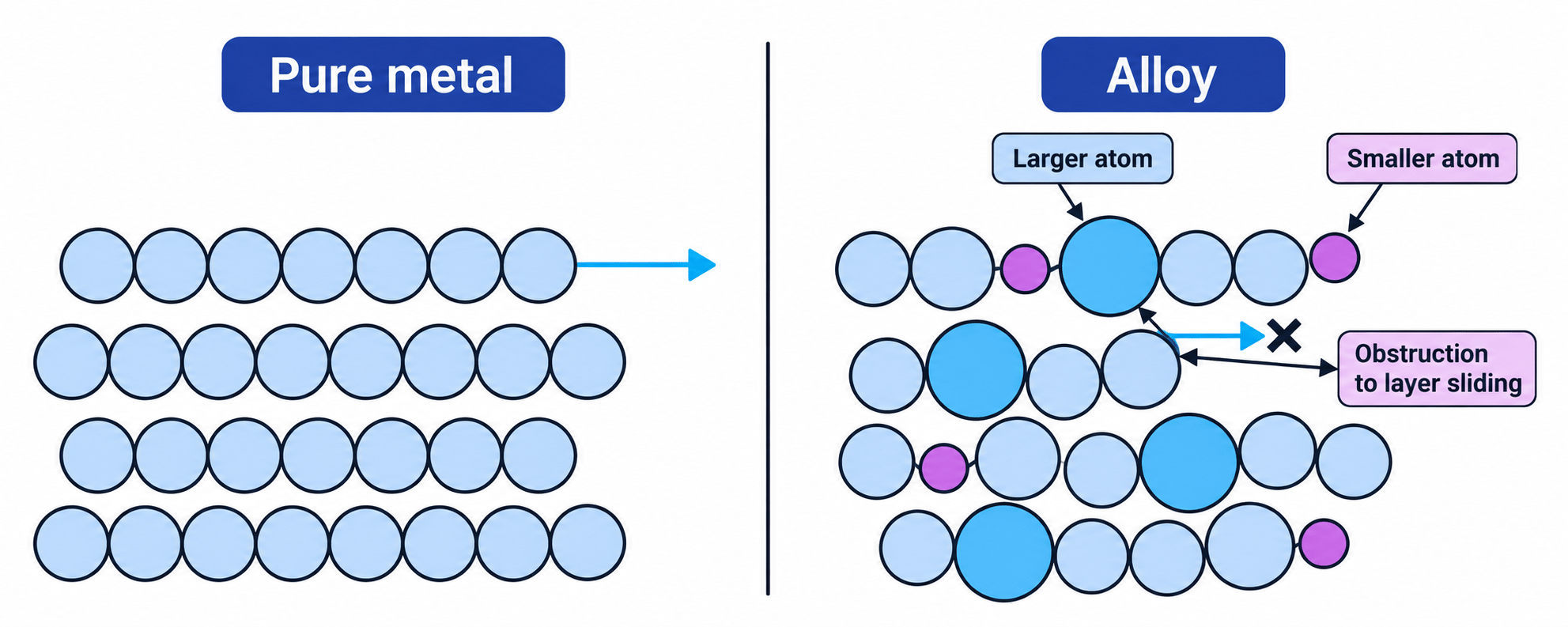
A pure metal is soft because its layers can slide
Definition
Metallic bond
The strong electrostatic attraction between positive metal ions and the delocalised electrons that surround them.
- A pure metal is a regular arrangement of identical atoms, stacked in layers.
- A force applied to the metal makes one layer slide over the next.
- The atoms are all the same size, so nothing obstructs a layer as it moves.
- Sliding layers are what make a pure metal soft and easy to shape.
- The metallic bonding is not broken by the sliding, so the metal bends rather than shatters.
Key Idea
Softness comes from the regularity of the arrangement, not from weak bonding.
An alloy has atoms of different sizes that block the layers
Definition
Alloy
A mixture of a metal with one or more other elements.
- Mixing a metal with another element puts atoms of a different size into the structure.
- Those atoms distort the layers, so the regular stacking is broken up.
- A distorted layer cannot slide past its neighbour as easily as a regular one.
- More force is then needed to change the shape, so the alloy is harder and stronger.
- Hardness is resistance to being scratched or dented, and strength is resistance to breaking under load.
Note
An alloy is a mixture, so its composition can be adjusted to suit the job.
Alloy steels are iron mixed for a purpose
- Pure iron is too soft for most structural uses on its own.
- Adding a small amount of carbon gives steel, which is far harder than iron.
- Adding chromium and nickel gives stainless steel, which resists corrosion.
- Different proportions give steels for girders, tools, cutlery and car bodies from one base metal.
- Iron is alloyed because the alloy can be matched to the job in a way the pure metal cannot.
Example
- Low-carbon steel: easily shaped, used for car bodies.
- High-carbon steel: hard and brittle, used for cutting tools.
- Stainless steel: resists corrosion, used for cutlery and sinks.
The use of a metal follows from its properties
- Aluminium has a low density, so it is used where lightness matters, as in aircraft.
- Aluminium also resists corrosion, because a layer of aluminium oxide seals its surface.
- Copper conducts electricity well and is ductile, so it is drawn into wiring.
- Copper is also unreactive enough not to react with water, which suits it to pipework.
- Gold does not corrode and can be beaten very thin, so it is used in jewellery and in electrical contacts.
Common Mistake
Aluminium's resistance comes from its oxide layer, not from the metal being unreactive.
Magnalium and brass are alloys with matched uses
- Magnalium is aluminium alloyed with magnesium.
- It keeps aluminium's low density while being stronger, which suits aircraft and racing car parts.
- Brass is copper alloyed with zinc.
- Brass is harder than copper and keeps a good appearance, which suits door fittings and musical instruments.
- In both cases the alloy keeps a useful property of the parent metal and improves on a weakness.
Self review
- Why can the layers in a pure metal slide over one another?
- Explain, in terms of layers, why an alloy is harder than the pure metal.
- Why is iron alloyed to make steels?
- Why does aluminium resist corrosion despite its position in the reactivity series?
- Name the two metals in brass and give a use for it.