An addition reaction opens the double bond
Definition
Addition reaction
A reaction in which two molecules join to form a single product, with nothing else formed.
- The double bond between the two carbons opens up.
- Each of those carbons then has a spare bond to use.
- An atom joins onto each of the two carbons.
- A single product is formed, with nothing else made alongside it.
- The product is saturated, since the double bond has gone.
Key Idea
Addition is possible only because the molecule is unsaturated: there is a bond to open.
Ethene reacts with bromine
- Bromine, Br2\text{Br}_2Br2, adds across the double bond of ethene.
- One bromine atom joins to each of the two carbon atoms.
- The equation is: C2H4+Br2→C2H4Br2\text{C}_2\text{H}_4 + \text{Br}_2 \rightarrow \text{C}_2\text{H}_4\text{Br}_2C2H4+Br2→C2H4Br2
- The product is 1,2-dibromoethane, with a bromine on each carbon.
- Its structure is two carbons joined by a single bond, each carrying two hydrogens and one bromine.
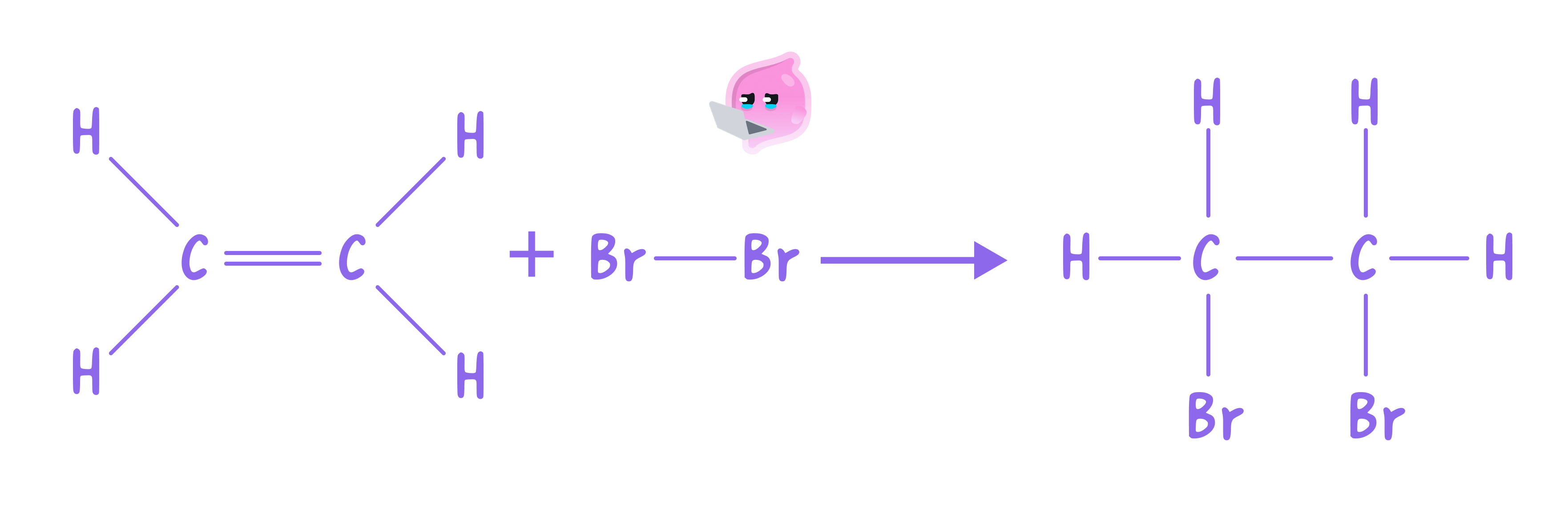
Example
- Before: two carbons joined by a double bond, two hydrogens on each.
- After: two carbons joined by a single bond, each with two hydrogens and one bromine.
The same reaction works for other alkenes
- Every alkene has the same functional group, so every one reacts in the same way.
- Propene adds bromine to give 1,2-dibromopropane.
- The pattern extends directly: C3H6+Br2→C3H6Br2\text{C}_3\text{H}_6 + \text{Br}_2 \rightarrow \text{C}_3\text{H}_6\text{Br}_2C3H6+Br2→C3H6Br2
- The two bromine atoms always end up on the carbons that held the double bond.
- The rest of the molecule is unchanged by the reaction.
Note
Predicting the product means finding the double bond and putting one atom on each of its carbons.
Bromine water distinguishes alkanes from alkenes
- Bromine water is orange.
- It is shaken with the hydrocarbon being tested.
- With an alkene it turns colourless, because the bromine has been used up in addition.
- With an alkane it stays orange, because there is no double bond to react with.
- Orange to colourless is therefore the positive result for an alkene.
Common Mistake
Colourless is not the same as white, and describing the result wrongly loses the point.
Self review
- What happens to the double bond in an addition reaction?
- Write the equation for ethene reacting with bromine.
- Name the product of that reaction and describe its structure.
- Predict the product when propene reacts with bromine.
- Describe how bromine water distinguishes ethane from ethene.
