A chemical cell turns a reaction into a voltage
Definition
Chemical cell
A source of electricity in which a chemical reaction produces a voltage between two different metals in an electrolyte.
Definition
Electrolyte
An ionic compound, molten or dissolved in water, whose ions are free to move and carry charge.
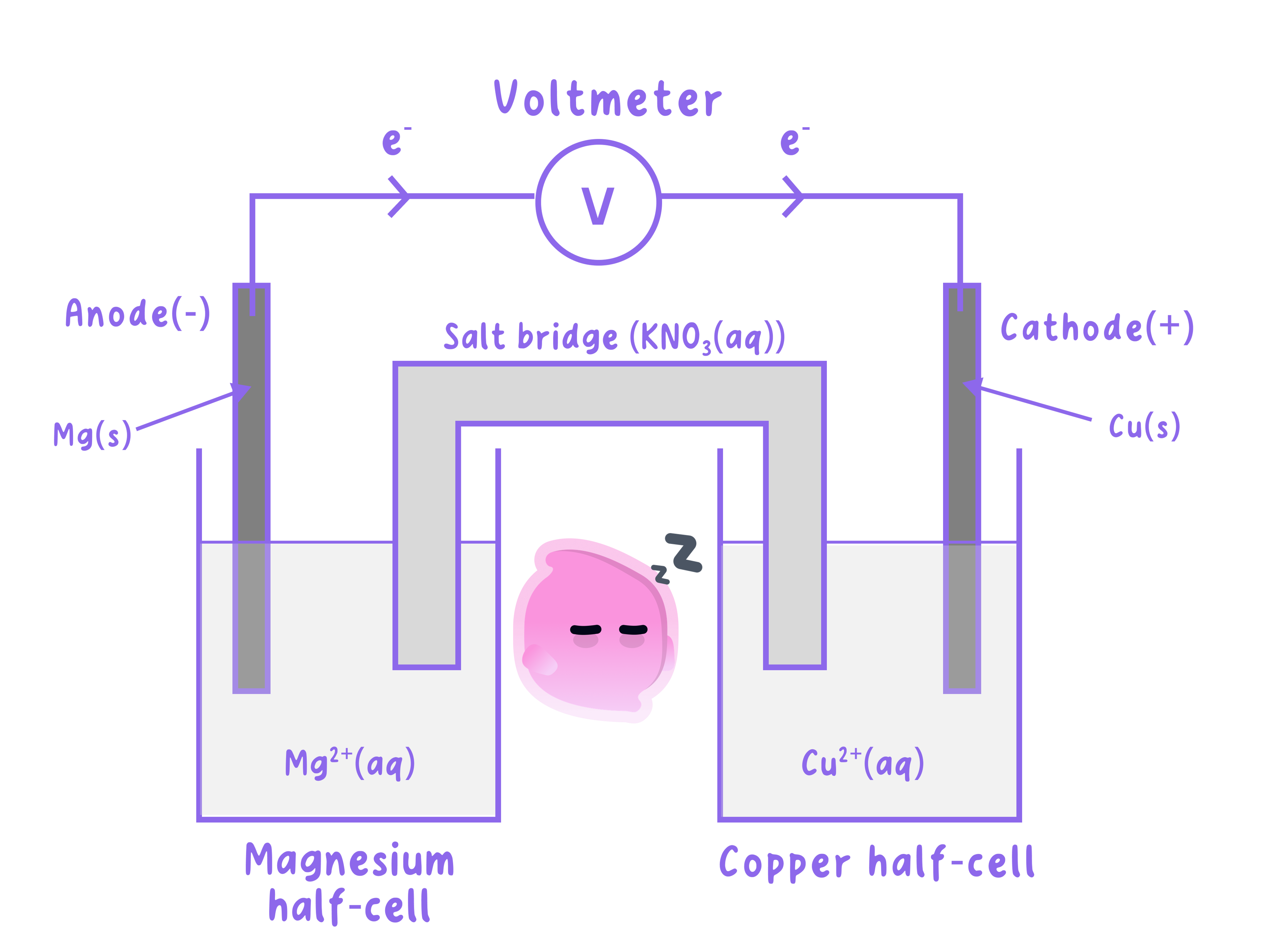
- A simple cell is built from two different metals dipping into an electrolyte.
- The more reactive metal loses electrons more readily than the other.
- Those electrons travel through the external circuit from one metal to the other, which is an electric current.
- The difference between the two metals appears as a voltage across the cell.
- The electrolyte completes the circuit by allowing ions to move between the electrodes.
Key Idea
A cell works because one metal gives up electrons more readily than the other, so a reaction drives the current.
The voltage depends on the two metals chosen
- The further apart the two metals are in the reactivity series, the larger the voltage.
- A magnesium and copper pair gives a larger voltage than a zinc and copper pair.
- Two pieces of the same metal give no voltage at all, because neither loses electrons in preference.
- The more reactive metal is always the negative electrode, since electrons leave from it.
- Changing the electrolyte also changes the voltage, though the choice of metals matters most.
Example
- Magnesium and copper: a large voltage, because they are far apart in the series.
- Zinc and copper: a smaller voltage.
- Copper and copper: no voltage.
A chemical cell stops when a reactant runs out
- The reaction inside the cell uses up the more reactive metal as it runs.
- The voltage is produced only while that reactant is still present.
- Once it is used up the reaction stops and the cell goes flat.
- A non-rechargeable cell is then discarded, because the reaction cannot be run backwards.
- This is the basic limit of any cell that carries its own fuel inside it.
Common Mistake
A flat cell has run out of reactant, not out of electricity to store.
A hydrogen oxygen fuel cell is supplied from outside
Definition
Fuel cell
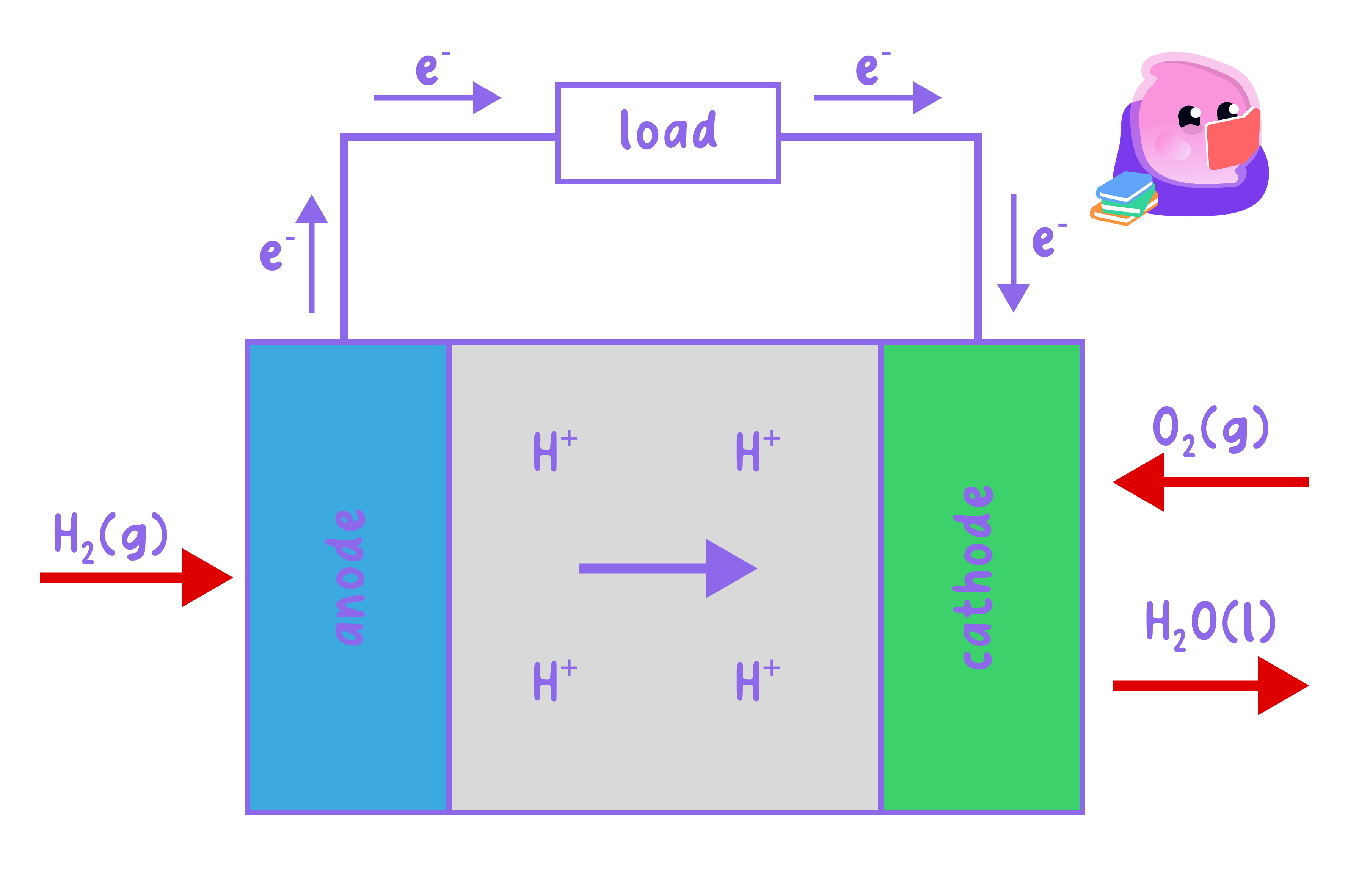
A cell in which a fuel and oxygen react to produce a voltage, with water as the only product when the fuel is hydrogen.
- Hydrogen and oxygen are fed into the cell rather than being sealed inside it.
- The overall reaction is the formation of water: 2H2+O2→2H2O2\text{H}_2 + \text{O}_2 \rightarrow 2\text{H}_2\text{O}2H2+O2→2H2O
- Water is the only product, so nothing else leaves the cell.
- The cell produces a voltage for as long as the fuel supply continues.
- It does not have to be recharged, because it is refuelled instead.
Note
A fuel cell is not a store of energy, so the comparison with a rechargeable battery is about refuelling time.
Judging a fuel cell for a given use
- The cell produces no carbon dioxide and no particulates at the point of use.
- A vehicle can be refuelled in minutes, where a battery takes far longer to recharge.
- Against that, hydrogen is difficult to store and transport, and it is highly flammable.
- Most hydrogen is currently made from natural gas, so carbon dioxide is released elsewhere.
- Fuel cells suit uses where refuelling speed and clean exhaust matter more than the cost of the fuel.
Self review
- What two things are needed to build a simple chemical cell?
- Why does a magnesium and copper cell give a larger voltage than a zinc and copper cell?
- Why does a chemical cell eventually stop producing a voltage?
- What is the only product of a hydrogen oxygen fuel cell?
- Give one advantage and one disadvantage of a fuel cell in a vehicle.
