Ways of reducing the use of resources
What you'll learn
- Why many everyday materials depend on limited raw materials and limited energy sources.
- How reduction, reuse and recycling reduce waste and environmental impacts.
- Why different materials, such as glass and metals, are recycled in different ways.
- How to evaluate resource-saving options using evidence, not just vague phrases like “better for the environment”.
The big idea: products have a resource cost
Every product has to come from somewhere. A glass bottle, metal can, plastic tray or brick starts with raw materials taken from the Earth. Energy is then used to process those materials, make the product, transport it, use it and dispose of it.
Raw materials and end users
A raw material is a natural material used to make products, such as iron ore, sand, limestone, clay or crude oil. An end user is the person or organisation that uses the final product, such as a household, school, shop or factory.
Limited resource
A limited resource is a resource that exists in a finite amount, or is used much faster than it is naturally replaced. In this topic, that includes many raw materials and many energy sources, especially fossil fuels such as coal, oil and natural gas.
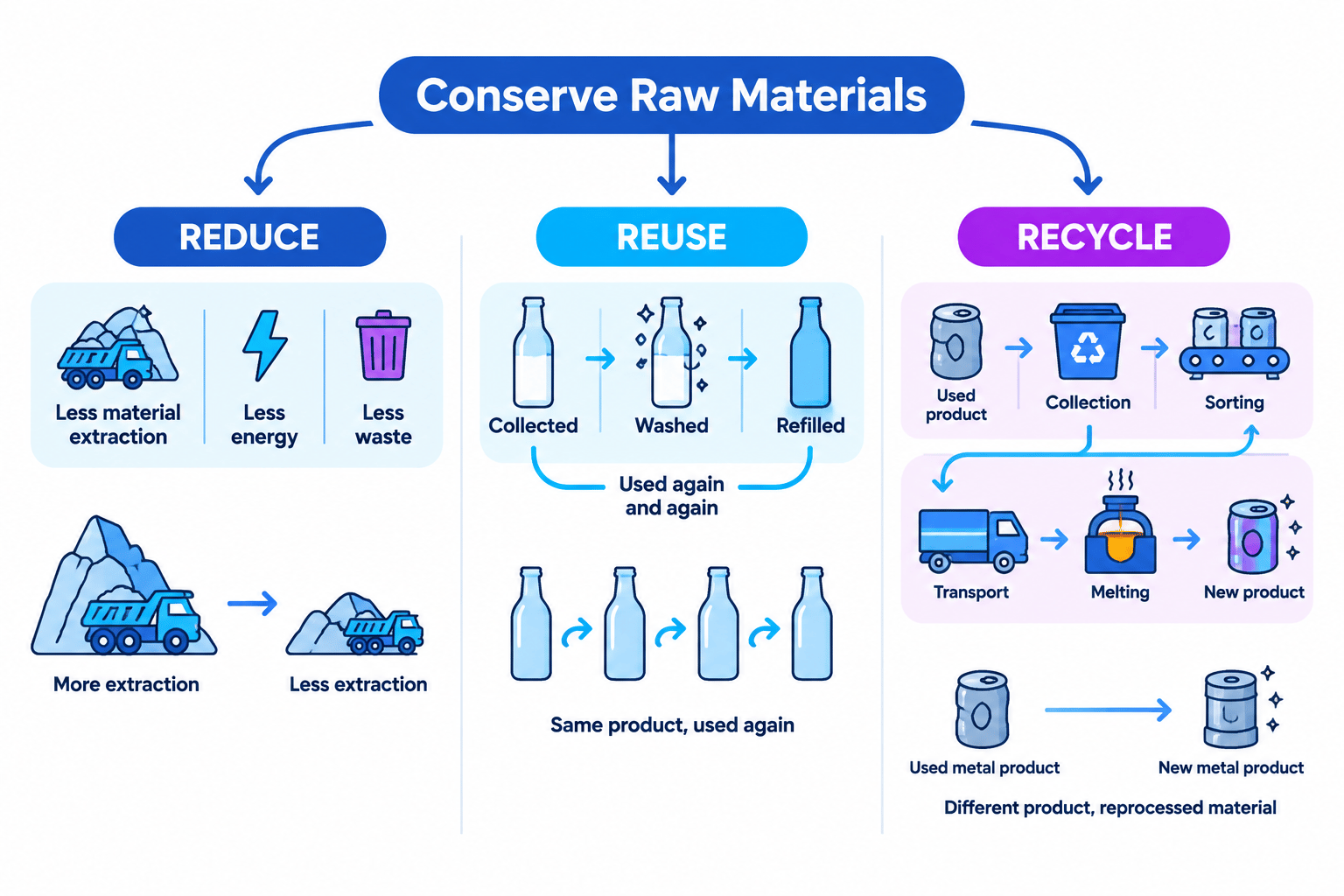
This diagram shows the main choice: keep following a “take → make → waste” route, or reduce the need for new resources by reducing, reusing and recycling.

Why extraction causes problems
Many useful materials are produced from limited raw materials:
- Metals are extracted from ores. An ore is a rock containing enough metal compound for extraction to be worthwhile.
- Glass is made from raw materials such as sand and limestone, which must be heated strongly.
- Building materials such as concrete, cement and bricks use quarried rocks, limestone, clay and aggregates.
- Clay ceramics, such as tiles and pottery, are made from clay minerals and fired in kilns.
- Most plastics are made from chemicals obtained from crude oil or natural gas.
Getting these materials often involves mining or quarrying.
Mining usually means digging underground or using large open pits to obtain ores or fuels. Quarrying usually means removing rock from the surface in an open site.
Both can cause environmental impacts, including:
- destruction of habitats
- scars in the landscape
- noise, dust and traffic
- pollution from waste rock or processing
- large energy use, often producing carbon dioxide
Environmental impact
An environmental impact is an effect on the surroundings caused by human activity. It may affect land, water, air, living organisms, climate, or the amount of waste produced.
The three main ways to reduce resource use
At GCSE, you need to know three main approaches used by end users: reduce, reuse and recycle.
1. Reduce
To reduce means to use less material in the first place.
Examples include:
- buying only what you need
- choosing products with less packaging
- using a product for longer before replacing it
- designing lighter containers that use less plastic, glass or metal
Reduction is powerful because it can avoid several stages of the life cycle: less raw material extraction, less manufacturing, less transport and less waste.
2. Reuse
To reuse means to use the same product again, usually for the same purpose, with little processing.
A classic example is a glass milk bottle or drinks bottle. It can be collected, washed, checked and refilled. This avoids making a completely new bottle each time.
Reuse still has impacts. Bottles may need transport, hot water, detergents and inspection. However, if the bottle is reused many times, the resource saving can be large.
3. Recycle
To recycle means to process a waste material so that it can be made into a useful material or product again.
Recycling usually involves stages such as:
- collecting the waste
- sorting and separating materials
- cleaning or removing labels
- melting, crushing or reforming the material
- making a new product
The resource-saving order
For the same product, reducing use usually saves the most resources, reusing usually comes next, and recycling is still useful but needs extra processing energy.
Reuse is not the same as recycle
A glass bottle that is washed and refilled has been reused. A glass bottle that is crushed, melted and made into another glass product has been recycled.
Choosing a lower-resource option
A school compares three ways of providing cups for an event with 100 drinks.
- Disposable plastic cups: 5.0 kg of new plastic, 40 MJ of energy, 5.0 kg of waste
- Reusable cups: 1.0 kg of plastic, 25 MJ of washing/transport energy, 0.5 kg of waste
- Recycled plastic cups: 1.5 kg of new plastic, 35 MJ of energy, 1.0 kg of waste
-
Compare raw materials. The reusable cups use the least new plastic. Compared with disposable cups, the percentage reduction is 5.0−1.05.0×100=80%\frac{5.0 - 1.0}{5.0} \times 100 = 80\%5.05.0−1.0×100=80%.
-
Compare energy use. The reusable option uses 25 MJ, which is lower than 35 MJ and 40 MJ, so it also saves energy in this set of data.
-
Compare waste. The reusable option produces 0.5 kg of waste, less than both the recycled and disposable options.
-
Make a judgement with a caveat. The reusable cups are best from the data given, but the conclusion could change if they were transported very long distances or only reused once.
Recycling different materials
Glass
Glass bottles can often be reused first. If they cannot be reused, they can be crushed and melted to make new glass products.
Recycling glass reduces the need for new raw materials and can reduce waste sent to landfill. However, glass may need to be separated by colour or type, because different glass products need different properties.
Metals
Metals are very useful to recycle because extracting metals from ores can use large amounts of energy.
Metals can be recycled by:
- melting and recasting them into new shapes
- reforming them into different products
- adding suitable scrap metal to new metal during manufacture
For example, some scrap steel can be added to iron from a blast furnace. This reduces the amount of iron that must be extracted from iron ore.
Building materials, clay ceramics and plastics
Some products cannot easily be reused in their original form. Instead, they may be recycled for a different purpose.
Examples include:
- crushed concrete or brick used as aggregate for roads
- broken ceramics used as hardcore or filler
- plastics melted and remoulded, if they can be separated properly
Plastics are often harder to recycle than metals or glass because different polymers have different properties. A mixture of plastics may melt unevenly or produce a weaker final material.
Why separation matters
The amount of separation needed depends on the material and the quality needed in the final product.
If the final product can tolerate some impurities, less separation may be needed. If the final product needs very specific properties, the recycling process must be much more carefully controlled.
For example:
- electrical copper needs high purity because impurities reduce conductivity
- steel for a particular use needs the correct mixture of iron, carbon and other elements
- plastics often need sorting by polymer type before being melted
Recycling is not magic
Recycling reduces extraction and waste, but it does not remove all environmental impacts. Collection, sorting, washing, melting and transport all use energy.
Calculating ore saved by using scrap steel
A steelworks makes 2000 kg of steel. It uses 30% scrap steel and the rest comes from newly extracted iron. Assume the iron ore is 70% iron by mass. Estimate the mass of iron ore saved by using scrap steel.
-
Calculate the mass of scrap steel used.
0.30×2000 kg=600 kg0.30 \times 2000\ \text{kg} = 600\ \text{kg}0.30×2000 kg=600 kg, so 600 kg of steel comes from scrap instead of newly extracted iron. -
Link scrap steel to iron not extracted.
If 600 kg of scrap steel is used, about 600 kg less iron needs to be obtained from ore. -
Use the ore percentage to estimate ore saved.
If the ore is 70% iron, then more=600 kg0.70=857 kgm_{\text{ore}} = \frac{600\ \text{kg}}{0.70} = 857\ \text{kg}more=0.70600 kg=857 kg. -
Round sensibly.
The steelworks saves about 860 kg of iron ore, assuming the extraction process is efficient.
How to evaluate ways of reducing resources
This topic often appears as an evaluation question. That means you should weigh up advantages and disadvantages using the information provided.
A strong answer compares:
- raw materials used
- energy used
- waste produced
- pollution or greenhouse gas emissions
- transport distance
- cost, if given
- whether the final product has the required properties
Life cycle assessment link
A life cycle assessment, or LCA, estimates the environmental impacts of a product across its whole life: raw material extraction, manufacture, use and disposal. Reducing, reusing and recycling are ways to lower impacts at different stages.
If you are given numbers, use them. For example, a percentage reduction can be calculated using:
percentage reduction=original value−new valueoriginal value×100\text{percentage reduction} = \frac{\text{original value} - \text{new value}}{\text{original value}} \times 100percentage reduction=original valueoriginal value−new value×100Writing a balanced evaluation
Do not just write “it is better for the environment”. Say which impact is lower, such as less mining, less energy use, less waste, or fewer carbon dioxide emissions, then mention any trade-off.
The key takeaway
Reducing, reusing and recycling all help to conserve limited resources. They reduce the need for mining and quarrying, reduce energy use, reduce waste, and lower environmental impacts.
However, the best option depends on the material, the product, and the evidence given. In Chemistry exams, your job is to make a justified judgement from the data.
In the exam
-
Use the exact terms: reduce means use less, reuse means use the same product again, and recycle means reprocess the material.
-
Quote evidence from the question: compare energy, raw materials, waste or emissions using the numbers and units given.
-
Give a balanced conclusion: choose the best option, but mention a sensible trade-off such as transport, sorting, cost or product quality.
Check yourself
- Why does reusing a glass bottle usually save more resources than crushing and melting it?
- What determines how carefully scrap metal must be separated before recycling?
- Give one environmental impact of mining or quarrying, and one way recycling can reduce it.