- What corrosion means, and why rusting is a special example.
- How to investigate whether air and water are needed for iron to rust.
- How barrier coatings such as paint, grease and electroplating prevent corrosion.
- How sacrificial protection works using a more reactive metal such as zinc.
Many useful materials are exposed to the environment: rain, air, soil, seawater and pollution. Over time, some materials are damaged because they take part in chemical reactions with substances around them.
For metals, this damage often appears as a flaky, dull or crumbly surface. That is not just “getting dirty” — it is a chemical change, because new substances are formed.
Corrosion
Corrosion is the destruction of materials by chemical reactions with substances in the environment.
Corrosion is a broad term. Different metals can corrode in different ways. In this topic, the key example is rusting.
Rusting
Rusting is the corrosion of iron, or alloys containing iron such as steel, to form rust.
Rust is hydrated iron(III) oxide. You do not usually need to memorise its formula for GCSE, but you should know the word equation idea:
iron (s) + oxygen (g) + water (l) → hydrated iron(III) oxide (s)
Rusting needs two things
Iron rusts only when both air, specifically oxygen in the air, and water are present.
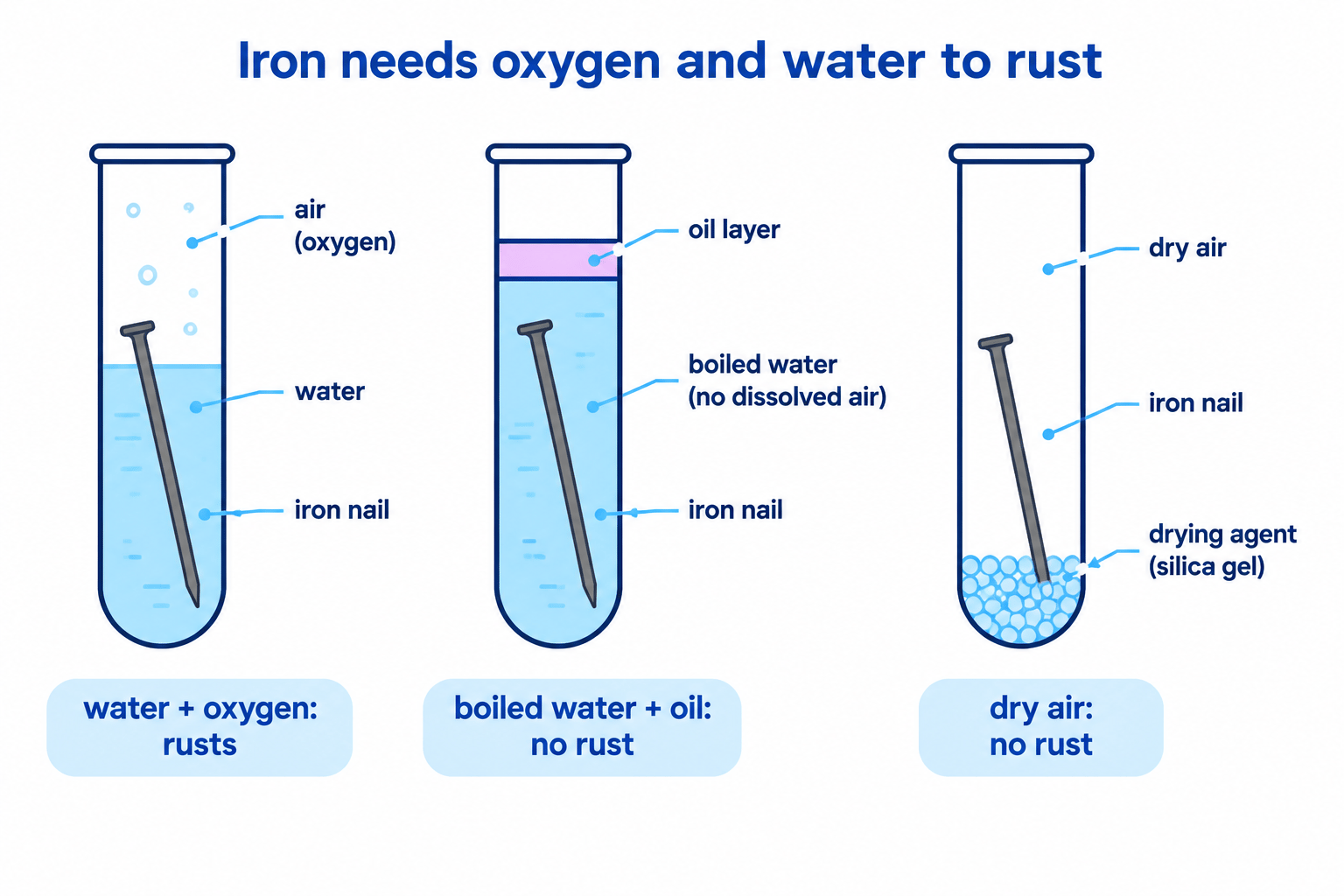
A classic rusting investigation uses iron nails in different conditions. The aim is to find out whether iron needs water, air, or both to rust.

The nail is in air, but there is no water. A drying agent is a substance that absorbs water vapour; calcium chloride is often used for this.
Result: no rust.
The nail is placed in boiled water. Boiling removes dissolved oxygen from the water. A layer of oil floats on top and prevents oxygen from the air dissolving back into the water.
Result: no rust.
The nail is in contact with both water and air.
Result: rust forms.
Interpreting rusting results
-
Compare Tube A and Tube C. Both contain air/oxygen, but Tube A has no water while Tube C has water. Rust forms only in Tube C, so water is needed for rusting.
-
Compare Tube B and Tube C. Both contain water, but Tube B has no air/oxygen while Tube C has air/oxygen. Rust forms only in Tube C, so air/oxygen is needed for rusting.
-
Combine the two comparisons. Since rust appears only when air/oxygen and water are both present, both conditions are necessary for iron to rust.
Best comparison
In an investigation, compare two test tubes where only one important condition changes. That lets you link the difference in result to that one condition.
Saying water alone causes rust
Water on its own is not enough. Iron also needs oxygen from the air. Salt water can make rusting faster, but salt is not one of the two required conditions in this specification.
Rust is a problem because it weakens iron and steel. Steel is mainly iron, so steel objects such as bridges, car bodies, gates and ships can rust.
Rust is flaky and does not stick tightly to the surface. This means it can fall away, exposing fresh iron underneath. That fresh iron can then rust as well, so the damage continues.
One way to stop corrosion is to stop the metal touching the substances that cause corrosion.
Barrier coating
A barrier coating is a layer placed on a material to stop air, water or other substances in the environment reaching its surface.
For iron, the barrier must stop both oxygen and water reaching the metal.
Common barrier methods include:
- Painting: used on car bodies, railings and bridges.
- Greasing or oiling: used on moving parts, tools and bike chains.
- Electroplating: using electricity to coat one metal with a thin layer of another metal.
Electroplating
Electroplating is a process that uses electrolysis to cover an object with a thin layer of metal.
At this level, the key point is that electroplating can act as a barrier. For example, a layer of chromium or nickel can stop water and oxygen reaching the iron or steel underneath.
Choosing a barrier coating
A steel bridge is exposed to rain and air. Suggest a suitable method to reduce corrosion.
-
Identify the material. Steel contains iron, so it can rust when oxygen and water are present.
-
Choose a method suited to a large fixed object. Painting is suitable because it can cover large surfaces and form a continuous barrier.
-
Explain the protection. The paint stops oxygen from the air and water from rain reaching the steel, so rusting is prevented unless the paint is damaged.
Forgetting the barrier can be scratched
A normal barrier coating only works while it stays complete. If paint or plating is scratched, air and water can reach the iron underneath and rusting can begin.
Aluminium is quite reactive, but it does not usually corrode away quickly. This is because it reacts with oxygen in the air to form a thin layer of aluminium oxide.
An oxide is a compound containing oxygen and one other element.
aluminium (s) + oxygen (g) → aluminium oxide (s)
The aluminium oxide layer sticks tightly to the aluminium surface and prevents more oxygen and water reaching the aluminium underneath. This protects the metal from further corrosion.
Aluminium oxide is protective
Aluminium seems corrosion-resistant because its oxide layer is tough, thin and strongly attached. Iron rust is different because it is flaky and does not protect the iron underneath.
Some coatings do more than act as a barrier. They can protect iron even when the surface is scratched.
To understand this, you need the idea of reactivity.
Reactivity
Reactivity describes how readily a substance takes part in chemical reactions. A more reactive metal reacts more easily than a less reactive metal.
Sacrificial protection
Sacrificial protection is when a more reactive metal is used to protect a less reactive metal by corroding instead of it.
Zinc is often used to protect iron. Zinc is more reactive than iron, so zinc reacts first. The zinc is gradually used up, but the iron is protected.

Galvanising
Galvanising is coating iron or steel with zinc to protect it from corrosion.
Galvanising gives iron two types of protection:
- The zinc coating acts as a barrier, stopping air and water reaching the iron.
- If the zinc layer is scratched, zinc still gives sacrificial protection because it is more reactive than iron.
In simple terms: zinc “sacrifices” itself so the iron does not rust.
Comparing zinc and copper coatings
An iron sheet is coated with either zinc or copper. Both coatings are scratched. Which coating still protects the iron?
-
Compare their positions in the reactivity series. Zinc is more reactive than iron, but copper is less reactive than iron.
-
Apply sacrificial protection. Zinc will corrode in preference to iron because it is more reactive, so zinc can still protect scratched iron.
-
Check the copper coating. Copper is less reactive than iron, so it will not corrode instead of the iron. If the copper coating is scratched, the exposed iron can rust.
The key phrase for sacrificial protection
Use the wording: “The more reactive metal corrodes instead of the iron.” Then name the metal, for example zinc.
Sacrificial metal gets used up
Sacrificial protection only works while some of the more reactive metal remains in contact with the iron. If all the zinc is used up, the iron can rust.
Barrier methods and sacrificial protection are both useful, but they work differently.
Barrier methods stop contact between the iron and the environment. Painting, greasing and electroplating are examples.
Sacrificial protection depends on relative reactivity. A more reactive metal, such as zinc, reacts instead of iron. This means galvanised iron can stay protected even if the surface is scratched.
Barrier versus sacrificial protection
A barrier blocks oxygen and water. Sacrificial protection uses a more reactive metal that corrodes instead of iron.
In the exam
-
For rusting investigations, compare pairs of test tubes and state what condition is different: water present or oxygen present.
-
For barrier methods, always say the coating prevents oxygen and water reaching the iron or steel.
-
For sacrificial protection, use relative reactivity: zinc is more reactive than iron, so zinc corrodes instead of the iron.
Check yourself
- Why does an iron nail in boiled water covered with oil not rust?
- Why can zinc protect scratched iron, but copper cannot?
- Why does aluminium resist further corrosion after its surface reacts with oxygen?