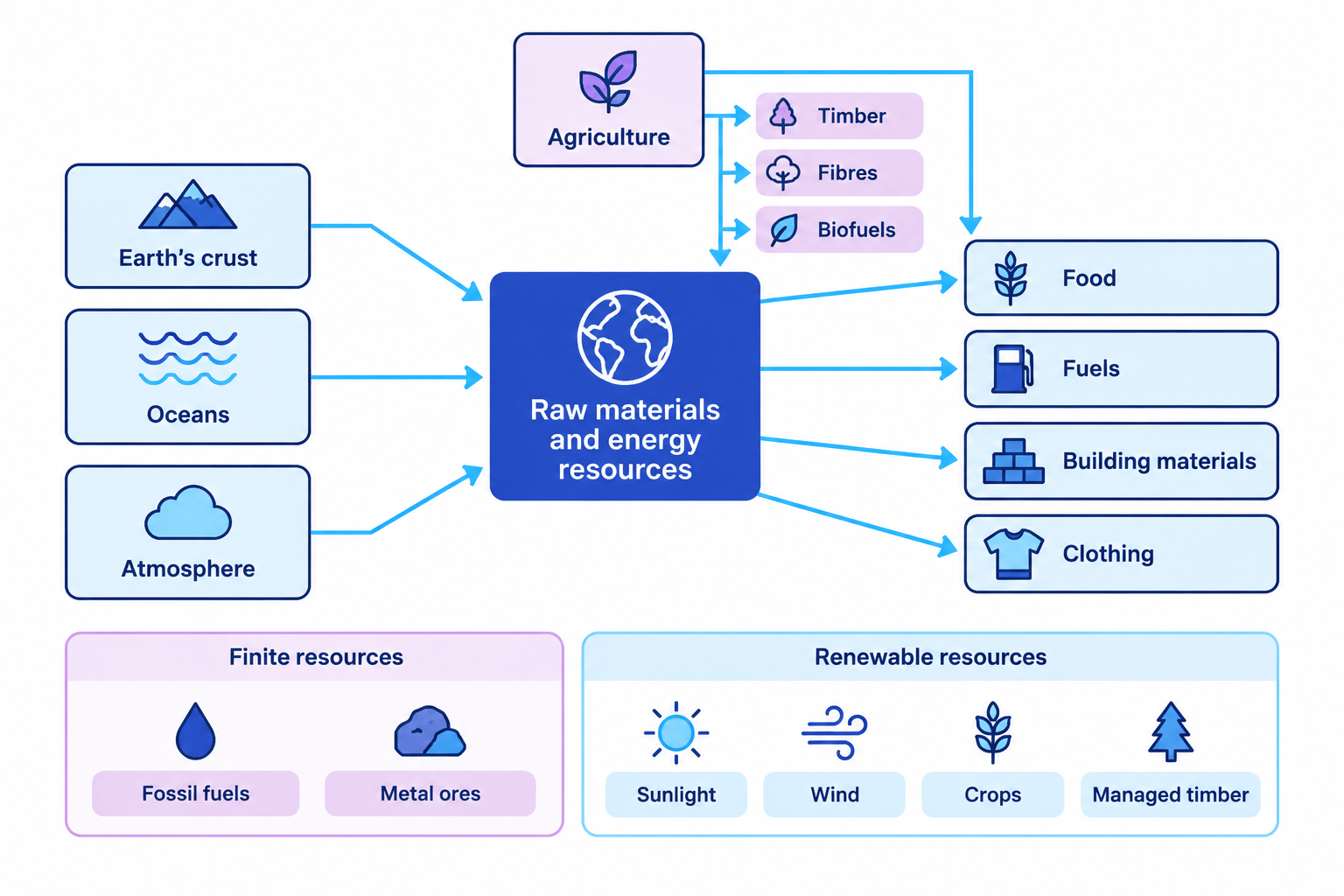
Earth's resources become the energy and materials you use
Definition
Agriculture
The growing of crops, rearing of animals and management of biological resources to provide food, materials and fuels.
- A natural resource is a material or feature of the Earth that people use to meet their needs.
- People rely on resources for warmth, shelter, food and transport.
- Natural resources, supplemented by agriculture, provide food, timber, clothing and fuels.
- Resources are taken from the Earth's crust, the oceans and the atmosphere.
- These raw materials are then processed into useful energy and materials.
- Some resources, including fossil fuels and metal ores, exist in limited amounts.
Key Idea
- The Earth supplies the raw materials used to make products and generate energy.
- Processing turns those raw materials into fuels, building materials, clothing and more.
Agricultural and synthetic products supplement or replace natural products
Definition
Natural product
A material or substance obtained from nature rather than manufactured synthetically.
Definition
Synthetic product
A product manufactured through chemical processes rather than obtained in its final form directly from nature.
- Food: agriculture supplements wild food by growing crops, rearing livestock and farming fish.
- Fish farms can reduce the pressure on wild fish populations.
- Timber: managed plantations supplement timber taken from natural forests.
- Trees can be replanted after harvesting if the forest is managed responsibly.
- Clothing: cotton and wool are agricultural products spun into natural fibres.
- Synthetic fibres such as polyester and nylon can supplement or replace cotton and wool.
- Materials: synthetic rubber can supplement or replace the natural rubber tapped from trees.
- Fuels: crops grown for biofuels supplement fuels taken from finite resources.
Example
- A waterproof coat may use polyester in place of cotton or wool.
- A new-build house may use timber from a managed plantation rather than a natural forest.
- A car tyre often contains synthetic rubber alongside natural rubber from trees.
Replacement rate separates finite resources from renewable resources
Definition
Fossil fuel
A finite fuel, such as coal, oil or natural gas, formed from the remains of ancient organisms over millions of years.
- A finite resource is used up faster than it is replaced, so its supply will eventually run out.
- Fossil fuels and metal ores are finite because they form far too slowly to replace what is extracted.
- A renewable resource is replenished naturally at least as fast as it is used.
- Sunlight and wind are renewable because using them does not reduce the future supply.
- Timber and crops can be renewable, but only if they are replanted and given time to regrow.
Common Mistake
- Do not assume a resource is renewable just because it occurs naturally.
- Fossil fuels are natural, yet finite, because they are used far faster than they form.
- Renewable does not mean unlimited: poor management can use a biological resource faster than it regrows.
Sustainable development meets present needs without removing future choices
- Sustainable development meets the needs of people today without stopping future generations from meeting their own needs.
- Using resources sustainably means not wasting finite raw materials and energy.
- It also means using renewable resources no faster than they can be replaced.
- Chemistry improves agricultural processes by raising food production or cutting the resources wasted.
- Chemistry improves industrial processes by using fewer raw materials, less energy or making less waste.
- A catalyst can let an industrial reaction run at a lower temperature, saving energy.
- Chemistry also develops new products that supplement or replace those made from scarce natural resources.
Note
- A synthetic product is not automatically more sustainable than a natural one.
- Weigh the resources and energy used to make it against the pressure it takes off a limited natural supply.
- Chemistry can slow the use of a finite resource, but it cannot make that resource renewable.
Reading resource data: check the scale before you compare
- Resource information is often given in charts, graphs and tables.
- First identify the resource, the time period and the units used.
- Check the scale carefully, because axes may rise in thousands, millions or unequal steps.
- Read the values accurately and only compare quantities measured in the same units.
- An order of magnitude is a factor of ten.
- A quantity ten times larger is one order of magnitude larger.
- A quantity one hundred times larger is two orders of magnitude larger, because 100=102100 = 10^2100=102.
- A quantity one thousand times larger is three orders of magnitude larger, because 1000=1031000 = 10^31000=103.
- Worked example: Resource A is used at 4×1064 \times 10^64×106 tonnes per year and Resource B at 4×1034 \times 10^34×103 tonnes per year.
- Dividing the larger value by the smaller gives 4×1064×103=103\dfrac{4 \times 10^6}{4 \times 10^3} = 10^34×1034×106=103.
- Resource A is therefore used one thousand times faster, a difference of three orders of magnitude.
Exam technique
- To compare two quantities, divide the larger by the smaller and write the result as a power of ten to read off the difference in orders of magnitude.
- Always quote the figures from the chart or table; a comparison with no numbers rarely gains full marks.
Judging whether resource use can continue
- A large supply does not prove a resource is renewable, because it may never be replaced after use.
- A renewable resource can still be used unsustainably if it is consumed faster than it is replaced.
- For a finite resource, compare the amount available with the rate of extraction.
- For a renewable biological resource, compare the rate of harvesting with the rate of regrowth.
- Use orders of magnitude to decide whether a numerical difference is small or large.
- A strong conclusion names the resource, states whether its use looks sustainable, and quotes data to back the judgement.
Self review
- What four human needs are supported by the Earth's resources?
- Give one agricultural product and one synthetic product that can replace it.
- What is the difference between a finite resource and a renewable resource?
- What is meant by sustainable development?
- How many orders of magnitude separate 6×1076 \times 10^76×107 and 6×1036 \times 10^36×103?