Potable water: safe to drink does not mean chemically pure
Definition
Microbe
A microscopic organism, some types of which can cause disease if present in drinking water.
Definition
Dissolved solids
Substances dissolved in water that remain as a solid residue when the water is evaporated.
- Water of an appropriate quality is essential for life.
- Potable water is water that is safe to drink because it has sufficiently low levels of dissolved salts and harmful microbes.
- Pure water in the chemical sense contains only H2O\text{H}_2\text{O}H2O molecules and no dissolved substances.
- Potable water is not chemically pure, because it can still contain small, safe amounts of dissolved substances.
Key Idea
- Potable describes whether water is safe to drink.
- Pure describes whether a substance contains only one compound.
- Potable water does not need a pH of exactly 7.
Fresh water treatment: filtration removes solids and sterilisation reduces microbes
Definition
Fresh water
Water that contains low levels of dissolved salts.
Definition
Filter bed
A layer of material, such as sand or gravel, that traps suspended insoluble particles as water passes through it.
Definition
Sterilisation
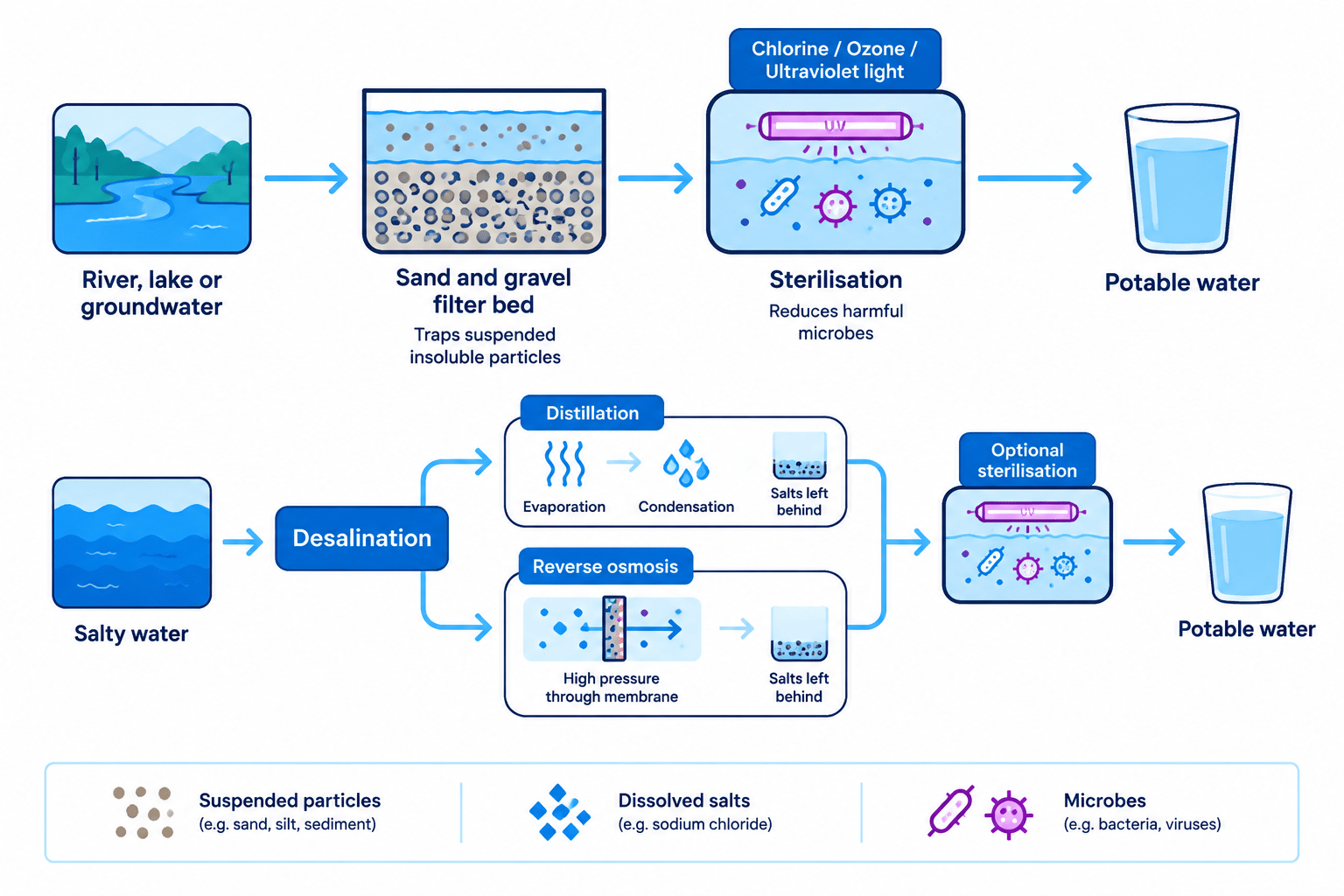
The treatment of water with chlorine, ozone or ultraviolet light to reduce harmful microbes to safe levels.
- Choose a suitable source: most potable water begins as fresh water from groundwater, lakes or rivers, because rain provides water with low levels of dissolved substances.
- A good source has manageable levels of pollutants, dissolved salts and microbes.
- Pass the water through filter beds: layers of sand and gravel trap suspended, insoluble particles such as soil and plant matter.
- Filtration does not remove dissolved salts or reliably kill microbes.
- Sterilise the water: chlorine, ozone or ultraviolet light reduces harmful microbes to safe levels.
- Chlorine and ozone are added chemicals that kill microbes; ultraviolet light damages microbes so they cannot reproduce.
Note
- When you explain a treatment step, name the unwanted material and say how the step removes it.
- Filter beds remove insoluble particles, while sterilisation reduces harmful microbes.
Desalination: salty water needs its dissolved salts removed
Definition
Distillation
A separation process in which a liquid is evaporated and then condensed so that it can be collected.
- Desalination is needed where supplies of fresh water are limited.
- Ordinary filter beds cannot remove salt from sea water because the salt is dissolved, not suspended.
- Distillation separates water from dissolved salts: the salty water is heated so the water evaporates, then the vapour is cooled and condensed while the salts stay behind.
- Reverse osmosis uses high pressure to force water molecules through a membrane, leaving the dissolved salts behind.
- Both methods need large amounts of energy, for heating in distillation and for producing high pressure in reverse osmosis.
Common Mistake
- Do not say that ordinary filtration removes dissolved salts.
- Filtration traps insoluble particles, while desalination separates dissolved salts from the water.
Choosing the treatment: groundwater is cleaned, salty water has salt removed
- The treatment method depends on the available supplies of water and local conditions.
- Groundwater usually has low levels of dissolved salts, so it can be filtered if needed and then sterilised.
- Salty water contains too much dissolved salt to be made potable by filtration and sterilisation alone.
- Salty water must first be desalinated by distillation or reverse osmosis, and the product may then be sterilised.
- UK supplies usually start with fresh water because treating it needs far less energy than desalinating sea water.
- Areas with little fresh water may rely on desalination despite its high energy cost.
Practical
Analysing a water sample: pH and dissolved solids
- Collect about 10 cm310\ \text{cm}^310 cm3 of each water sample to be tested; the source of the water is the independent variable, and the pH and the mass of dissolved solids are the dependent variables.
- Use universal indicator paper or solution to measure the pH of each sample and compare it with the pH of pure water.
- Accurately weigh an empty evaporating basin and record its mass to two decimal places.
- Pour 10 cm310\ \text{cm}^310 cm3 of the water sample into the basin.
- Heat the basin on a tripod and gauze with a Bunsen burner until dissolved solids start to appear and most of the water has evaporated.
- Let the basin cool, then reweigh it: mass of dissolved solids=mass of basin and residue−mass of empty basin\text{mass of dissolved solids} = \text{mass of basin and residue} - \text{mass of empty basin}mass of dissolved solids=mass of basin and residue−mass of empty basin.
- Heat gently near the end so hot solid does not spit out, and use the same volume for every sample so the comparison is fair.
- Record the pH and the mass of dissolved solids in 10 cm310\ \text{cm}^310 cm3 for each sample in a table so the sources can be compared.
Purifying the water by distillation
- Place about 10 cm310\ \text{cm}^310 cm3 of the sample in a conical flask fitted with a delivery tube and bung, clamped to a stand.
- Rest the delivery tube in a boiling tube standing in an ice bath, keeping the tube end at least 2 cm2\ \text{cm}2 cm above any collected liquid to avoid suck-back.
- Heat with a Bunsen burner until the water boils, then reduce the heat so it boils gently, removing the heat if the sample looks likely to boil over into the delivery tube.
- The water evaporates, passes along the delivery tube and condenses in the cooled boiling tube, while the dissolved solids stay behind in the flask.
- Collect about 1 cm1\ \text{cm}1 cm depth of distillate, then stop heating.
- Check the distillate is pure by finding its boiling point: pure water boils at 100 ∘C100\,^{\circ}\text{C}100∘C, and evaporating the distillate leaves little or no residue.
Reading the results: residue and boiling point reveal how pure the water is
- A sample with more dissolved solids leaves a greater mass of residue when equal volumes are evaporated.
- The distillate should leave little or no residue and boil at 100 ∘C100\,^{\circ}\text{C}100∘C, showing it is close to pure.
- These tests cannot prove the water is safe to drink, because they do not show whether harmful microbes are present.
Self review
- What is the difference between potable water and pure water?
- Name the three agents used to sterilise fresh water.
- Why can filtration not make sea water potable?
- Describe how distillation separates pure water from a salty sample.
- How would you calculate the mass of dissolved solids in a 10 cm310\ \text{cm}^310 cm3 sample?