Typical properties
What you'll learn
- The three “typical properties” of many transition metal compounds.
- How the same transition metal can form ions with different charges.
- Examples of coloured compounds of chromium, manganese, iron, cobalt, nickel and copper.
- Why transition metals and their compounds are often useful catalysts.
This is part of the separate Chemistry content, so it is worth having a few clear examples ready to use in exam answers.
Starting point: what are transition elements?
The transition elements are the metals in the central block of the periodic table. At GCSE, the important examples for this section are chromium (Cr), manganese (Mn), iron (Fe), cobalt (Co), nickel (Ni) and copper (Cu).
A compound is a substance made from two or more elements chemically joined. Many transition metal compounds are ionic: they contain positive metal ions and negative ions.
Ion
An ion is an atom or group of atoms with an electrical charge because it has gained or lost electrons. A positive ion is called a cation; most metal ions are cations.
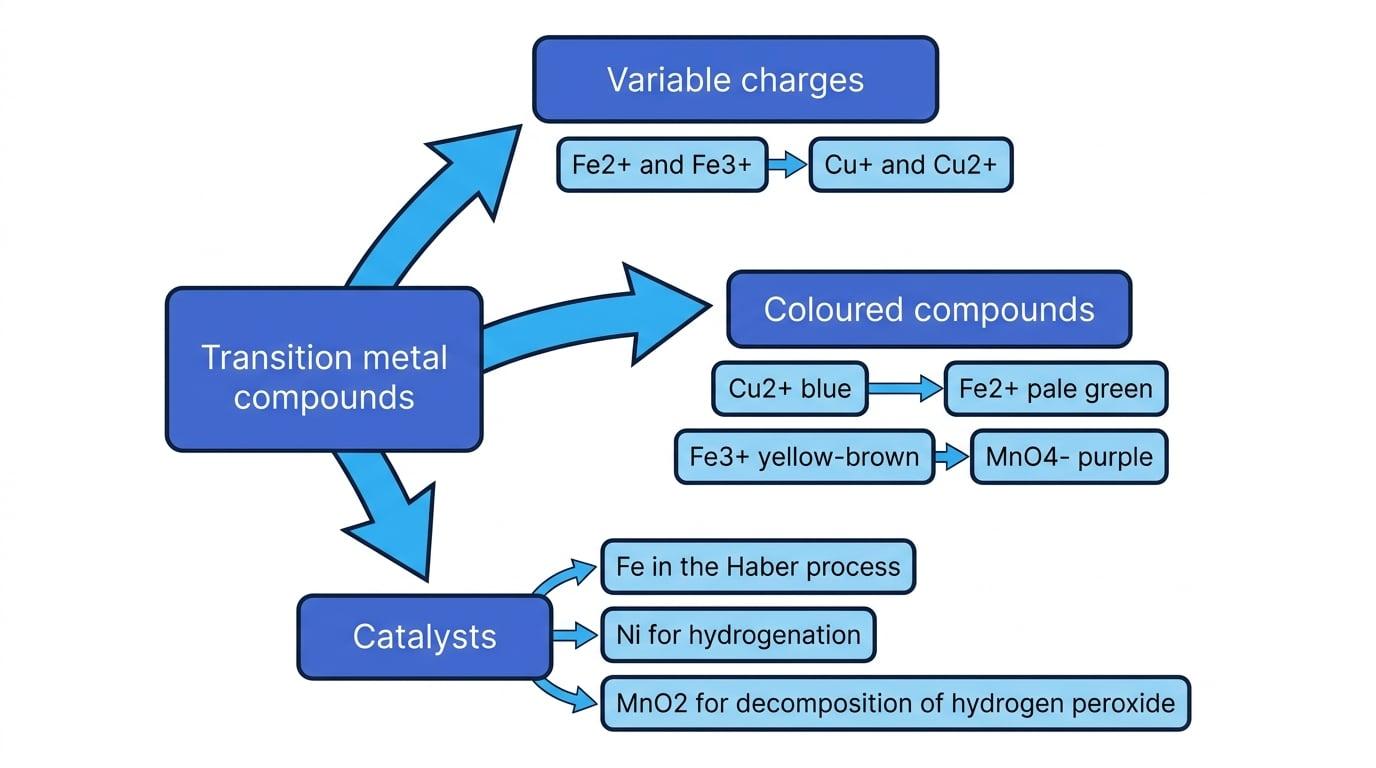
The summary map below connects the three key properties you need: variable charges, coloured compounds and catalytic uses.

The big GCSE pattern
Many transition elements have ions with different charges, form coloured compounds and are useful as catalysts.
Remember the three Cs
For transition metal compounds, think charges, colours, catalysts: variable charges, often coloured compounds and useful catalysts.
1. Ions with different charges
Some metals form only one common positive ion. For example, sodium usually forms Na+ and magnesium usually forms Mg2+.
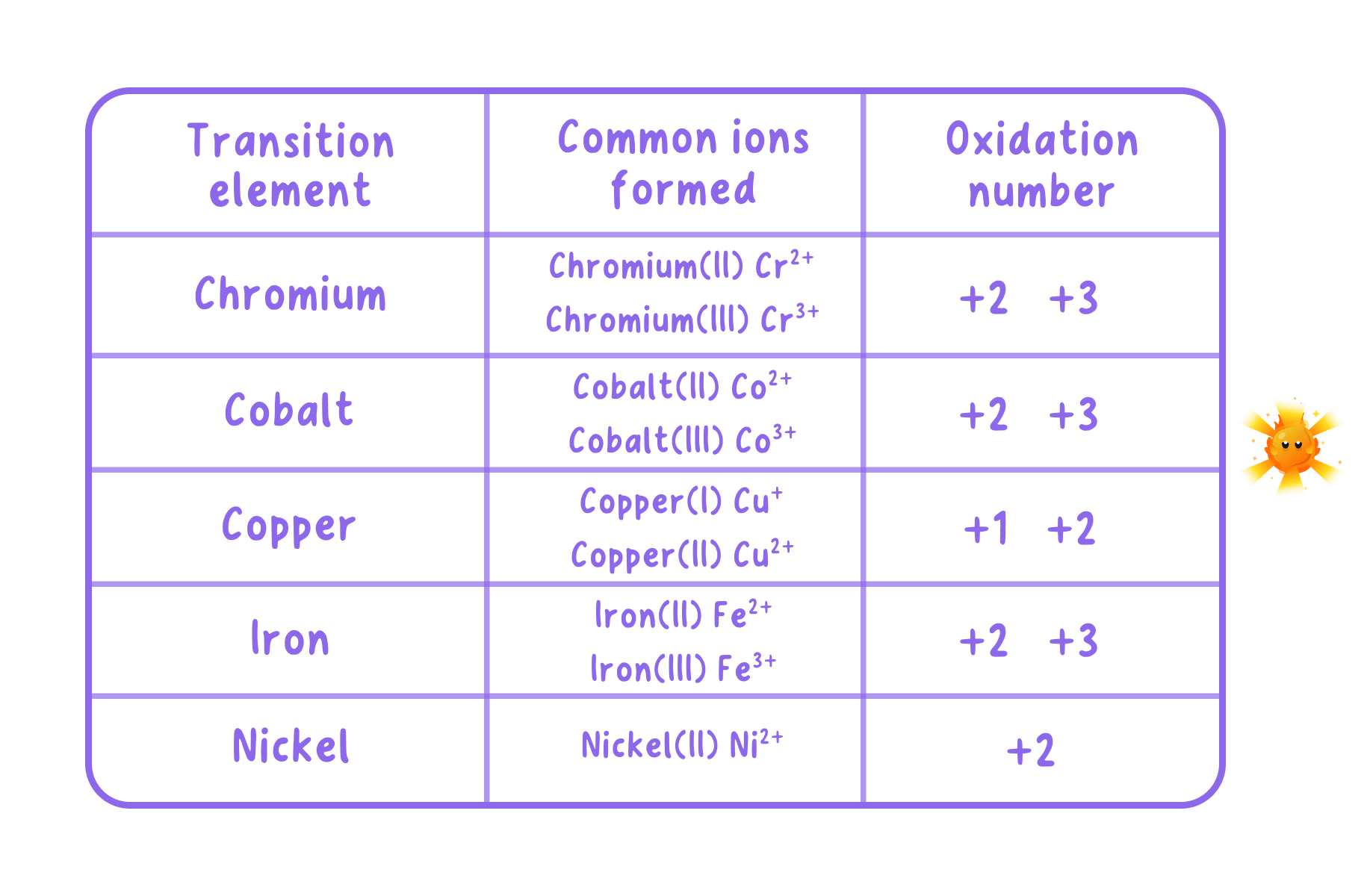
Transition metals are different: the same element can often form ions with different positive charges. For example:
- iron can form Fe2+ and Fe3+
- copper can form Cu+ and Cu2+
- manganese appears in compounds with several different oxidation states, such as +2, +4 and +7
Oxidation state
An oxidation state is the charge an atom is treated as having in a compound or ion. In simple metal ions such as Fe3+, the oxidation state is the same as the ion charge.
Roman numerals in compound names
Transition metal compounds often use Roman numerals in their names. The Roman numeral tells you the charge or oxidation state of the transition metal.
For example:
- iron(II) chloride contains Fe2+
- iron(III) chloride contains Fe3+
- copper(I) oxide contains Cu+
- copper(II) sulfate contains Cu2+
Examples you can quote
| Element | Useful GCSE examples |
|---|---|
| Chromium, Cr | chromium(III) compounds contain Cr3+; chromium(VI) compounds include chromate(VI) and dichromate(VI) ions |
| Manganese, Mn | manganese(II) compounds contain Mn2+; manganese dioxide, MnO2, contains manganese(IV); manganate(VII) ions are purple |
| Iron, Fe | iron(II) compounds contain Fe2+; iron(III) compounds contain Fe3+ |
| Cobalt, Co | cobalt(II) compounds contain Co2+; cobalt(III) compounds also exist |
| Nickel, Ni | nickel(II) compounds contain Ni2+; nickel compounds are often green |
| Copper, Cu | copper(I) compounds contain Cu+; copper(II) compounds contain Cu2+ |
Naming iron chlorides from their formulas
-
For FeCl2, let the charge on the iron ion be xxx. Chloride ions each have charge −1-1−1, so the two chloride ions have total charge 2×(−1)=−22 \times (-1) = -22×(−1)=−2.
-
The compound is neutral overall, so the total charge must be zero: x+(−2)=0x + (-2) = 0x+(−2)=0. Therefore x=+2x = +2x=+2, so the compound is iron(II) chloride.
-
For FeCl3, the three chloride ions have total charge 3×(−1)=−33 \times (-1) = -33×(−1)=−3. So x+(−3)=0x + (-3) = 0x+(−3)=0, giving x=+3x = +3x=+3, so the compound is iron(III) chloride.
Roman numerals do not count atoms
The “III” in iron(III) chloride means the iron ion is Fe3+. It does not mean there are three iron atoms.
2. Coloured compounds
Many transition metal compounds are coloured. This is a very useful contrast with many Group 1 and Group 2 compounds, which are often white solids or colourless solutions.
The colour is usually linked to the transition metal ion present, but the exact shade can depend on the other ions or molecules in the compound.
Colour examples to recognise
| Ion or compound | Typical colour |
|---|---|
| Cu2+ compounds, such as copper(II) sulfate solution | blue |
| Fe2+ compounds | pale green |
| Fe3+ compounds | yellow, orange or brown |
| Ni2+ compounds | green |
| Co2+ compounds | pink in many solutions; cobalt(II) chloride can be blue when anhydrous |
| Cr3+ compounds | green |
| Dichromate(VI) compounds | orange |
| Manganate(VII) ion, MnO4− | purple |
| Manganese dioxide, MnO2 | black or dark brown |
You do not usually need to memorise every possible shade, but you should be able to give clear examples, such as copper(II) compounds are often blue or manganate(VII) is purple.
Using colour to suggest a transition metal compound
-
Suppose a solution is described as blue. That observation makes a transition metal compound likely, because many transition metal ions form coloured solutions.
-
Compare the colour with known examples. Blue is strongly associated at GCSE with Cu2+ compounds, such as copper(II) sulfate solution.
-
A sensible conclusion is that the solution may contain copper(II) ions, Cu2+. You would still need chemical tests to confirm this if the question asks for proof.
Do not say every transition metal compound is coloured
The safe exam wording is many transition metal compounds are coloured. Some may be very pale or not obviously coloured, and the colour can change with the compound.
3. Transition metals as catalysts
A catalyst speeds up a chemical reaction without being used up overall. It may take part during the reaction, but it is regenerated by the end.
Catalyst
A catalyst is a substance that increases the rate of a chemical reaction and is not used up overall.
Transition metals and their compounds are often good catalysts. This is one reason they are very important in industry.
Catalyst examples to quote
| Catalyst | Reaction or process | Why it matters |
|---|---|---|
| Iron, Fe | Haber process: N2(g) + 3H2(g) ⇌ 2NH3(g) | makes ammonia for fertilisers |
| Nickel, Ni | hydrogenation of vegetable oils using hydrogen gas | makes margarine and spreads |
| Manganese dioxide, MnO2 | decomposition of hydrogen peroxide | speeds up oxygen production |
For hydrogen peroxide decomposition:
2H2O2(aq) → 2H2O(l) + O2(g)
MnO2(s) is a catalyst in this reaction.
Deciding whether manganese dioxide is a catalyst
-
Compare the reaction rate. If hydrogen peroxide produces oxygen much faster when MnO2(s) is added, then MnO2 is increasing the rate of reaction.
-
Check whether the substance is used up overall. If the black MnO2(s) remains at the end and can be separated and reused, it has not been consumed overall.
-
Since it speeds up the reaction and is not used up overall, MnO2(s) is acting as a catalyst.
A catalyst is not a reactant
Do not put the catalyst as a normal reactant that gets used up. In word explanations, say it speeds up the reaction without being used up overall.
Pulling the topic together
When an exam question asks for the “typical properties” of transition metals, it is usually looking for a comparison with simpler metals such as Group 1 metals.
A strong answer might say:
- transition metals can form ions with different charges, such as Fe2+ and Fe3+
- many transition metal compounds are coloured, such as blue Cu2+ compounds or purple manganate(VII)
- transition metals and their compounds can act as catalysts, such as iron in the Haber process or MnO2 in hydrogen peroxide decomposition
In the exam
-
If asked for typical properties, give the property and an example: “iron forms Fe2+ and Fe3+” is better than “different charges”.
-
Use Roman numerals carefully: iron(II) means Fe2+, while iron(III) means Fe3+.
-
For catalysts, always include the key phrase: speeds up the reaction without being used up overall.
Check yourself
- What is the difference between iron(II) chloride and iron(III) chloride?
- Name two coloured transition metal compounds or ions and give their colours.
- How could you tell from observations that manganese dioxide is acting as a catalyst?