x

Revision notes for AQA GCSE Chemistry Comparison with Group 1 elements. Open the guide for explanations and worked examples. Written against the AQA GCSE Chemistry (8462) specification, so the content matches what's examinable rather than general Chemistry background.

Comparison with Group 1 elements

What you'll learn

  • Where transition metals and Group 1 metals are found in the periodic table.
  • How their melting points, densities, strength and hardness compare.
  • How their reactions with oxygen, water and halogens are different.
  • How to use examples such as Cr, Mn, Fe, Co, Ni and Cu in exam answers.

The big picture

This is part of the transition metals topic in GCSE Chemistry. You are comparing two sets of metals:

  • Group 1 metals, such as lithium, sodium and potassium.
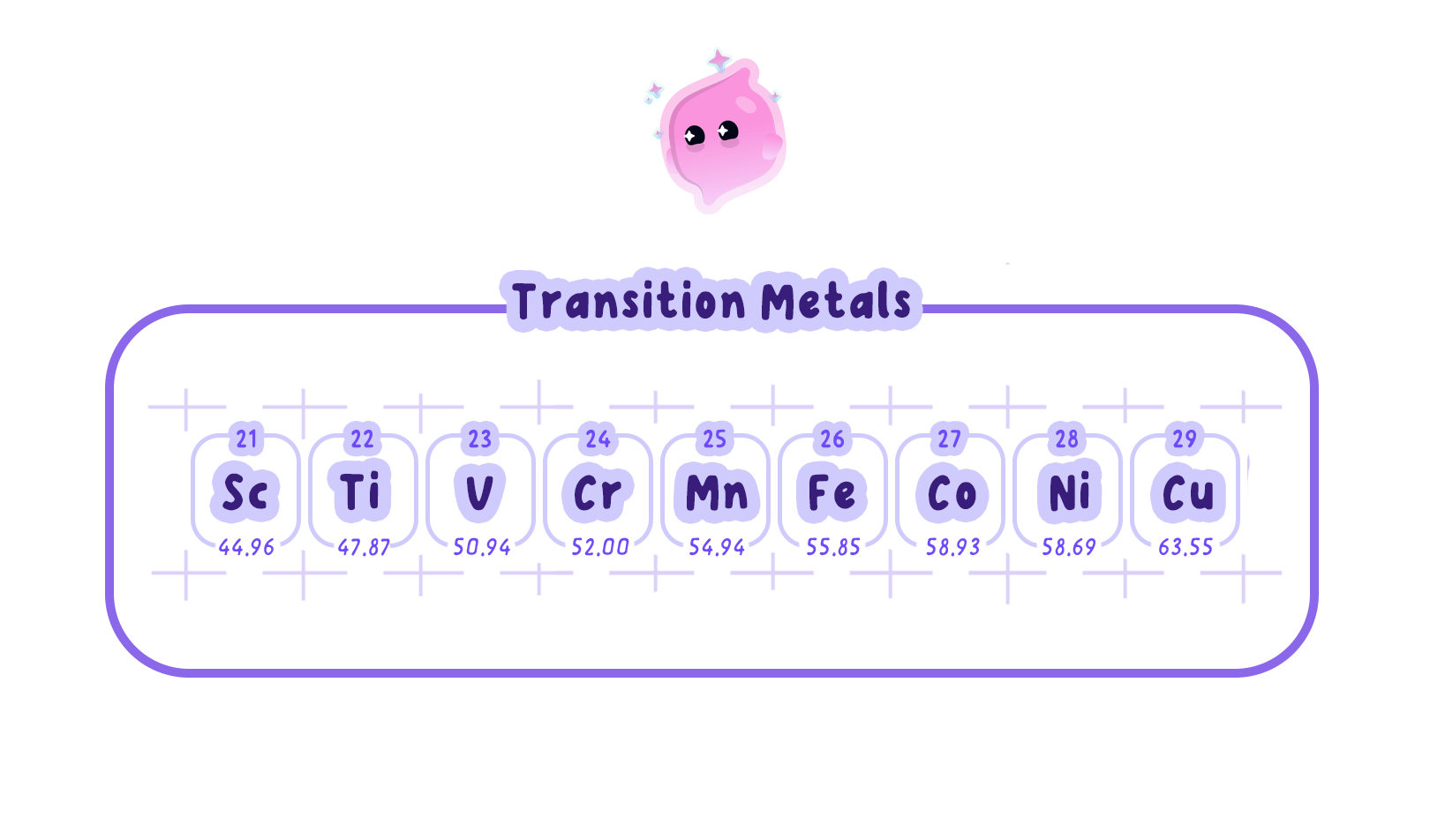
  • Transition metals, especially chromium, manganese, iron, cobalt, nickel and copper.

Both groups are metals, but they behave very differently.

Here is a simplified map of where the two sets of elements sit in the periodic table.

Simplified periodic table showing Group 1 metals and the transition metals Cr, Mn, Fe, Co, Ni and Cu

Definition

Group 1 elements

Group 1 elements, also called alkali metals, are the metals in the first column of the periodic table, such as lithium (Li), sodium (Na) and potassium (K). They form alkaline solutions when they react with water.

Definition

Transition elements

At GCSE, transition elements are the metals in the central block of the periodic table. The key examples here are chromium (Cr), manganese (Mn), iron (Fe), cobalt (Co), nickel (Ni) and copper (Cu).

Both groups are metals

A metal is an element that usually conducts electricity and heat, is often shiny when freshly cut or polished, and tends to form positive ions.

So Group 1 metals and transition metals do share some general metal properties. For example, sodium and copper both conduct electricity.

The key GCSE point is that transition metals are generally:

  • stronger
  • harder
  • denser
  • higher melting point
  • less reactive

than Group 1 metals.

Key Idea

The big comparison

Transition metals are generally harder, stronger, denser and have higher melting points than Group 1 metals, and they are less reactive with oxygen, water and halogens.

Physical properties

Melting point

The melting point is the temperature at which a solid changes into a liquid.

Group 1 metals have relatively low melting points. For example, sodium melts at about 98 °C, so it can melt in hot water.

Transition metals usually have much higher melting points. Iron, nickel, copper, chromium and cobalt all need very high temperatures before they melt.

That is one reason transition metals are useful for objects that must stay solid and strong when heated, such as machinery, tools and structural materials.

Density

Density means mass per unit volume. In simpler terms, it tells you how much mass is packed into a certain amount of space.

Group 1 metals have low densities. Lithium, sodium and potassium are so low-density that they float on water.

Transition metals have much higher densities. Iron, nickel, copper, cobalt and chromium feel much “heavier for their size” than Group 1 metals.

Example

Calculating density to compare metals

A metal cube has a mass of 39.3 g and a volume of 5.0 cm³. Is its density more like a Group 1 metal or a transition metal?

  1. Use the relationship density = mass divided by volume, because density compares how much mass is packed into each cubic centimetre.

  2. Substitute the values: density=39.3 g5.0 cm3=7.86 g/cm3\text{density} = \frac{39.3\ \text{g}}{5.0\ \text{cm}^3} = 7.86\ \text{g}/\text{cm}^3density=5.0 cm339.3 g​=7.86 g/cm3.

  3. Compare this with sodium, which has a density of about 0.97 g/cm³. Since 7.860.97≈8.1\frac{7.86}{0.97} \approx 8.10.977.86​≈8.1, the cube is much denser than sodium and is more like a transition metal such as iron.

Strength and hardness

Strength is how well a material resists breaking when a force is applied.

Hardness is how well a material resists being scratched, cut or dented.

Group 1 metals are very soft. Sodium and potassium can be cut with a knife. They are not suitable for strong structures.

Transition metals are usually much stronger and harder. Iron is used in buildings and bridges, chromium is hard and shiny, and nickel is used in alloys and coatings.

Common Mistake

Strength and hardness are not the same

A material can be strong without being the hardest material. In this topic, you only need the general comparison: transition metals are usually stronger and harder than Group 1 metals.

Chemical reactivity

Reactivity means how easily a substance reacts chemically with other substances.

Group 1 metals are very reactive. They react quickly with oxygen, water and halogens.

Transition metals are less reactive. Some still react, especially when heated, but the reactions are usually slower or need more energy to start.

Reaction with oxygen

Oxygen is the gas in air that many metals react with to form metal oxides.

Group 1 metals react rapidly with oxygen. A freshly cut piece of sodium quickly becomes dull because sodium oxide forms on the surface:

4Na(s) + O₂(g) → 2Na₂O(s)

Transition metals usually react more slowly with oxygen. Some need heating before they react noticeably. For example, copper forms black copper oxide when heated in oxygen:

2Cu(s) + O₂(g) → 2CuO(s)

Iron can also react with oxygen, especially in moist air, forming rust over time. Rusting is slower than the fast reactions of Group 1 metals.

Reaction with water

Group 1 metals react with cold water. The products are a metal hydroxide and hydrogen gas.

For sodium:

2Na(s) + 2H₂O(l) → 2NaOH(aq) + H₂(g)

You would see sodium move around on the water surface, fizz, and sometimes melt into a ball because the reaction releases heat.

Transition metals are much less reactive with water. Iron, cobalt, nickel and copper do not react with cold water in the same vigorous way.

Some transition metals can react with steam when heated. For example, hot iron reacts with steam to form iron oxide and hydrogen:

3Fe(s) + 4H₂O(g) → Fe₃O₄(s) + 4H₂(g)

Copper does not react with cold water or steam, which shows how unreactive it is compared with Group 1 metals.

Reaction with halogens

Definition

Halogens

Halogens are the Group 7 non-metals, such as chlorine, bromine and iodine. When a metal reacts with a halogen, the product is a metal halide.

Group 1 metals react vigorously with halogens. For example, sodium reacts with chlorine to form sodium chloride:

2Na(s) + Cl₂(g) → 2NaCl(s)

Transition metals can react with halogens too, but usually less vigorously and often when heated. For example, iron reacts with chlorine to form iron(III) chloride:

2Fe(s) + 3Cl₂(g) → 2FeCl₃(s)

Common Mistake

Less reactive does not mean unreactive

Transition metals are less reactive than Group 1 metals, but many of them still react with substances such as oxygen or chlorine, especially when heated.

Example

Using observations to identify the type of metal

A metal is hard, does not react with cold water, and only reacts with oxygen when strongly heated. Is it more likely to be a Group 1 metal or a transition metal?

  1. Compare hardness: Group 1 metals are soft and can often be cut easily, so a hard metal is unlikely to be Group 1.

  2. Compare reaction with cold water: Group 1 metals react with cold water to produce hydrogen gas, so no reaction with cold water suggests it is less reactive.

  3. Compare reaction with oxygen: needing strong heating before reacting is typical of a less reactive metal, so the metal is more likely to be a transition metal.

Named transition metal examples

You should be able to refer to specific transition metals, not just say “transition metals” every time.

Transition metalUseful GCSE example
Chromium (Cr)Hard, shiny and used in coatings and stainless steel.
Manganese (Mn)Dense, hard, and used in alloys with other metals.
Iron (Fe)Strong, high melting point, used in construction and steel.
Cobalt (Co)Hard, dense, and has a high melting point.
Nickel (Ni)Hard, corrosion-resistant, used in alloys and plating.
Copper (Cu)Dense, conducts electricity well, and is much less reactive than Group 1 metals.
Tip

Use named examples

In comparison questions, iron and copper are very useful examples. Iron shows strength and high melting point; copper shows low reactivity with water and good metallic properties.

Summary comparison table

PropertyGroup 1 metalsTransition metals
Melting pointLowHigh
DensityLowHigh
StrengthLowHigh
HardnessSoftHard
Reaction with oxygenFast, tarnish quicklySlower, often need heating
Reaction with waterReact with cold waterLittle or no reaction with cold water
Reaction with halogensVigorousLess vigorous, often need heating
Exam technique

In the exam

  1. Make direct comparisons: write “Group 1 metals are soft, whereas transition metals are hard” rather than describing only one group.

  2. If the question mentions reactivity, say what the metal is reacting with: oxygen, water or a halogen.

  3. Use named examples such as iron, copper, chromium or nickel to support your answer when asked for examples.

Self review

Check yourself

  • Why is copper more suitable for water pipes than sodium?
  • Give two physical properties that are generally higher for transition metals than for Group 1 metals.
  • How would the reaction of sodium with water differ from the reaction of iron with cold water?

Properties of transition metals (chemistry only)

Guide 1 of 2

You've reached the end

Test yourself on this topic, or move on to the next guide.

Next guideTypical propertiesStart

How was this guide?

Comparison with Group 1 elements Revision Guide

  1. GCSE
  2. /Chemistry
  3. /Comparison with Group 1 elements