x

Revision notes for AQA GCSE Chemistry Chemical bonds. Open the guide for explanations and worked examples. Written against the AQA GCSE Chemistry (8462) specification, so the content matches what's examinable rather than general Chemistry background.

Chemical bonds

What you'll learn

  • The three types of strong chemical bond: ionic, covalent and metallic.
  • How bonding depends on whether the substance contains metals, non-metals, or both.
  • How to explain bonding using electrons and electrostatic forces.
  • How to choose the correct bonding type from a formula or description.

Before bonding: atoms, charges and electrons

Atoms are made from a tiny central nucleus containing protons and neutrons, with electrons arranged around the nucleus in shells.

  • Protons have a positive charge.
  • Electrons have a negative charge.
  • Neutrons have no charge.

In chemical bonding, the most important particles are usually the outer-shell electrons. These are the electrons in the highest occupied energy level of an atom.

Definition

Chemical bond

A chemical bond is a strong force of attraction that holds particles together in a substance.

The key idea behind this whole topic is simple: opposite charges attract. Positive particles and negative particles pull towards each other.

Definition

Electrostatic force

An electrostatic force is a force of attraction or repulsion between charged particles. In bonding, it usually means attraction between positive and negative charges.

The three strong chemical bonds

There are three types of strong chemical bond in GCSE Chemistry:

  1. Ionic bonding
  2. Covalent bonding
  3. Metallic bonding

Each type involves electrons, but in a different way.

The diagram below compares the three bonding models: electron transfer in ionic bonding, electron sharing in covalent bonding, and delocalised electrons in metallic bonding.

Comparison of ionic, covalent and metallic bonding

Key Idea

The big pattern

  • Metal + non-metal usually gives ionic bonding.
  • Non-metal + non-metal usually gives covalent bonding.
  • Metal atoms only, including alloys, have metallic bonding.

Ionic bonding: electrons are transferred

Ionic bonding happens in compounds formed from metals combined with non-metals.

A metal atom loses electron(s) to become a positive ion. A non-metal atom gains electron(s) to become a negative ion.

Definition

Ion

An ion is a charged particle formed when an atom or group of atoms gains or loses electrons.

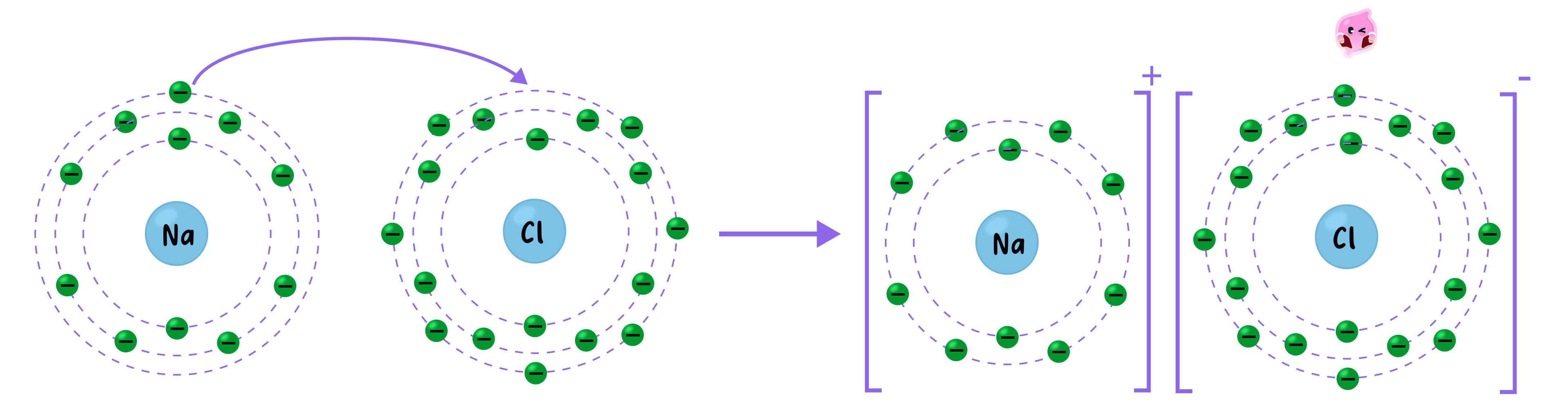
For example, sodium chloride forms when sodium atoms transfer electrons to chlorine atoms.

  • Sodium is a metal.
  • Chlorine is a non-metal.
  • Sodium loses one electron to form Na⁺.
  • Chlorine gains one electron to form Cl⁻.
  • The Na⁺ and Cl⁻ ions attract each other strongly.

That attraction is the ionic bond.

Definition

Ionic bonding

Ionic bonding is the strong electrostatic attraction between oppositely charged ions.

Notice that the bond is not the electron transfer itself. The transfer makes ions. The bond is the attraction between those ions.

Common Mistake

Saying the transfer is the bond

Do not write “an ionic bond is when electrons are transferred” as your full explanation. Electrons are transferred to form ions; the ionic bond is the strong electrostatic attraction between oppositely charged ions.

Example

Explaining ionic bonding in sodium chloride

  1. Sodium is a metal, so it tends to lose its outer electron and form a positive ion, Na⁺.

  2. Chlorine is a non-metal, so it gains one electron and forms a negative ion, Cl⁻.

  3. The oppositely charged Na⁺ and Cl⁻ ions attract each other. This strong electrostatic attraction is the ionic bond in sodium chloride.

Ionic bonding in formulae

You can often spot ionic compounds from the elements present. If the formula contains a metal and a non-metal, it is usually ionic.

Examples include:

  • sodium chloride, NaCl
  • magnesium oxide, MgO
  • calcium chloride, CaCl₂
Tip

Spotting ionic substances

Look for a metal on the left-hand side of the periodic table combined with a non-metal on the right-hand side. That is usually an ionic compound.

Covalent bonding: electrons are shared

Covalent bonding happens in most non-metallic elements and in compounds made from non-metals only.

Instead of transferring electrons, atoms share pairs of electrons. The shared electrons are attracted to the nuclei of both atoms, holding the atoms together.

Definition

Covalent bonding

Covalent bonding is the strong electrostatic attraction between the nuclei of atoms and shared pairs of electrons.

A simple example is chlorine gas, Cl₂.

Each chlorine atom has 7 electrons in its outer shell. Two chlorine atoms can share one pair of electrons. This gives each chlorine atom a full outer shell.

You do not need to think of the electrons as belonging to just one atom after sharing. The shared pair sits between the two atoms and helps hold them together.

Example

Explaining covalent bonding in chlorine

  1. Chlorine is a non-metal, so two chlorine atoms bond by sharing electrons rather than transferring them.

  2. Each chlorine atom contributes one electron to a shared pair between the atoms.

  3. The shared pair of electrons is attracted to both chlorine nuclei, creating a strong covalent bond in Cl₂.

Covalent elements and compounds

Covalent bonding occurs in many non-metal elements, such as:

  • hydrogen, H₂
  • oxygen, O₂
  • nitrogen, N₂
  • chlorine, Cl₂

It also occurs in many compounds of non-metals, such as:

  • water, H₂O
  • carbon dioxide, CO₂
  • methane, CH₄
  • ammonia, NH₃
Common Mistake

Thinking covalent means weak

Covalent bonds themselves are strong. Later, you will learn that some simple molecular substances have weak forces between molecules, but the covalent bonds inside molecules are strong.

Metallic bonding: electrons are delocalised

Metallic bonding occurs in metallic elements and alloys.

A metal contains a regular arrangement of positive metal ions surrounded by electrons that can move through the structure.

Definition

Delocalised electrons

Delocalised electrons are electrons that are not attached to one particular atom. They can move through a structure.

In a metal, the outer-shell electrons become delocalised. This leaves positive metal ions packed together. The metallic bond is the attraction between these positive ions and the delocalised electrons.

Definition

Metallic bonding

Metallic bonding is the strong electrostatic attraction between positive metal ions and delocalised electrons.

This bonding occurs in pure metals, such as iron, copper and aluminium. It also occurs in alloys, such as brass and steel.

Definition

Alloy

An alloy is a mixture of two or more elements where at least one element is a metal.

Example

Explaining metallic bonding in aluminium

  1. Aluminium is a metal, so its atoms form a structure with positive metal ions.

  2. The outer electrons become delocalised and can move throughout the metal.

  3. The strong electrostatic attraction between the positive aluminium ions and the delocalised electrons is metallic bonding.

Choosing the bonding type

In GCSE questions, you are often given a substance and asked what type of bonding it has. The fastest route is to identify the types of elements present.

Step 1: Is it a metal, non-metal, or both?

Use the periodic table:

  • Metals are mostly on the left and centre.
  • Non-metals are mostly on the right.
  • Hydrogen is a non-metal, even though it is placed on the left.

Step 2: Apply the bonding pattern

  • Metal + non-metal → ionic
  • Non-metal + non-metal → covalent
  • Metal atoms only → metallic
Example

Classifying bonding from substances

Classify the bonding in magnesium oxide, carbon dioxide and copper.

  1. Magnesium oxide contains magnesium and oxygen. Magnesium is a metal and oxygen is a non-metal, so magnesium oxide has ionic bonding.

  2. Carbon dioxide contains carbon and oxygen. Both are non-metals, so carbon dioxide has covalent bonding.

  3. Copper contains only copper atoms, which are metal atoms, so copper has metallic bonding.

Common Mistake

Rules have a GCSE purpose

These patterns work well for the substances you meet at GCSE. Later chemistry has some more complicated cases, but for this specification you should focus on metal/non-metal patterns and electron transfer or sharing.

What examiners want in explanations

For this section, naming the bond is often not enough. You should be able to explain bonding in terms of:

  • the particles involved
  • what happens to electrons
  • the electrostatic attraction present

For example, a strong answer about ionic bonding mentions:

  • oppositely charged ions
  • electrons transferred from metal atoms to non-metal atoms
  • strong electrostatic attraction between ions

A strong answer about covalent bonding mentions:

  • atoms of non-metals
  • shared pairs of electrons
  • attraction between nuclei and shared electrons

A strong answer about metallic bonding mentions:

  • positive metal ions
  • delocalised electrons
  • attraction between the positive ions and delocalised electrons
Tip

Use the word electrostatic

When explaining any strong chemical bond, include electrostatic attraction if it fits the question. It shows you understand that bonding is caused by attraction between charged particles.

Quick comparison

Bonding typeUsually found inWhat happens to electrons?Particles attracted
IonicMetal + non-metal compoundsElectrons are transferredOppositely charged ions
CovalentNon-metal elements and compounds of non-metalsPairs of electrons are sharedAtomic nuclei and shared electrons
MetallicMetals and alloysElectrons are delocalisedPositive metal ions and delocalised electrons
Exam technique

In the exam

  1. Decide whether the substance contains metals, non-metals, or both before naming the bond type.

  2. For ionic bonding, say electrons are transferred to form oppositely charged ions, then mention strong electrostatic attraction between the ions.

  3. For covalent or metallic bonding, do not describe ions unless they are really present: covalent bonding uses shared pairs of electrons, while metallic bonding uses delocalised electrons.

Self review

Check yourself

  • Why does sodium chloride have ionic bonding rather than covalent bonding?
  • What is the difference between a shared pair of electrons and delocalised electrons?
  • How would you explain metallic bonding using the words “positive ions”, “delocalised electrons” and “electrostatic attraction”?

Chemical bonds, ionic, covalent and metallic

Guide 1 of 5

You've reached the end

Test yourself on this topic, or move on to the next guide.

Next guideIonic bondingStart

How was this guide?

Chemical bonds Revision Guide

  1. GCSE
  2. /Chemistry
  3. /Chemical bonds