This question is about metals, non-metals, and chemical bonding.
Figure 1 shows an outline of part of the periodic table with regions labeled P, Q, R, and S.
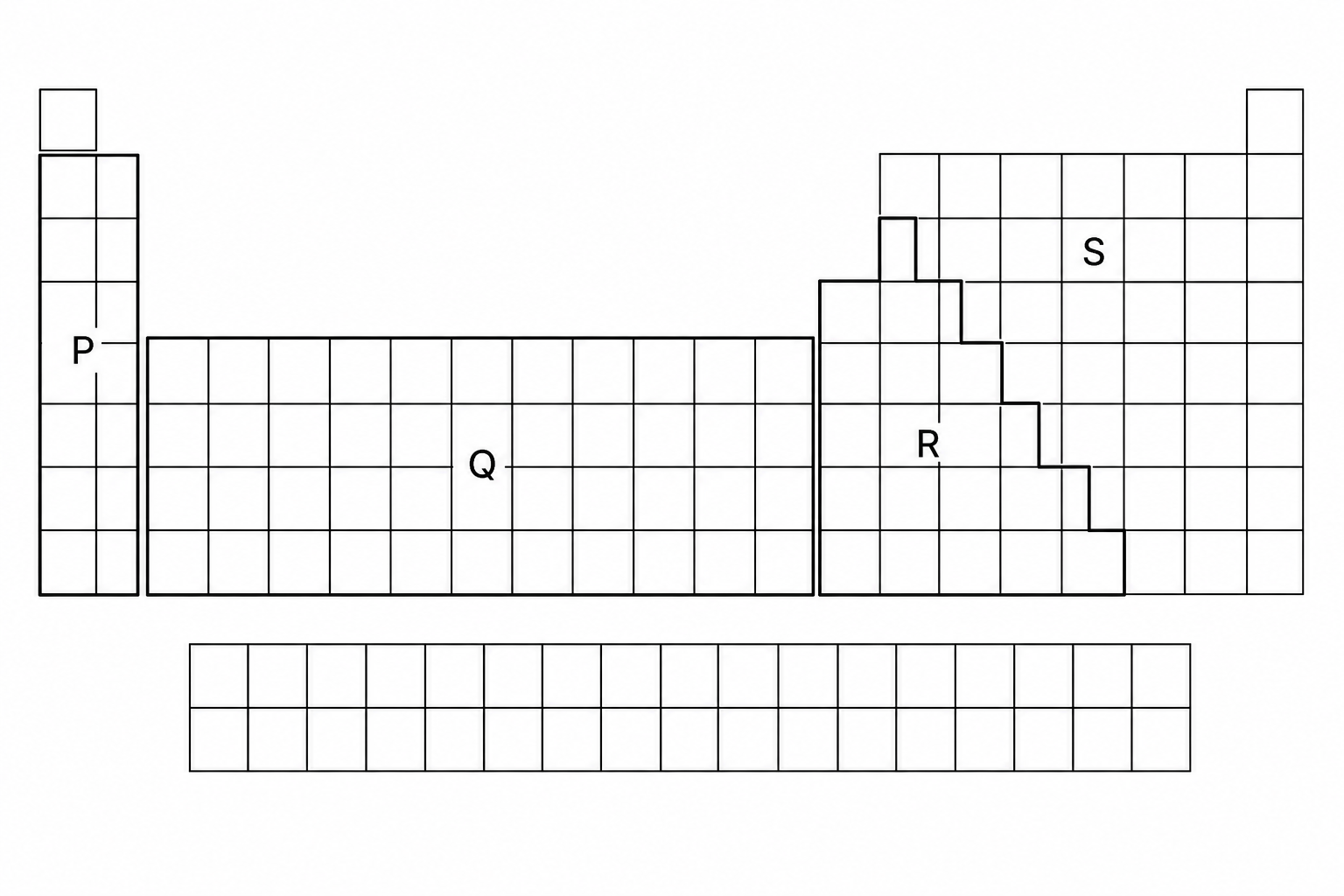
Element M is a highly reactive, soft, silvery metal with a density so low it can float on water. Which section of the periodic table in Figure 1 is most likely to contain element M?
Element T is a dense metal that can exhibit multiple stable oxidation states (such as +2 and +4) and is widely used as an industrial catalyst. Which section of the periodic table in Figure 1 is most likely to contain element T?
State two physical differences between the elements in Region Q (transition metals) and those in Region P (alkali metals).
Potassium sulfide (K2S\text{K}_2\text{S}K2S) is an ionic compound formed from the alkali metal potassium and the non-metal sulfur. Describing the process in terms of electron transfer, explain what happens when potassium atoms react with sulfur atoms to form potassium sulfide.