This question is about metals, non-metals, and chemical bonding.
Figure 1 shows an outline of part of the periodic table with regions labeled J, K, L, and M.
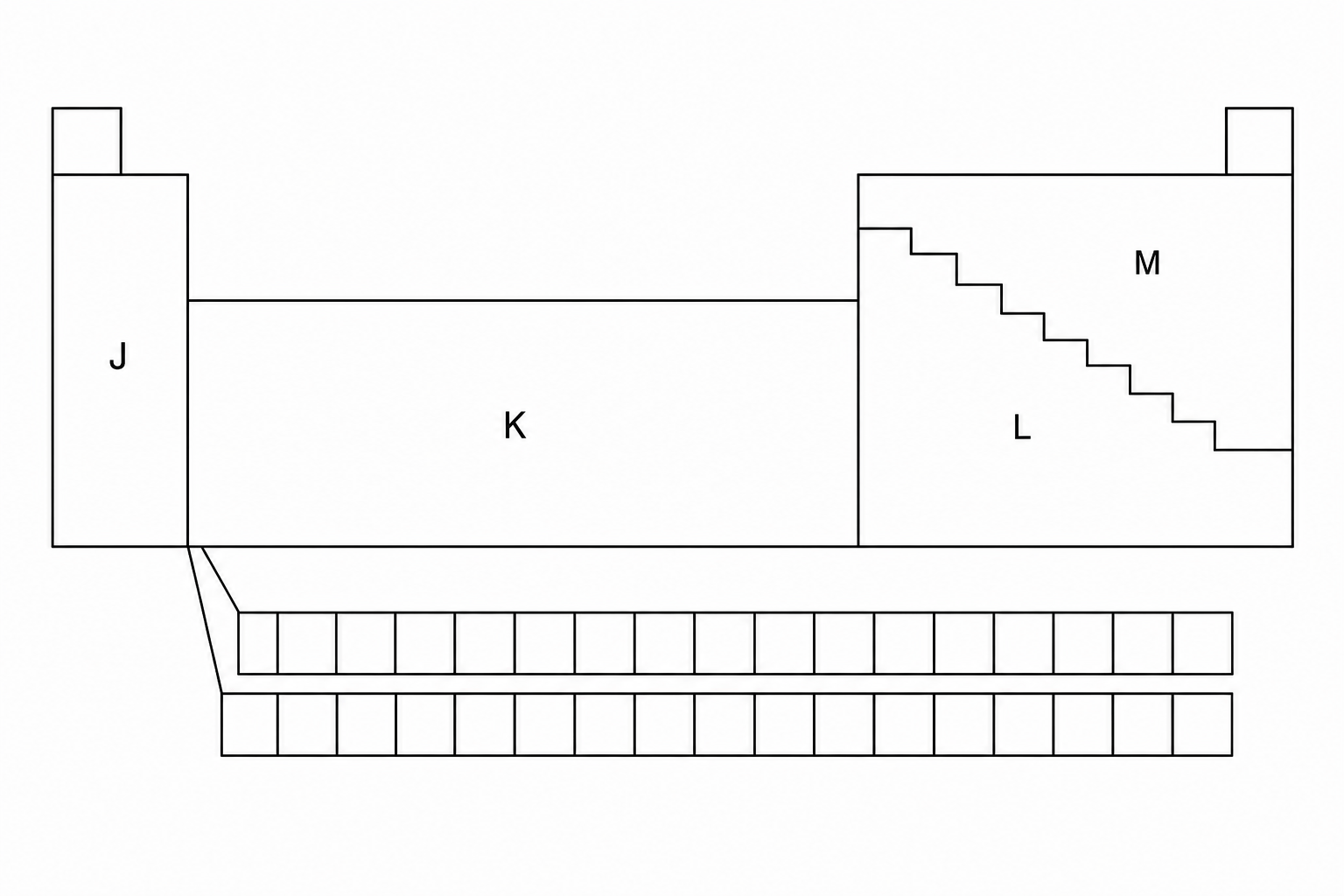
Element P is stored under oil to prevent reaction with air, has an exceptionally low density (less than water), and reacts rapidly with cold water to produce an alkaline solution and a gas that burns with a squeaky pop. Which region of the periodic table in Figure 1 is most likely to contain element P?
Element Q forms brightly coloured compounds, exhibits multiple stable oxidation states (such as +2, +4, and +7), and is frequently employed in industrial processes to speed up chemical reactions without being consumed. Which region of the periodic table in Figure 1 is most likely to contain element Q?
State two physical properties that are significantly higher or greater for elements in Region K (transition metals) compared to elements in Region J (alkali metals).
Potassium oxide (K2O\text{K}_2\text{O}K2O) is an ionic solid formed by reacting the alkali metal potassium with oxygen. By describing the electron transfer, explain how potassium atoms and oxygen atoms react to form potassium oxide.