- What a system at equilibrium means in a reversible reaction.
- How endothermic and exothermic reactions respond to temperature changes.
- How to predict whether the relative amount of products increases or decreases.
- How to interpret simple data about equilibrium mixtures at different temperatures.
Some reactions can go both ways. These are called reversible reactions. Instead of using a one-way arrow, we use the equilibrium arrow:
A(g)+B(g)⇌C(g)\text{A}(g) + \text{B}(g) \rightleftharpoons \text{C}(g)A(g)+B(g)⇌C(g)
The forward reaction makes products. The reverse reaction turns products back into reactants.
Dynamic equilibrium
A dynamic equilibrium is reached in a closed system when the forward and reverse reactions happen at the same rate, so the amounts of reactants and products stay constant.
A closed system is one where no reactants or products can escape. Equilibrium does not mean “nothing is happening”. It means both reactions are still happening, but their effects cancel out.
The position of equilibrium describes which side of the reversible reaction is favoured.
- If equilibrium lies to the right, there is a greater relative amount of products.
- If equilibrium lies to the left, there is a greater relative amount of reactants.
Relative amount
The relative amount of products means the amount of products compared with the amount of reactants in the equilibrium mixture. It does not necessarily mean the total amount of everything has increased.
This section is Higher Tier only. To predict the effect of temperature, you need to know whether the forward reaction is exothermic or endothermic.
Exothermic and endothermic reactions
An exothermic reaction transfers energy to the surroundings. An endothermic reaction takes in energy from the surroundings.
For equilibrium questions, it helps to imagine heat as if it is on one side of the reversible reaction.
Energy is released in the forward direction, so you can think of heat as being on the products side:
reactants ⇌ products + heat
For example, the Haber process is exothermic in the forward direction:
N2(g)+3H2(g)⇌2NH3(g)\text{N}_2(g) + 3\text{H}_2(g) \rightleftharpoons 2\text{NH}_3(g)N2(g)+3H2(g)⇌2NH3(g)
The forward reaction releases energy.
Energy is taken in in the forward direction, so you can think of heat as being on the reactants side:
reactants + heat ⇌ products
The temperature rule
Increasing temperature favours the endothermic direction. Decreasing temperature favours the exothermic direction.
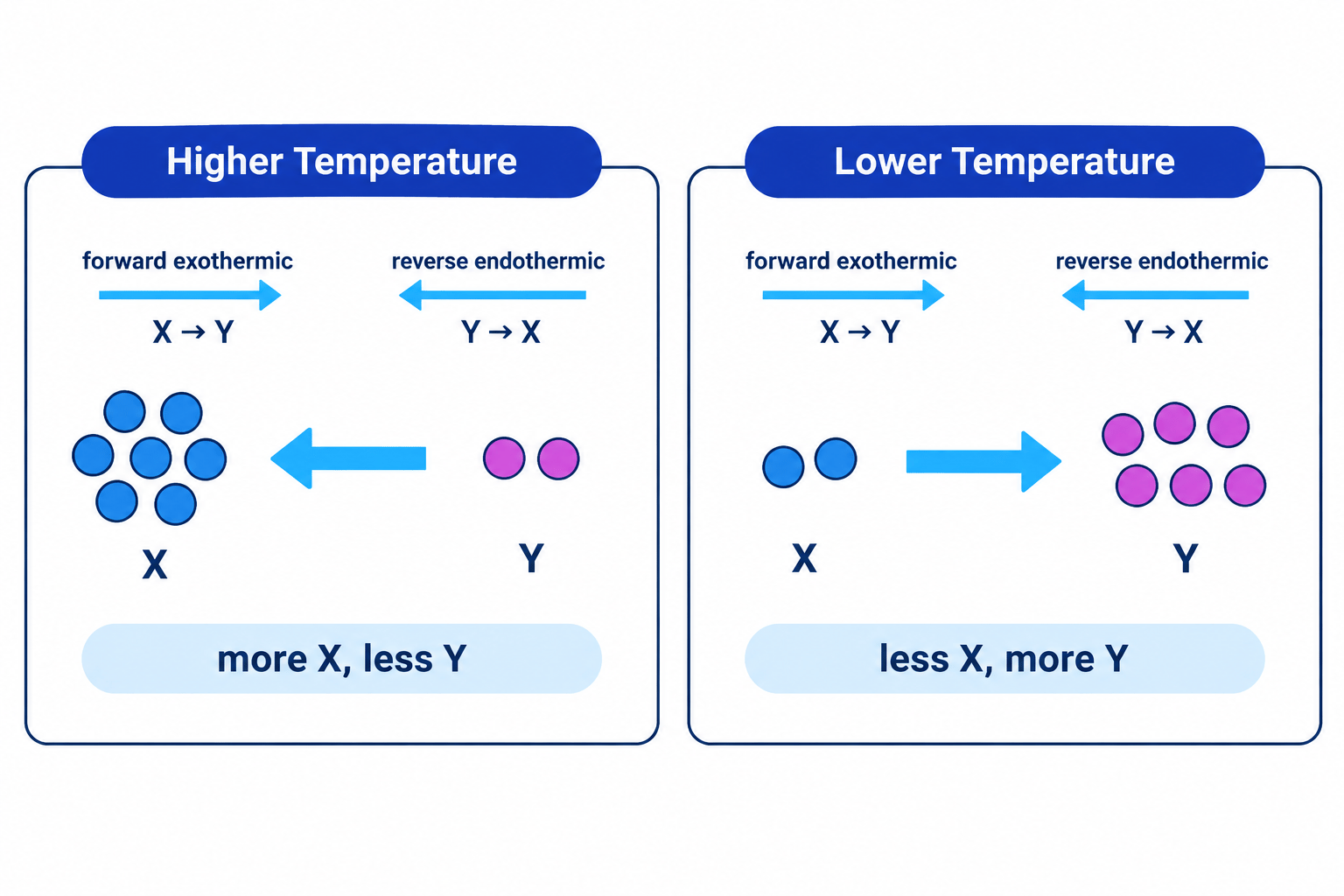
The diagram uses the “heat on one side” model to show both cases.

When you increase the temperature, you add energy to the equilibrium mixture. The equilibrium shifts in the direction that takes in energy — the endothermic direction.
If the forward reaction is endothermic, the forward reaction takes in energy.
So increasing temperature favours the forward reaction.
That means the relative amount of products at equilibrium increases.
If the forward reaction is exothermic, the reverse reaction is endothermic.
So increasing temperature favours the reverse reaction.
That means the relative amount of products at equilibrium decreases.
Predicting the effect of increasing temperature
For the equilibrium below, the forward reaction is exothermic:
N2(g)+3H2(g)⇌2NH3(g)\text{N}_2(g) + 3\text{H}_2(g) \rightleftharpoons 2\text{NH}_3(g)N2(g)+3H2(g)⇌2NH3(g)
Predict the effect of increasing temperature on the amount of ammonia, NH3(g)\text{NH}_3(g)NH3(g), at equilibrium.
- The question says the forward reaction is exothermic, so making ammonia releases energy.
- Increasing temperature favours the endothermic direction, which must be the reverse reaction here.
- The reverse reaction uses up ammonia, so the relative amount of ammonia at equilibrium decreases.
Mixing up rate and equilibrium amount
A higher temperature usually makes reactions faster, but this question is about the final equilibrium mixture, not just how quickly equilibrium is reached. Increasing temperature can make the amount of product decrease if the forward reaction is exothermic.
When you decrease the temperature, you remove energy from the equilibrium mixture. The equilibrium shifts in the direction that gives out energy — the exothermic direction.
If the forward reaction is endothermic, the reverse reaction is exothermic.
So decreasing temperature favours the reverse reaction.
That means the relative amount of products at equilibrium decreases.
If the forward reaction is exothermic, decreasing temperature favours the forward reaction.
That means the relative amount of products at equilibrium increases.
Predicting the effect of decreasing temperature
For this equilibrium, the forward reaction is endothermic:
CoCl42−(aq)+6H2O(l)⇌Co(H2O)62+(aq)+4Cl−(aq)\text{CoCl}_4^{2-}(aq) + 6\text{H}_2\text{O}(l) \rightleftharpoons \text{Co(H}_2\text{O)}_6^{2+}(aq) + 4\text{Cl}^-(aq)CoCl42−(aq)+6H2O(l)⇌Co(H2O)62+(aq)+4Cl−(aq)
Predict what happens to the relative amount of products when the temperature is decreased.
- The forward reaction is endothermic, so the reverse reaction is exothermic.
- Decreasing temperature favours the exothermic direction, so equilibrium shifts to the left.
- The products are on the right, so the relative amount of products at equilibrium decreases.
You can summarise the whole topic like this:
| Temperature change | Forward reaction is endothermic | Forward reaction is exothermic |
|---|
| Temperature increased | More products at equilibrium | Fewer products at equilibrium |
| Temperature decreased | Fewer products at equilibrium | More products at equilibrium |
Shortcut
Ask: “Which direction uses up the temperature change?” Heating favours the direction that absorbs heat. Cooling favours the direction that releases heat.
Sometimes the exam may give you data instead of directly telling you whether the reaction is exothermic or endothermic.
You may see a table showing the amount or percentage of product at different temperatures. Your job is to spot the pattern.
If increasing temperature gives more product, the forward reaction is endothermic.
If increasing temperature gives less product, the forward reaction is exothermic.
Interpreting equilibrium data
A reversible reaction reaches equilibrium at different temperatures. The table shows the percentage of product in the equilibrium mixture.
| Temperature in °C | Percentage of product |
|---|
| 200 | 68% |
| 400 | 43% |
| 600 | 21% |
Decide whether the forward reaction is exothermic or endothermic.
- Compare the percentage of product as temperature increases: from 200 °C to 600 °C, the product decreases from 68% to 21%.
- Increasing temperature has made the equilibrium mixture contain less product, so the equilibrium has shifted towards the reactants.
- Heating favours the endothermic direction. Since heating favoured the reverse direction, the reverse reaction is endothermic and the forward reaction is exothermic.
You may hear this idea described using Le Chatelier’s principle.
Le Chatelier’s principle
Le Chatelier’s principle says that if a change is made to a system at equilibrium, the equilibrium shifts in the direction that tends to oppose the change.
For temperature:
- If you heat the system, equilibrium shifts to reduce the effect of heating by favouring the endothermic direction.
- If you cool the system, equilibrium shifts to replace heat by favouring the exothermic direction.
This does not mean the system returns to exactly the original temperature. It means the equilibrium position changes in the direction that partly opposes the temperature change.
The balanced equation does not change
Changing temperature changes the position of equilibrium, not the balanced chemical equation. The formulae and balancing numbers stay the same.
A strong answer usually needs three pieces:
- State whether the forward reaction is exothermic or endothermic.
- State which direction the equilibrium shifts when temperature changes.
- State whether the relative amount of products increases or decreases.
Writing a complete prediction
The reaction below is reversible and the forward reaction is exothermic:
A(g)+2B(g)⇌C(g)\text{A}(g) + 2\text{B}(g) \rightleftharpoons \text{C}(g)A(g)+2B(g)⇌C(g)
Predict the effect of lowering the temperature on the amount of C(g)\text{C}(g)C(g) at equilibrium.
- The forward reaction is exothermic, so the forward direction releases energy.
- Lowering the temperature favours the exothermic direction, so equilibrium shifts to the right.
- C(g)\text{C}(g)C(g) is the product on the right, so the relative amount of C(g)\text{C}(g)C(g) at equilibrium increases.
In the exam
- Decide whether the forward reaction is exothermic or endothermic before you predict the change.
- For heating, choose the endothermic direction; for cooling, choose the exothermic direction.
- Always finish by saying whether the relative amount of products increases or decreases.
Check yourself
- If increasing temperature gives more product at equilibrium, what type of reaction is the forward reaction?
- For an exothermic forward reaction, what happens to the amount of product when temperature is decreased?
- Why is “the reaction gets faster” not enough as an answer to an equilibrium temperature question?