Pure substances and mixtures: chemical bonding is the dividing line
Definition
Pure substance
A substance made of only one element or one compound, with nothing else mixed into it.
- In chemistry, a pure substance is made of a single element or a single compound, so every particle in it is the same.
- This is stricter than the everyday meaning: shop “pure” orange juice is really a mixture of water, sugars and flavourings, so a chemist would not call it pure.
- A mixture contains two or more elements or compounds that are mixed but not chemically bonded together.
- Each substance in a mixture keeps its own chemical properties, because no reaction has joined them.
- Air (mainly nitrogen and oxygen), seawater (water with dissolved salts) and crude oil are everyday mixtures.
- Because the parts of a mixture are not held by chemical bonds, they can be pulled apart by physical methods that use far less energy than breaking bonds.
- A physical separation only changes how substances are arranged and makes no new substances, so no chemical reaction takes place.
- The best method depends on the state of each part and on properties such as boiling point and solubility.
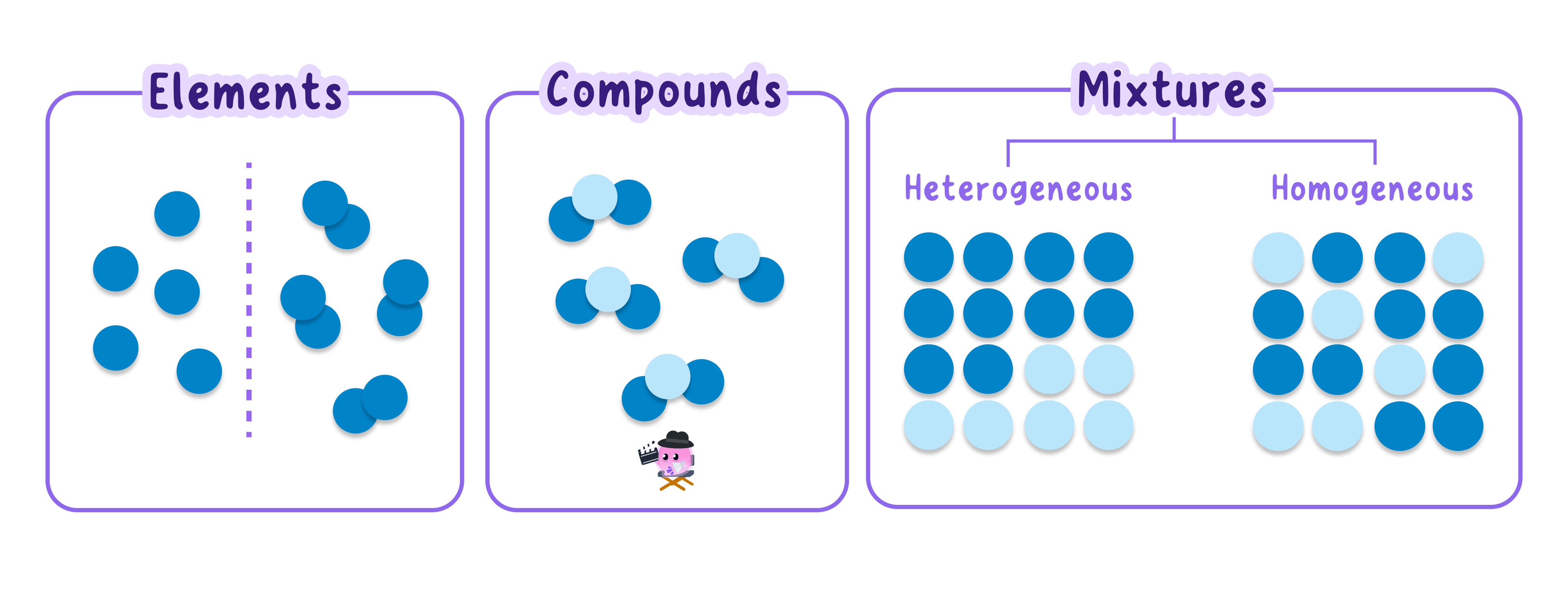
Key Idea
- A pure substance is one element or one compound; a mixture is physically combined and each part keeps its properties.
- All the separation methods here are physical, so they make no new substances.
Filtration: pulling an insoluble solid out of a liquid
Definition
Filtrate
The liquid that passes through the filter paper during filtration.
- Filtration separates an insoluble solid from a liquid or from a solution.
- Pour the mixture into filter paper in a funnel; the liquid drains through while the solid is trapped.
- The solid left in the paper is the residue; the liquid that passes through is the filtrate.
- It works because the solid particles are too large to fit through the tiny holes in the paper, while liquid particles pass easily.
- For example, sand can be filtered out of a mixture of sand and water.
Example
- Rock salt is a mixture of salt (soluble) and sand (insoluble).
- Stir it into water so the salt dissolves but the sand does not.
- Filter the mixture: the sand is the residue, and the salt solution is the filtrate.
Crystallisation: recovering a soluble solid from its solution
Definition
Solubility
The amount of a substance that can dissolve in a particular solvent at a given temperature.
- Crystallisation gets back a soluble solid that is dissolved in a solvent.
- Warm the solution gently so the solvent evaporates, leaving fewer solvent particles to keep the solid dissolved.
- As solvent leaves, the solution becomes saturated (it can hold no more solid) and crystals begin to form.
- Stop heating once the first crystals appear and let the rest cool slowly, so larger, purer crystals grow.
- Filter off the crystals and pat them dry between sheets of filter paper.
- Gentle heating over a water bath protects crystals that would be damaged, and salts that break down when heated strongly.
Common Mistake
- Do not evaporate a salt solution to dryness over a strong flame.
- Some salts decompose or spit when overheated, so evaporate slowly and stop when crystals appear.
Distillation: separating liquids by their boiling points
Definition
Distillate
The liquid collected after a vapour has cooled and condensed during distillation.
- Distillation separates a liquid from a solution, or separates two or more liquids that are mixed.
- Simple distillation separates a solvent from a solution, for example pure water from salt water.
- Heat the solution; the liquid boils and turns to vapour, leaving the dissolved solid behind.
- The vapour passes through a condenser, where it cools and condenses back to a liquid.
- The liquid collected is the distillate, and the dissolved solid stays in the flask.
- Fractional distillation separates miscible liquids (liquids that mix) that have different boiling points.
- A fractionating column stands between the flask and the condenser.
- Vapours rise and repeatedly condense and re-evaporate up the column, so the liquid with the lowest boiling point reaches the top first.
- Each liquid is collected as the thermometer reaches its boiling point; this is how crude oil and mixtures like ethanol and water are separated.
Note
- Use simple distillation to get one liquid back from a dissolved solid.
- Use fractional distillation when several liquids with different boiling points must be separated.
Chromatography: separating dissolved substances by how far they travel
Definition
Chromatography
A method that separates the dissolved substances in a mixture by how far each one travels through a material as a solvent moves through it.
- Chromatography separates the dissolved substances in a mixture, such as the coloured dyes in an ink.
- A spot of the mixture is placed on paper (the stationary phase) and a solvent (the mobile phase) moves through it.
- Each substance is attracted to the paper and dissolves in the solvent by a different amount.
- A substance that is more soluble and less attracted to the paper is carried further.
- The substances spread into separate spots, which shows how many substances were in the mixture.
- No new substances are made, so chromatography is a physical separation like the others.
Self review
- What is the difference between a pure substance and a mixture?
- Which method separates an insoluble solid from a liquid?
- Why does crystallisation use gentle heating?
- What property lets fractional distillation separate two liquids?
- In chromatography, why do some substances travel further than others?
