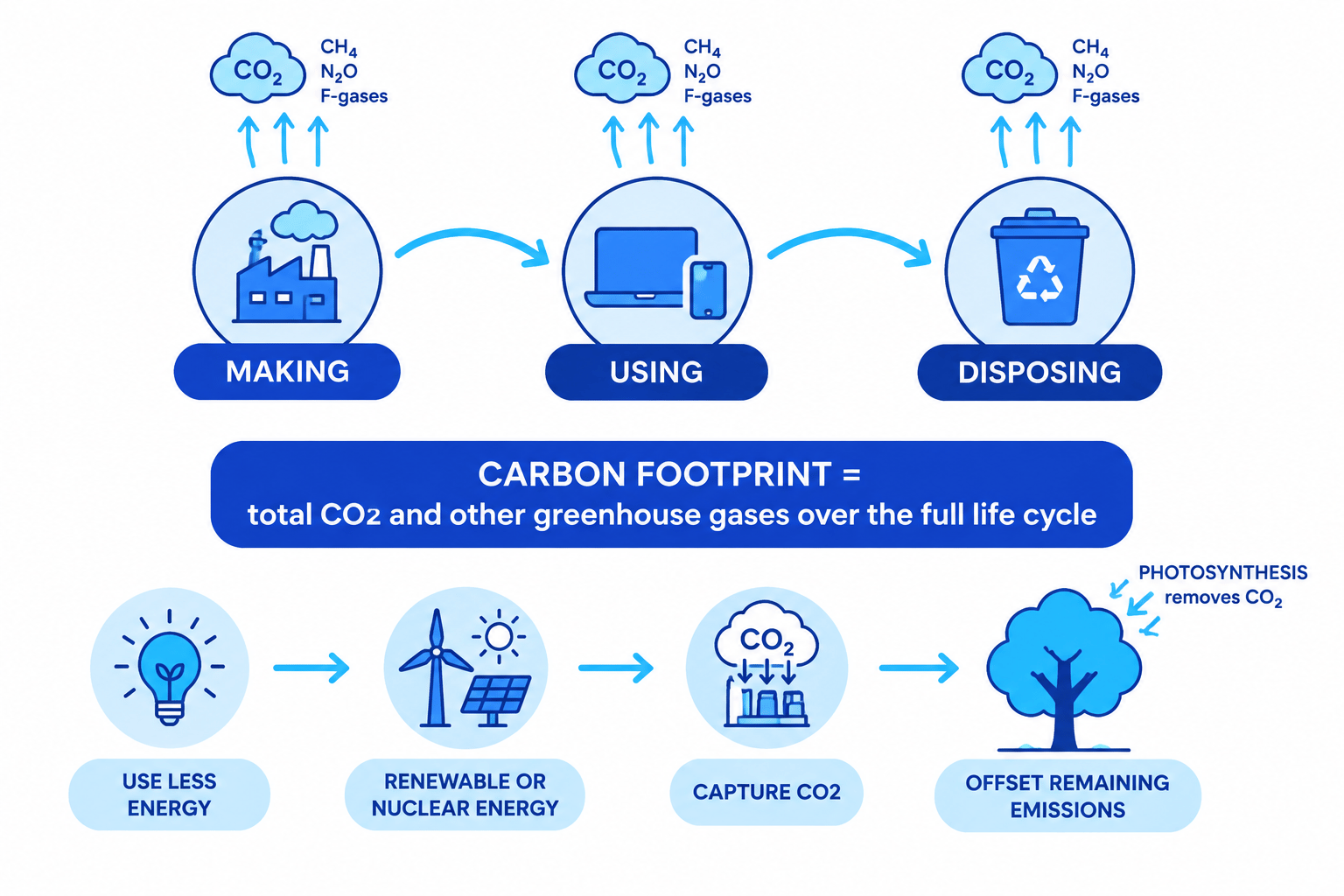
- What a carbon footprint means, including the idea of a full life cycle.
- Where carbon dioxide and methane emissions come from.
- Practical ways to reduce emissions of carbon dioxide and methane.
- Why some reduction actions are limited by cost, technology, behaviour, or trade-offs.
An emission is a substance released into the environment. In this topic, we mainly mean gases released into the atmosphere.
Some gases are greenhouse gases. They absorb infrared radiation from the Earth and help trap energy in the atmosphere. This contributes to global warming and climate change.
Greenhouse gas
A greenhouse gas is a gas in the atmosphere that absorbs infrared radiation and helps keep heat in the Earth’s atmosphere. In this topic, the key examples are carbon dioxide, CO₂, and methane, CH₄.
Carbon dioxide is produced when carbon-containing fuels burn. A fossil fuel is a fuel such as coal, oil or natural gas, formed over millions of years from the remains of living organisms.
Burning is also called combustion. For example, methane burns completely in oxygen:
CH₄(g) + 2O₂(g) → CO₂(g) + 2H₂O(g)
So, using petrol and diesel vehicles, gas boilers, coal power stations, and many industrial processes can all increase CO₂ emissions.
Methane is another important greenhouse gas. It is the main gas in natural gas, so leaks during extraction, transport and use can release methane.
Methane is also produced when organic material decomposes anaerobically, which means without oxygen. This can happen in landfill sites, rice fields, and the digestive systems of cattle and sheep.
The gases to focus on
For this GCSE section, reducing a carbon footprint mainly means reducing emissions of carbon dioxide and methane.
A carbon footprint is not just the gas released at one moment. It includes emissions across the full life cycle of something.
A life cycle means all the stages a product, service or event goes through, from the beginning to the end. For a product, this could include raw materials, manufacture, transport, use, and disposal.
Carbon footprint
The carbon footprint is the total amount of carbon dioxide and other greenhouse gases emitted over the full life cycle of a product, service or event.
A product is a physical item, such as a phone, T-shirt or bottle. A service is an activity provided for someone, such as a train journey or food delivery. An event could be a concert, sports match or school trip.
You may see carbon footprints measured in kg CO₂e. This means “kilograms of carbon dioxide equivalent”. It allows different greenhouse gases, such as CO₂ and CH₄, to be compared using one unit.
The diagram shows how emissions can occur at different stages of a product’s life cycle.

Only counting the use stage
Do not say a product has no carbon footprint just because it does not release gas while you use it. Its materials, manufacture, transport, electricity use and disposal may still produce greenhouse gases.
Calculating a product carbon footprint
A reusable bottle has these life-cycle emissions: raw materials 1.8 kg CO₂e, manufacture 0.7 kg CO₂e, transport 0.3 kg CO₂e, use 0.2 kg CO₂e, and disposal 0.1 kg CO₂e. Recycling the bottle saves 0.6 kg CO₂e but adds 0.1 kg CO₂e for extra transport.
- Add the original life-cycle emissions: 1.8+0.7+0.3+0.2+0.1=3.11.8 + 0.7 + 0.3 + 0.2 + 0.1 = 3.11.8+0.7+0.3+0.2+0.1=3.1, so the original footprint is 3.1 kg CO₂e.
- Find the overall change due to recycling: 0.6−0.1=0.50.6 - 0.1 = 0.50.6−0.1=0.5, so recycling gives a net saving of 0.5 kg CO₂e.
- Subtract the saving from the original footprint: 3.1−0.5=2.63.1 - 0.5 = 2.63.1−0.5=2.6, so the new carbon footprint is 2.6 kg CO₂e.
To reduce a carbon footprint, you can reduce the amount of CO₂ produced during the life cycle.
Many CO₂ emissions come from generating electricity or heating buildings using fossil fuels. Using less energy reduces the fuel burned.
Examples include:
- insulating homes so less heating is needed
- using more efficient appliances
- switching off unused devices
- designing factories to waste less energy
Energy efficiency means getting the same useful output while using less energy.
A low-carbon energy source produces little or no CO₂ while generating electricity. Examples include wind, solar, hydroelectric power and nuclear power.
These can replace electricity generated by burning fossil fuels.
Transport often releases CO₂ because petrol, diesel and aviation fuel are burned.
Actions include:
- walking, cycling or using public transport
- sharing car journeys
- using electric vehicles, especially if the electricity is generated from low-carbon sources
- reducing unnecessary flights and long-distance transport
Making new materials often needs lots of energy. Recycling metals, plastics and glass usually uses less energy than extracting and processing new raw materials.
Reusing a product can be even better, because it avoids making a replacement.
Calculating an electricity-saving reduction
A household reduces its electricity use by 500 kWh in one year. The electricity supplier produces 0.20 kg CO₂ for each kWh generated.
- Link the action to the source of emissions: using less electricity means the power station needs to generate less electricity, so less fuel may be burned.
- Multiply the electricity saved by the emission per kWh: 500×0.20=100500 \times 0.20 = 100500×0.20=100.
- Include the unit: the reduction is 100 kg CO₂ for that year.
Use the chain of reasoning
For reduction questions, try the chain: action → less fuel burned or less methane released → lower greenhouse gas emissions → smaller carbon footprint.
Methane matters because it is a greenhouse gas. Reducing methane emissions can therefore reduce the carbon footprint.
In landfill sites, buried food waste and other organic material can decay without oxygen and produce methane. Landfill sites can collect this gas instead of letting it escape.
The methane can then be burned to generate electricity. Burning methane still produces CO₂, but it prevents methane being released directly.
Less food waste means less organic material sent to landfill. This can reduce methane production.
It also reduces emissions from producing, transporting and storing food that would never be eaten.
Cattle and sheep produce methane during digestion. Some farming changes can reduce methane emissions, such as improving animal feed or managing manure more carefully.
Eating less beef and lamb can also reduce demand for livestock farming, though this depends on people’s choices and food availability.
Natural gas is mostly methane. Better maintenance of pipelines, gas equipment and extraction sites can reduce leaks.
Choosing how to handle landfill methane
A council can either let landfill methane escape or collect it and burn it to generate electricity.
- Compare the gases released: letting methane escape releases CH₄ directly, which adds to the greenhouse effect.
- Apply the chemical change: burning methane converts it into CO₂ and water, so less methane enters the atmosphere.
- Include the energy benefit: if the burned methane generates electricity, it may replace some electricity from fossil fuels, reducing the carbon footprint further.
In exams, you are often asked not just to describe actions, but also to explain why they may be difficult to carry out.
Low-carbon technologies can be expensive to install. For example, solar panels, home insulation, electric vehicles, and methane capture systems all need money upfront.
A company or government may save money later, but the starting cost can still be a barrier.
Infrastructure means the support systems needed for something to work, such as charging points, public transport networks, recycling centres, or electricity grids.
For example, electric cars are less useful if there are not enough chargers. Recycling is harder if materials cannot be separated properly.
Some renewable energy sources are intermittent, meaning they do not produce power all the time. Solar panels depend on sunlight, and wind turbines depend on wind.
This does not mean they are bad, but it means energy storage and backup supplies may be needed.
Some actions need people to change habits, such as eating less meat, flying less, wasting less food, or using public transport. These changes may be unpopular, inconvenient or difficult for some people.
A change can reduce emissions in one stage but increase them in another. For example, an electric car has no exhaust emissions while being driven, but making its battery and generating its electricity may still produce CO₂.
Always think full life cycle
A choice is not automatically “zero carbon” just because one stage looks clean. Compare the whole life cycle before deciding which option has the lower carbon footprint.
Evaluating a transport change
A delivery company wants to replace petrol vans with electric vans. Explain why this could reduce its carbon footprint, and why the reduction may be limited.
- Compare the use stage: petrol vans burn fuel and release CO₂ from their exhausts, while electric vans produce no exhaust gases during driving.
- Add the full-life-cycle idea: electric vans may still have emissions from battery manufacture and from generating the electricity used to charge them.
- Give a limitation: the change may be limited by the cost of buying vans, the availability of charging points, and whether the electricity comes from fossil fuels or low-carbon sources.
When a question asks for actions to reduce emissions, do not just list random “green” ideas. Link each action to the gas it reduces.
Good answers often include:
- the source of the greenhouse gas
- the action taken
- the gas reduced, usually CO₂ or CH₄
- the reason the action may be limited
For example, “use renewable electricity” is better if you explain that it reduces the need to burn fossil fuels, so less CO₂ is produced.
In the exam
- Define carbon footprint using the phrase full life cycle and include carbon dioxide and other greenhouse gases.
- For reduction actions, name the source and gas: for example, “capture methane from landfill” or “use less fossil fuel so less CO₂ is released”.
- For limitations, give a real reason such as cost, infrastructure, technology, reliability, behaviour, or life-cycle trade-offs.
Check yourself
- What stages of a product’s life cycle might contribute to its carbon footprint?
- Give two actions that reduce carbon dioxide emissions and two that reduce methane emissions.
- Why might an electric vehicle have a lower carbon footprint than a petrol vehicle, but not a zero carbon footprint?