x

Revision notes for AQA GCSE Chemistry Atmospheric pollutants from fuels. Open the guide for explanations and worked examples. Written against the AQA GCSE Chemistry (8462) specification, so the content matches what's examinable rather than general Chemistry background.

Atmospheric pollutants from fuels

What you'll learn

  • Where atmospheric pollutants like carbon monoxide, sulfur dioxide, and nitrogen oxides come from.
  • The difference between complete and incomplete combustion.
  • How to predict the gases released when a specific fuel is burned.

What is actually in our fuels?

To understand the gases that come out of a car exhaust or a factory chimney, we first need to look at what goes in.

Most of the fuels we use today (like petrol, diesel, and natural gas) are processed from crude oil. This means they are almost entirely made of hydrocarbons — compounds containing only carbon and hydrogen atoms. Another very common fuel is coal, which is mostly carbon.

However, natural fuels are rarely 100% pure. When dug out of the ground, they often contain small amounts of other elements, particularly sulfur.

When we burn these fuels to release energy, the elements inside them react with oxygen in the air.


The fate of Carbon and Hydrogen: Complete vs. Incomplete Combustion

When you burn a hydrocarbon fuel, the carbon and hydrogen atoms combine with oxygen from the air. The products of this reaction depend entirely on how much oxygen is available.

Complete Combustion

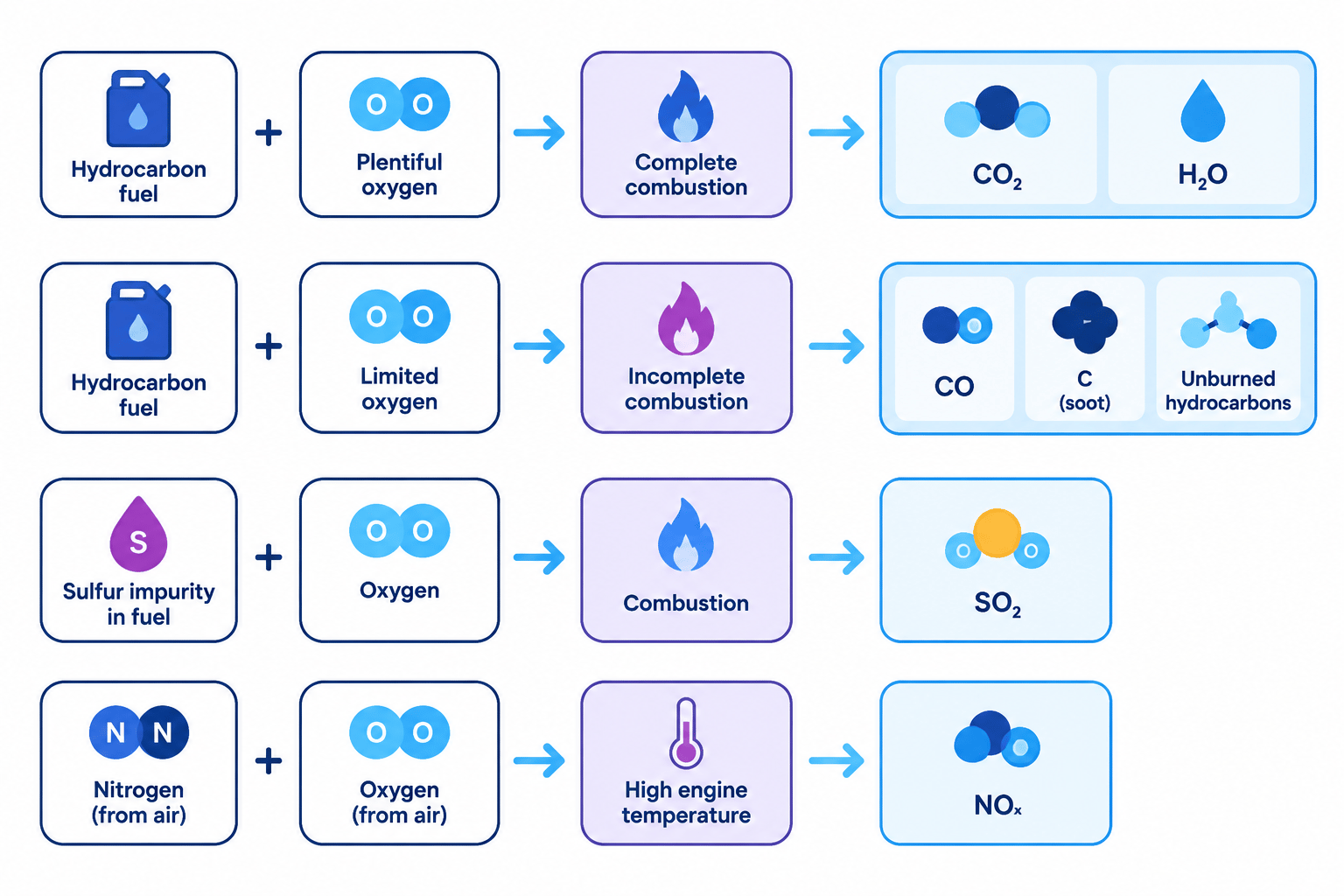
If there is plenty of oxygen, complete combustion happens. All the carbon turns into carbon dioxide (CO2\text{CO}_2CO2​), and all the hydrogen turns into water vapour (H2O\text{H}_2\text{O}H2​O).

For example, burning methane completely:

CH4(g)+2O2(g)→CO2(g)+2H2O(g) \text{CH}_4\text{(g)} + 2\text{O}_2\text{(g)} \to \text{CO}_2\text{(g)} + 2\text{H}_2\text{O(g)} CH4​(g)+2O2​(g)→CO2​(g)+2H2​O(g)

Carbon dioxide isn't toxic, but it is a major greenhouse gas that contributes to global warming.

Incomplete Combustion

If there isn't enough oxygen to go around — like inside a cramped car engine or a faulty boiler — incomplete combustion happens.

Because oxygen is limited, the carbon atoms can't all fully oxidise to become carbon dioxide. Instead, two dangerous pollutants are formed:

  1. Carbon monoxide (CO\text{CO}CO): A toxic, colourless, and odourless gas.
  2. Soot (carbon particles): Solid flakes of unburned carbon.
Definition

Particulates

Solid particles (like soot) and tiny droplets of unburned liquid hydrocarbons released into the air are known together as particulates. They cause global dimming and respiratory problems in humans.


Sulfur and Nitrogen: The unwanted extras

We know where the carbon dioxide and soot come from. But what about the other choking gases that cause acid rain?

Sulfur dioxide (SO2\text{SO}_2SO2​)

Coal and heavy oils naturally contain sulfur impurities. When the fuel is burned, the sulfur reacts with oxygen in the air to form sulfur dioxide gas.

S(s)+O2(g)→SO2(g) \text{S(s)} + \text{O}_2\text{(g)} \to \text{SO}_2\text{(g)} S(s)+O2​(g)→SO2​(g)

Sulfur dioxide is a toxic gas that causes breathing problems and mixes with clouds to form acid rain.

Oxides of nitrogen (NOx\text{NO}_xNOx​)

This one is slightly different. The nitrogen doesn't come from the fuel — it comes from the air itself.

Normally, the nitrogen gas (N2\text{N}_2N2​) and oxygen gas (O2\text{O}_2O2​) in the air ignore each other because nitrogen is very unreactive. However, inside a car engine, the temperature gets incredibly high. Under these extreme conditions, the nitrogen and oxygen from the air are forced to react, forming oxides of nitrogen (often written generally as NOx\text{NO}_xNOx​).

These oxides of nitrogen also cause breathing problems and contribute to acid rain.

Sources of pollutants

Common Mistake

Where does the nitrogen come from?

A very common mistake is to say that oxides of nitrogen are formed "because the fuel contains nitrogen". They aren't! The nitrogen comes from the air reacting with oxygen at the high temperatures found inside engines.

Key Idea

Summary of Pollutant Sources

  • Carbon dioxide (CO2\text{CO}_2CO2​): Complete combustion of carbon.
  • Carbon monoxide (CO\text{CO}CO) & Soot: Incomplete combustion of carbon.
  • Sulfur dioxide (SO2\text{SO}_2SO2​): Burning of sulfur impurities in the fuel.
  • Oxides of nitrogen (NOx\text{NO}_xNOx​): Nitrogen and oxygen from the air reacting at high temperatures.

Predicting the products of combustion

In the exam, you might be given a description of a fuel and the conditions it is burned in, and asked to predict what gases will come out of the exhaust. Let's look at how to tackle this logically.

Example

Predicting exhaust gases

A fuel oil containing hydrocarbons and a small amount of sulfur is burned inside a ship's engine. The engine intake is slightly blocked, restricting the airflow. Predict three pollutants that will be released from the ship's funnel and explain how they form.

  1. Check the fuel composition: The question states the fuel contains hydrocarbons (carbon and hydrogen) and sulfur.
  2. Check the conditions: The airflow is restricted, which means oxygen is limited. This tells us incomplete combustion will happen. The high temperature of the engine is also a clue.
  3. Determine the products from Carbon: Because oxygen is limited, incomplete combustion of carbon occurs. This will produce carbon monoxide and soot (carbon particles).
  4. Determine the products from Sulfur: The sulfur impurities burn in oxygen to produce sulfur dioxide.
  5. Consider the engine conditions: The ship's engine will be extremely hot. At high temperatures, nitrogen and oxygen from the air will react to form oxides of nitrogen.
Tip

Spotting the clues

Whenever a question mentions "a car engine" or "high temperatures", always look for an opportunity to mention oxides of nitrogen. Whenever it mentions a "poorly ventilated room" or "restricted air", it is testing incomplete combustion.


Exam technique

In the exam

  1. Read the fuel description carefully. If they tell you a fuel contains sulfur, make sure you mention sulfur dioxide in your answer. If they only say "pure methane", don't mention sulfur!
  2. Be precise with your words. Do not say "makes carbon" — say "makes soot" or "solid carbon particles" to be completely clear.
  3. When explaining oxides of nitrogen, you must specify that the nitrogen comes from the air, not the fuel, and that the reaction requires high temperatures.
Self review

Check yourself

  • What is the difference between the conditions needed for complete combustion versus incomplete combustion?
  • Which two toxic pollutants are formed during incomplete combustion?
  • Where does the sulfur come from to make sulfur dioxide?
  • Why do oxides of nitrogen only form inside environments like car engines?

Common atmospheric pollutants and their sources

Guide 1 of 2

You've reached the end

Test yourself on this topic, or move on to the next guide.

Next guideProperties and effects of atmospheric pollutantsStart

How was this guide?

Atmospheric pollutants from fuels Revision Guide

  1. GCSE
  2. /Chemistry
  3. /Atmospheric pollutants from fuels