- What oxygen is and why it helps burning happen.
- How to prepare and use a glowing splint safely.
- The exact positive result for oxygen: the glowing splint relights.
- Common wording mistakes to avoid in exam answers.
In GCSE Chemistry, you often need to identify an unknown gas made in a reaction. You do this using a gas test: a practical test that gives a clear observation for a particular gas.
Gas test
A gas test is a simple practical method used to identify a gas by a distinctive observation, such as a splint relighting, a pop sound, or a colour change.
For oxygen, the test is very short:
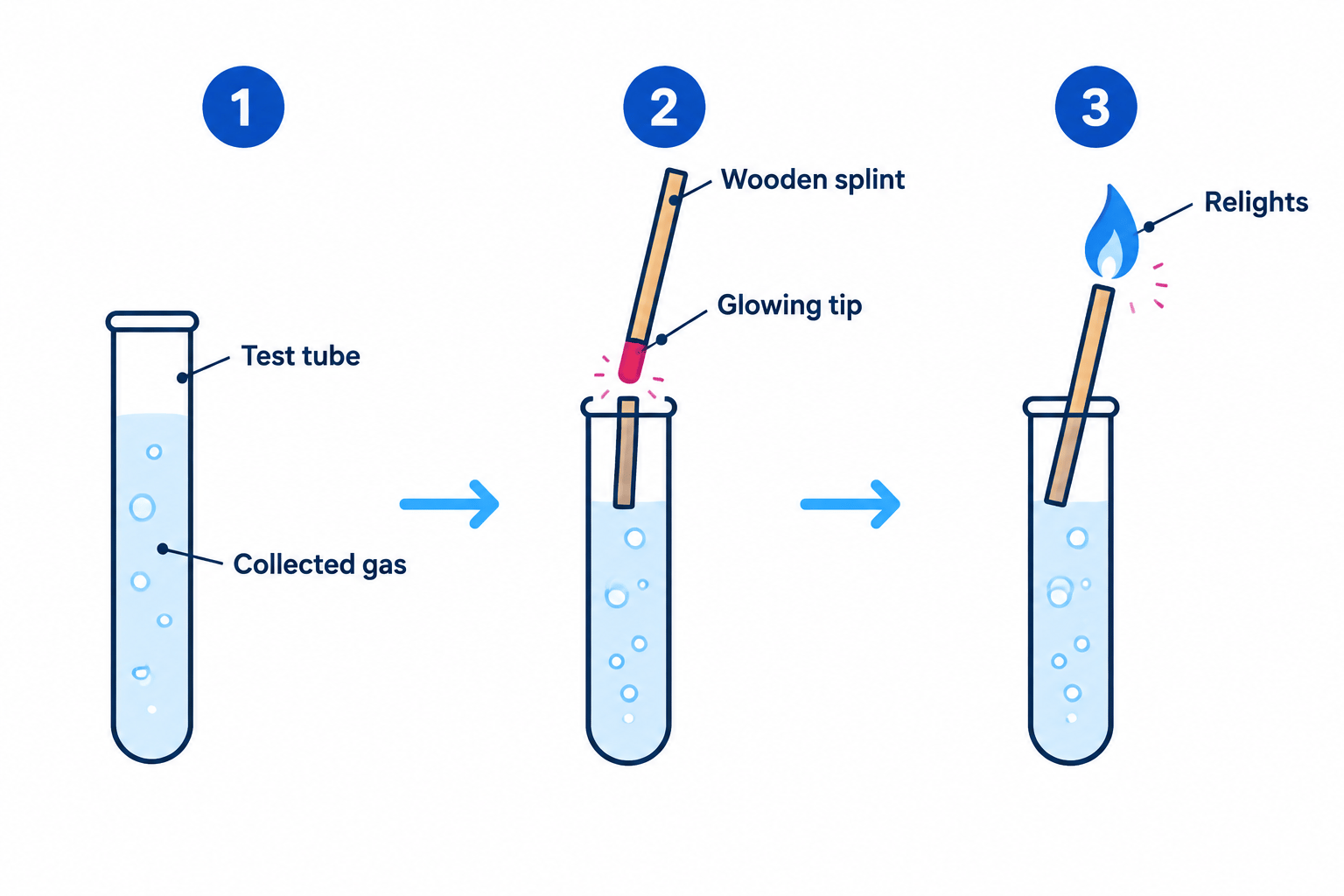
Insert a glowing splint into a test tube of the gas. If the splint relights, the gas is oxygen.
The result to remember
The test for oxygen is: a glowing splint relights in oxygen.
Oxygen is a colourless gas in the air. Its formula is O₂, meaning oxygen molecules contain two oxygen atoms joined together.
Oxygen is important because it supports combustion.
Combustion
Combustion means burning. It is a chemical reaction where a substance reacts with oxygen and releases energy, usually as heat and light.
A glowing splint already has hot material at its tip. If enough oxygen is present, that hot material can start burning again, so the splint relights.
Oxygen does not burn
Do not write “oxygen burns” or “oxygen is flammable”. Oxygen supports combustion: it helps other substances burn.
The test uses very simple apparatus:
- a test tube containing the gas being tested
- a wooden splint
- a flame, such as a Bunsen burner flame, to light the splint first
Splint
A splint is a thin piece of wood used in flame tests and gas tests.
Glowing splint
A glowing splint is a wooden splint that has been lit, then blown out, so the tip is still hot and glowing but there is no flame.
The splint must be glowing, not fully burning with a flame. This matters because different gas tests use different types of splint.
To test a gas for oxygen:
- Collect the gas in a test tube.
- Light a wooden splint.
- Blow out the flame so the splint is glowing.
- Insert the glowing splint into the test tube of gas.
- Look for the observation: the glowing splint relights.
The diagram shows the key practical observation: the hot, glowing splint is placed into the gas, and a positive test is shown by the splint relighting.

Best exam wording
Write: “A glowing splint relights.” This is clearer and more precise than “it burns” or “there is a flame”.
A positive result means the test has shown the gas you are testing for is present.
For oxygen, the positive result is very specific:
- The splint starts as glowing.
- It is placed into the gas.
- It relights, meaning a flame appears again.
Relights
Relights means starts burning with a flame again after the flame had previously gone out.
If the glowing splint does not relight, then the test has not shown that oxygen is present. The gas might be something else, or there may not be enough oxygen for a clear result.
Using the observation to identify the gas
A student collects a colourless gas in a test tube. They insert a glowing splint, and the splint relights. Identify the gas and explain the result.
- The key observation is that a glowing splint relights, not just that the splint changes slightly.
- A glowing splint relighting is the positive test for oxygen because oxygen supports combustion.
- The gas is oxygen, O₂(g). The hot splint begins burning again because the oxygen allows combustion to restart.
A glowing splint is not completely cold. Its tip is still hot enough that it can start burning again if there is plenty of oxygen nearby.
In normal air, only about one fifth of the air is oxygen. In a test tube containing oxygen gas, the oxygen concentration is much higher, so the glowing wood reacts more easily with oxygen and relights.
Why relighting happens
The splint relights because oxygen supports combustion and allows the hot wood at the end of the splint to burn again.
You do not need a detailed equation for the splint burning at GCSE for this test. The important chemical idea is that burning needs oxygen.
In an experiment, the oxygen may have been produced by a reaction before you test it. For example, oxygen can be made when hydrogen peroxide breaks down:
2H₂O₂(aq) → 2H₂O(l) + O₂(g)
This reaction is often sped up using manganese dioxide as a catalyst, but for this topic the main point is the gas produced: oxygen gas, O₂(g).
Catalyst
A catalyst is a substance that speeds up a reaction without being used up overall.
The test for oxygen does not depend on how the oxygen was made. If the gas is oxygen, a glowing splint should relight.
This topic belongs to the wider GCSE section on identifying common gases. The splint test for oxygen is easy to mix up with other gas tests.
For oxygen:
- use a glowing splint
- positive result: the splint relights
For hydrogen:
- use a lighted splint
- positive result: a squeaky pop
So the type of splint matters.
Glowing vs lighted splint
Do not confuse the oxygen test with the hydrogen test. Oxygen uses a glowing splint. Hydrogen uses a lighted splint and gives a squeaky pop.
Sometimes the splint may glow a bit brighter but not fully relight. In an exam, that is not the standard positive result.
A clear positive test for oxygen is not just:
- “it glows”
- “it burns brighter”
- “there is heat”
- “the splint reacts”
The GCSE wording you want is:
“The glowing splint relights.”
Be precise with observations
If the splint does not relight, do not claim the gas is definitely oxygen. The expected positive result is a clear relighting of the glowing splint.
You may not be asked detailed safety questions for this tiny test, but good practical wording helps your answers sound confident.
Sensible habits include:
- keep the test tube pointing away from people
- handle the hot splint carefully
- do not leave burning splints on the bench
- test only a small sample of gas in a test tube
The method should be quick because gases can escape or mix with air if the test tube is left open for too long.
Quick practical memory
Oxygen gives old fire new life: a glowing splint relights.
In the exam
- If asked for the test for oxygen, write the full method and result: “Insert a glowing splint into the gas; it relights.”
- Use the word relights rather than vague phrases like “burns” or “glows”.
- If asked to explain the result, say that oxygen supports combustion, not that oxygen is flammable.
Check yourself
- What is the positive result when a glowing splint is inserted into oxygen?
- Why must the splint be glowing rather than fully lighted for the oxygen test?
- What common incorrect phrase should you avoid when describing oxygen and burning?