- Which chemical is used to test for carbon dioxide gas.
- How to carry out the test by bubbling or shaking with limewater.
- Why limewater turns milky when carbon dioxide is present.
- How to describe the test accurately in GCSE exam answers.
Carbon dioxide, CO₂, is a colourless gas. That means you usually cannot identify it just by looking at it.
In chemistry, you use a test that gives a clear, observable result. For carbon dioxide, the test uses limewater.
Gas test
A gas test is a practical method used to identify a gas by producing a distinctive observation, such as a colour change, a sound, or a cloudy solution.
Carbon dioxide is commonly produced when a carbonate reacts with an acid. For example, marble chips are calcium carbonate, CaCO₃, and they make carbon dioxide when reacted with dilute hydrochloric acid.
The reagent is the chemical you use to carry out a test. The reagent for carbon dioxide is limewater.
Limewater
Limewater is an aqueous solution of calcium hydroxide, Ca(OH)₂(aq). Aqueous means dissolved in water, so the state symbol is (aq).
Limewater starts off clear and colourless. If carbon dioxide is present, it turns milky or cloudy.
Limewater is not lime juice
In GCSE Chemistry, limewater means calcium hydroxide solution, not the juice from a lime fruit. Always name it as limewater or aqueous calcium hydroxide.
A positive result means the test has shown the gas you were looking for is present.
Positive test for carbon dioxide
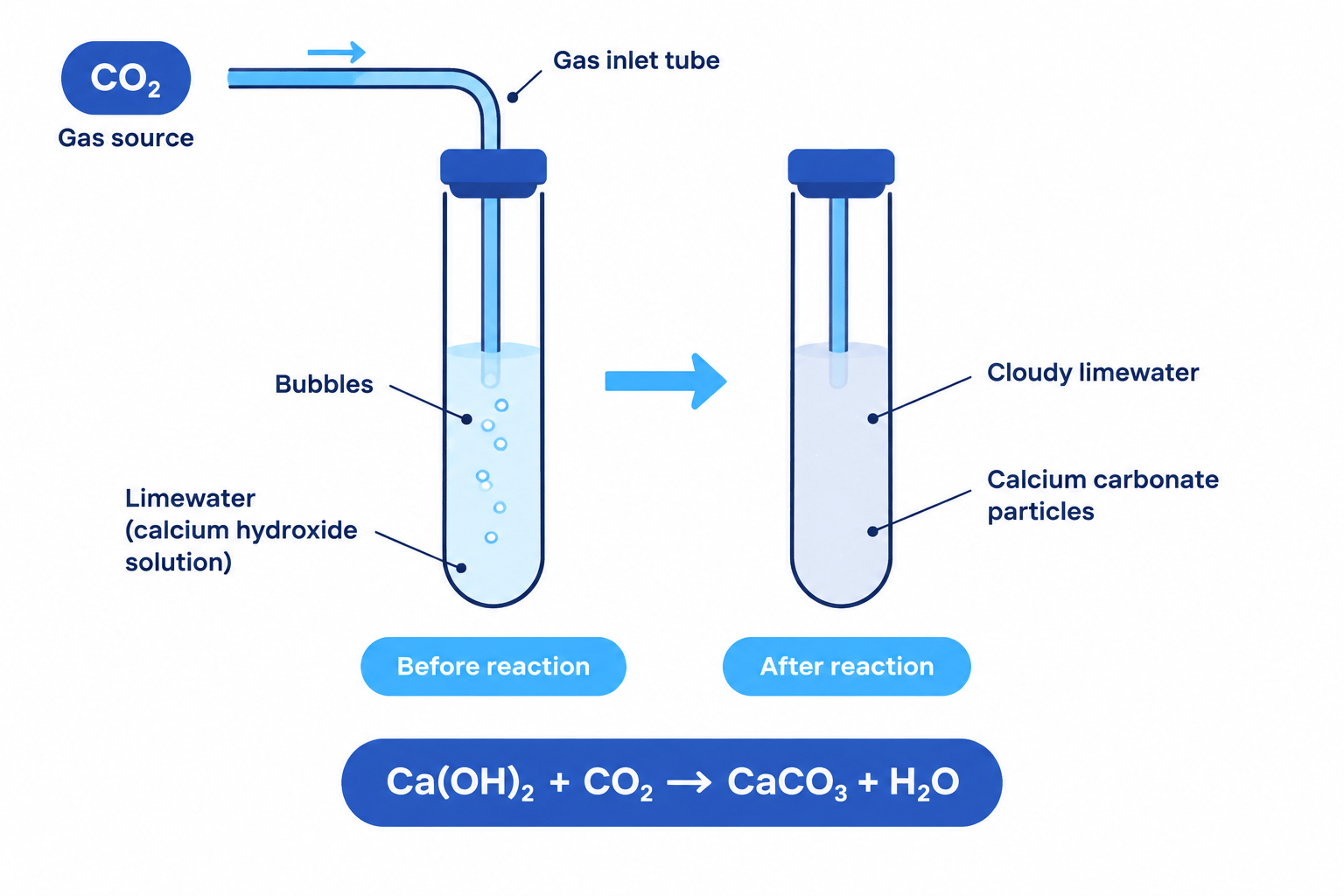
To test for carbon dioxide, bubble the gas through limewater or shake it with limewater. If carbon dioxide is present, the limewater turns milky/cloudy.
This is the exact observation examiners expect. “Turns cloudy” and “turns milky” both describe the correct result.
Carbon dioxide reacts with calcium hydroxide in the limewater. The reaction forms calcium carbonate, CaCO₃.
Calcium carbonate is insoluble, meaning it does not dissolve in water. Instead, tiny solid particles form in the liquid, making the limewater look cloudy.
Precipitate
A precipitate is an insoluble solid that forms during a reaction in a solution.
The word equation is:
carbon dioxide + calcium hydroxide → calcium carbonate + water
The balanced symbol equation, including state symbols, is:
CO₂(g) + Ca(OH)₂(aq) → CaCO₃(s) + H₂O(l)
The state symbols mean:
- (g) = gas
- (aq) = aqueous, dissolved in water
- (s) = solid
- (l) = liquid
The important product is CaCO₃(s). This solid calcium carbonate is the precipitate that makes the limewater appear milky.
You can test carbon dioxide by passing the gas into a test tube of limewater using a delivery tube. The end of the delivery tube should go below the surface of the limewater so the gas bubbles through it.

Use this method when carbon dioxide is being produced in a reaction, such as an acid reacting with a carbonate.
- Put a small amount of limewater into a clean test tube.
- Use a delivery tube to bubble the gas through the limewater.
- Watch for the limewater turning milky or cloudy.
Use this method if the gas has already been collected in a test tube or gas jar.
- Add a small amount of limewater to the container of gas.
- Stopper the container.
- Shake gently.
- A positive result is limewater turning milky/cloudy.
Best exam wording
For a two-mark exam answer, include both the method and the result: “Bubble the gas through limewater; if it is carbon dioxide, the limewater turns milky/cloudy.”
A common GCSE situation is that a gas is produced in a reaction, and you are asked how to identify it.
Carbon dioxide is often made by reacting an acid with a carbonate. For example:
calcium carbonate + hydrochloric acid → calcium chloride + water + carbon dioxide
With state symbols:
CaCO₃(s) + 2HCl(aq) → CaCl₂(aq) + H₂O(l) + CO₂(g)
Testing gas from an acid-carbonate reaction
A student adds dilute hydrochloric acid to marble chips and bubbles the gas produced through limewater. Explain how the result confirms carbon dioxide.
-
Identify the type of reaction: marble chips are calcium carbonate, so reacting them with hydrochloric acid should produce carbon dioxide. The reaction is CaCO₃(s) + 2HCl(aq) → CaCl₂(aq) + H₂O(l) + CO₂(g).
-
Apply the carbon dioxide test: the gas is bubbled through limewater, which contains calcium hydroxide, so carbon dioxide would react as CO₂(g) + Ca(OH)₂(aq) → CaCO₃(s) + H₂O(l).
-
Link the product to the observation: CaCO₃(s) is an insoluble white solid, so it makes the limewater turn milky/cloudy. This positive result confirms the gas is carbon dioxide.
If the question asks for the test for carbon dioxide, a complete answer needs:
- the chemical used: limewater
- what you do: bubble the gas through it or shake the gas with it
- the positive observation: limewater turns milky/cloudy
Avoid vague wording like “it changes colour” because limewater does not simply change to a new colour. It becomes cloudy because a solid precipitate forms.
Forgetting the observation
Do not just write “use limewater”. That only names the reagent. You must also state the result: it turns milky/cloudy.
Carbon dioxide is one of the common gases you need to identify. Its test is different from the tests for oxygen, hydrogen and chlorine.
For carbon dioxide, remember:
- Reagent: limewater
- Positive result: turns milky/cloudy
- Reason: insoluble calcium carbonate forms
You do not need a flame or a glowing splint for this test.
In the exam
- If asked for the test, write: “Bubble the gas through limewater.”
- If asked for the positive result, write: “The limewater turns milky/cloudy.”
- If asked to explain why, mention that insoluble calcium carbonate, CaCO₃(s), forms.
Check yourself
- What is limewater, and what chemical does it contain?
- What observation shows that carbon dioxide is present?
- Can you write the balanced symbol equation for carbon dioxide reacting with limewater, including state symbols?