x

Revision notes for AQA GCSE Chemistry Test for hydrogen. Open the guide for explanations and worked examples. Written against the AQA GCSE Chemistry (8462) specification, so the content matches what's examinable rather than general Chemistry background.

Test for hydrogen

What you'll learn

  • What hydrogen gas is and why it burns.
  • How to carry out the GCSE test for hydrogen safely.
  • What a positive result looks and sounds like.
  • How to describe the test clearly in exam answers.

The big idea

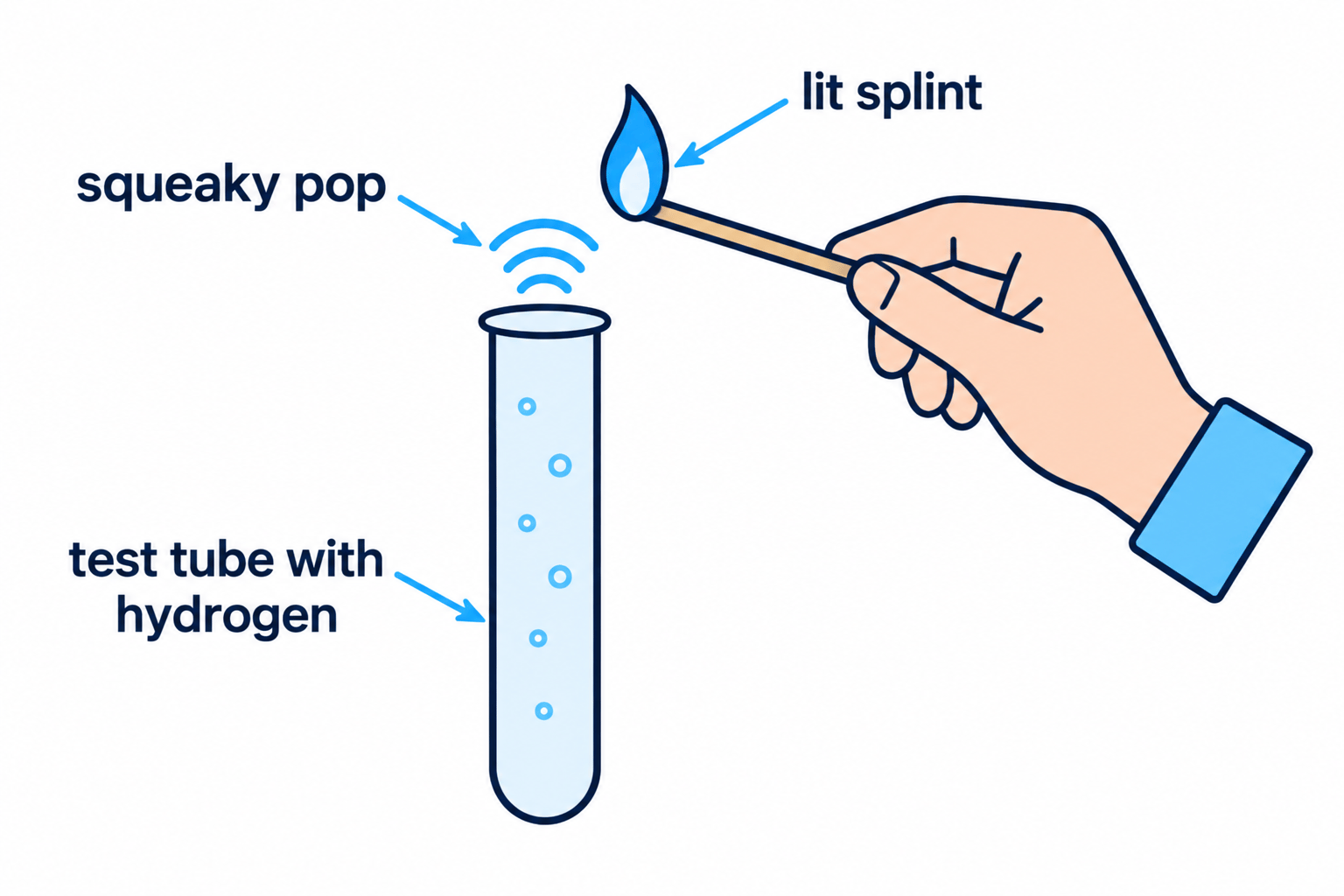
Hydrogen is one of the common gases you need to identify in GCSE Chemistry. The test is simple: bring a burning splint to the open end of a test tube containing the gas. If the gas is hydrogen, it burns rapidly with a pop sound.

Key Idea

Test for hydrogen

A positive test for hydrogen is a burning splint making a squeaky pop at the open end of a test tube of the gas.

Prerequisite: what is hydrogen?

Hydrogen is a gas at room temperature. Its molecules are made from two hydrogen atoms joined together, so we write hydrogen gas as H₂(g).

Definition

Gas

A gas is a state of matter with particles that are far apart and moving randomly. A gas spreads out to fill its container.

Hydrogen is also flammable, which means it can catch fire and burn.

Definition

Flammable

A flammable substance is one that burns easily when it is ignited.

When hydrogen burns, it reacts with oxygen from the air. This reaction makes water vapour:

2H₂(g) + O₂(g) → 2H₂O(g)

This burning happens very quickly, which is why you hear the characteristic pop.

The apparatus: what is a splint?

A splint is a thin piece of wood used in gas tests. For the hydrogen test, the splint must be burning, not just glowing.

Definition

Burning splint

A burning splint is a wooden splint with a flame on it. It is used to test whether a gas can burn or support combustion.

You hold the burning splint at the open end of the test tube, not deep inside it. This matters because the hydrogen needs oxygen from the air to burn.

Labelled diagram of the hydrogen gas test using a burning splint at the open end of a test tube

The method

Step-by-step test

To test for hydrogen:

  1. Collect the gas in a test tube.
  2. Hold the test tube so the open end is accessible.
  3. Light a wooden splint.
  4. Hold the burning splint at the open end of the test tube.
  5. Listen for a squeaky pop.

If you hear the pop, hydrogen is present.

Tip

Exam phrase to memorise

“Hydrogen gives a squeaky pop when a burning splint is placed at the mouth of the test tube.”

What counts as a positive result?

A positive result means the test shows that the substance you are testing for is present.

Definition

Positive result

A positive result is the expected observation that confirms a particular substance is present.

For hydrogen, the positive result is:

  • a rapid burning reaction
  • a popping or squeaky pop sound
  • sometimes a tiny flash or flame at the mouth of the test tube

You do not need to describe the colour of the flame. The important observation is the pop.

Common Mistake

Using the wrong splint

Do not say hydrogen is tested with a glowing splint. A glowing splint is used to test for oxygen. Hydrogen is tested with a burning splint.

Why does hydrogen make a pop?

Hydrogen reacts quickly with oxygen in the air. The reaction releases energy, mainly as heat and sound. Because the reaction is fast, you hear a pop rather than a slow burn.

The word equation is:

hydrogen + oxygen → water

The balanced symbol equation is:

2H₂(g) + O₂(g) → 2H₂O(g)

This is a combustion reaction because hydrogen is burning in oxygen.

Definition

Combustion

Combustion is a reaction in which a substance burns in oxygen, releasing energy.

Example

Explaining the pop sound

A gas collected in a test tube gives a squeaky pop when a burning splint is held at the open end. Explain why this identifies the gas as hydrogen.

  1. The burning splint provides the energy needed to ignite the gas at the mouth of the test tube.
  2. Hydrogen is flammable, so it reacts rapidly with oxygen from the air.
  3. The rapid combustion produces water vapour and releases energy as sound, heard as a squeaky pop.
  4. Therefore, the gas is identified as hydrogen.

Why test at the open end?

The gas is inside the test tube, but oxygen from the air is outside the test tube. Holding the flame at the open end allows hydrogen and oxygen to meet where the flame is.

If you pushed the splint deep into the test tube, there may not be enough oxygen inside for the hydrogen to burn properly. It is also less safe.

Common Mistake

Safety point

Only test small amounts of hydrogen and keep the test tube pointed away from people. Hydrogen is flammable and burns rapidly.

How hydrogen might be made in the lab

You may meet hydrogen during reactions between certain metals and acids. For example, magnesium reacts with hydrochloric acid to produce magnesium chloride and hydrogen:

Mg(s) + 2HCl(aq) → MgCl₂(aq) + H₂(g)

The bubbles produced are hydrogen gas. You could collect that gas in a test tube and then test it with a burning splint.

Example

Linking a reaction to the gas test

Magnesium is added to hydrochloric acid. A gas is produced. Describe how you would confirm that the gas is hydrogen.

  1. The reaction between magnesium and hydrochloric acid produces a gas, so the gas should be collected in a test tube.
  2. A burning splint should be held at the open end of the test tube so the gas can ignite in air.
  3. If the gas is hydrogen, it will burn rapidly and make a squeaky pop.
  4. The observation of a squeaky pop confirms that the gas is hydrogen.

Hydrogen compared with other gas tests

In this part of the specification, you need to identify common gases. The hydrogen test is easily confused with oxygen and carbon dioxide, so keep the observations separate.

  • Hydrogen: burning splint gives a squeaky pop.
  • Oxygen: glowing splint relights.
  • Carbon dioxide: turns limewater cloudy.
Common Mistake

Mixing up gas tests

A burning splint making a pop is hydrogen, not oxygen. Oxygen relights a glowing splint; it does not give the squeaky pop test.

Writing a good observation

In practical chemistry, an observation is what you detect using your senses or equipment. For this test, the observation is not just “it burns”. The key GCSE wording is “squeaky pop”.

Definition

Observation

An observation is something you notice during an experiment, such as a colour change, gas produced, temperature change, or sound.

A strong exam answer says:

“The gas burns with a squeaky pop when a burning splint is held at the mouth of the test tube.”

A weaker answer says:

“It pops.”

That is not wrong, but it may not be detailed enough if the question asks for the test and result.

Tip

Test plus result

When a question asks you to describe a test, include both the method and the positive result.

Common exam wording

You might be asked:

  • “Describe the test for hydrogen.”
  • “What is the positive result for hydrogen?”
  • “A gas gives a squeaky pop with a burning splint. Identify the gas.”
  • “A metal reacts with acid. How could you test the gas produced?”

For the first and fourth types, you need the full method and result. For the third type, you only need to identify the gas as hydrogen.

Example

Identifying hydrogen from observations

A student tests an unknown gas. A burning splint is placed at the open end of the test tube and a squeaky pop is heard. Identify the gas and justify your answer.

  1. The test uses a burning splint, which is the correct splint for testing hydrogen.
  2. The observation is a squeaky pop, which is the positive result for hydrogen.
  3. Therefore, the gas is hydrogen.

Key wording to avoid

Try not to write:

  • “Hydrogen explodes.”
  • “Hydrogen relights a splint.”
  • “Hydrogen turns limewater cloudy.”
  • “Use a glowing splint for hydrogen.”

The word “explodes” is too dramatic for the small-scale lab test. The safer and more accurate wording is that hydrogen burns rapidly with a pop sound.

Exam technique

In the exam

  1. If asked for the test, write: “Hold a burning splint at the open end of the test tube.”
  2. If asked for the result, write: “Hydrogen burns with a squeaky pop.”
  3. Do not confuse the splints: burning splint for hydrogen, glowing splint for oxygen.
Self review

Check yourself

  • What type of splint is used to test for hydrogen?
  • What sound tells you that hydrogen is present?
  • Why is the splint held at the open end of the test tube?
You've reached the end

Test yourself on this topic, or move on to the next guide.

FlashcardsSelf-test with active recall
Test for oxygenUp next

How was this guide?

Test for hydrogen Revision Guide

  1. GCSE
  2. /Chemistry
  3. /Test for hydrogen