Welcome to the test for chlorine! In this topic, you'll learn:
- How to carry out the standard laboratory test for chlorine gas.
- The positive observations you need to look out for.
- Exactly why the litmus paper used in the test must be damp.
Identifying gases is a core practical skill in chemistry. Instead of guessing what a gas might be based on its colour or smell (which can be incredibly dangerous!), chemists use specific, reliable chemical tests.
Before we test for it, let's briefly recap what chlorine is. Chlorine (Cl2\text{Cl}_2Cl2) is an element in Group 7 of the periodic table, known as the halogens. At room temperature, chlorine is a pale green, highly reactive, and toxic gas.
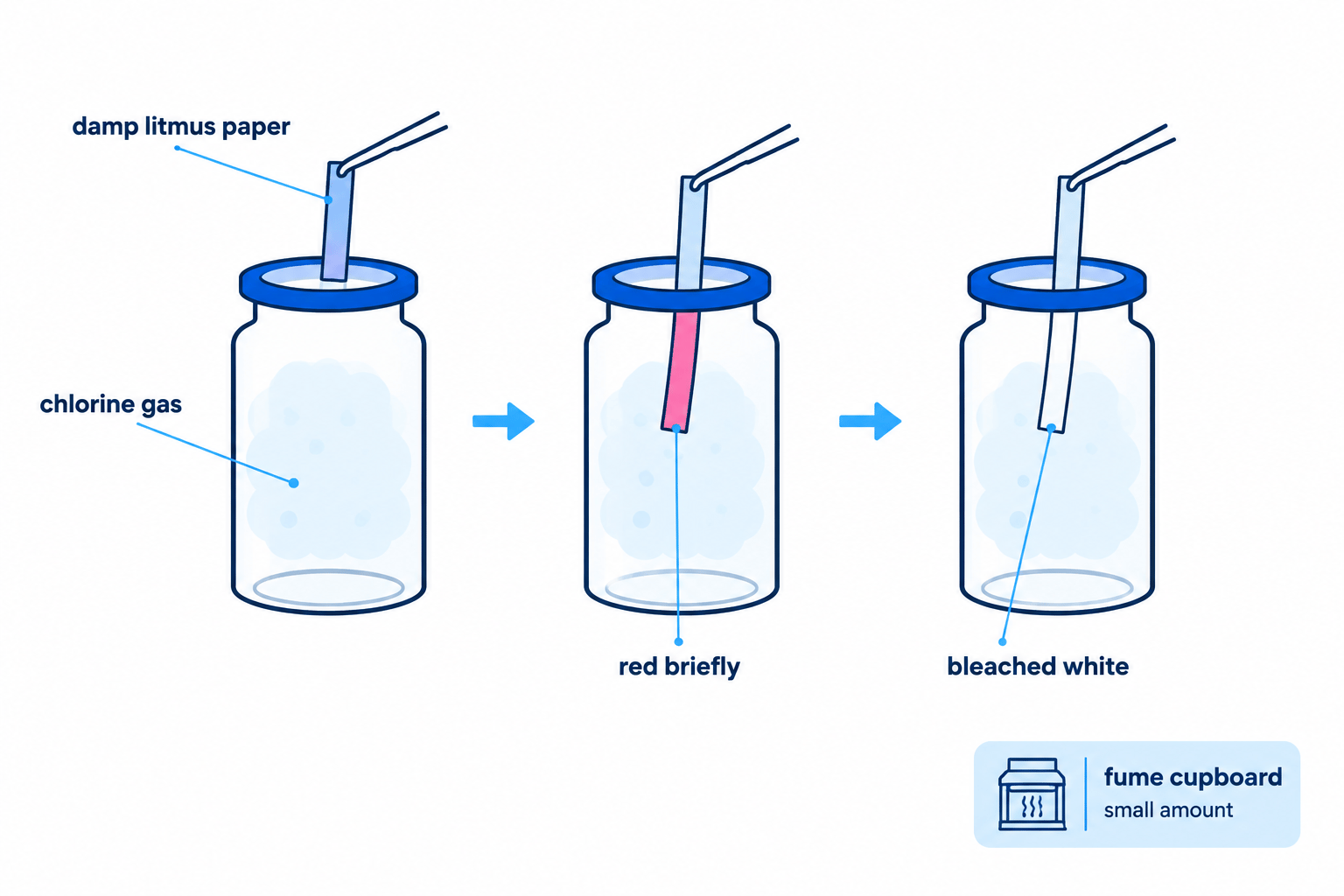
Because it is toxic and can irritate the respiratory system, any experiment that produces a significant amount of chlorine gas is always carried out inside a fume cupboard.
To test for chlorine gas, we use a very common piece of laboratory equipment: litmus paper.
Litmus paper
Litmus paper is a small strip of paper treated with a natural, water-soluble dye extracted from lichens. It acts as an indicator, meaning it changes colour to show whether a substance is acidic or alkaline.
The test is incredibly straightforward, but you have to be careful with your setup. Here is the exact procedure:
- Take a piece of blue litmus paper.
- Dampen it with a little tap water or distilled water.
- Hold the damp paper using metal tongs at the mouth of the test tube suspected to contain chlorine gas.
If the gas is indeed chlorine, the damp blue litmus paper will quickly be bleached and turn white. You might briefly see the paper turn red before it bleaches, but the final, permanent change to pure white is the key observation.

The exact exam answer
If you are asked how to test for chlorine, state: "Use damp litmus paper. It will be bleached and turn white."
This is the most common follow-up question in an exam! If you put a completely dry piece of litmus paper into a tube of dry chlorine gas, nothing will happen. The paper will stay blue.
Chlorine needs moisture to react. When the chlorine gas touches the water on the damp paper, it dissolves and reacts to form a mixture of acids.
Cl2(g)+H2O(l)⇌HCl(aq)+HClO(aq)
\text{Cl}_2\text{(g)} + \text{H}_2\text{O(l)} \rightleftharpoons \text{HCl(aq)} + \text{HClO(aq)}
Cl2(g)+H2O(l)⇌HCl(aq)+HClO(aq)
Although you don't usually need to memorise this equation for GCSE, understanding it makes the test completely logical! The reaction produces hydrochloric acid (HCl\text{HCl}HCl) and hypochlorous acid (HClO\text{HClO}HClO).
- Because acids turn blue litmus paper red, you often see a tiny flash of red as the acid forms.
- However, the hypochlorous acid is a powerful bleach (in fact, it's the exact same chemistry used in household cleaning bleaches). It instantly destroys the dye in the litmus paper, leaving it entirely white.
Forgetting the word 'damp'
Examiners are incredibly strict on this detail. If an exam question asks "Describe the test for chlorine gas" and you just write "litmus paper turns white", you will likely lose the mark for the method. You must specify that the litmus paper is damp.
Blue or red litmus paper?
You can technically use either damp blue or damp red litmus paper to test for chlorine. Both will eventually be bleached white. However, damp blue litmus paper is most commonly used in schools because it provides that extra, brief intermediate step (blue →\to→ red →\to→ white) showing that the dissolved gas is acidic before the bleach completely takes over!
As mentioned earlier, chlorine is a toxic gas. If you have asthma, you need to be particularly careful around it. When you perform this test in a school lab, you will usually generate only tiny amounts of the gas in a small test tube. You should never deliberately inhale it. If a demonstration requires making larger volumes of chlorine, your teacher will stand the test tube rack inside a working fume cupboard to safely draw the dangerous fumes away from the classroom.
In the exam
- Be specific with your equipment: Always write "damp litmus paper". Do not just write "indicator paper" or "universal indicator".
- Be specific with the result: State clearly that the paper is "bleached" and "turns white". Saying "the colour fades" or "it goes clear" is often rejected by examiners.
- Don't confuse your gases: Chlorine bleaches litmus paper. Carbon dioxide turns limewater cloudy. Hydrogen gives a squeaky pop. Oxygen relights a glowing splint. Keep your gas tests strictly separated in your memory!
Check yourself
- What happens to damp litmus paper when it is placed in chlorine gas?
- Why will the test fail if the litmus paper is completely dry?
- What piece of safety equipment is required if you are generating large amounts of chlorine gas?