x

Relative atomic mass

What you'll learn

  • Why the atomic masses of some elements on the periodic table aren't whole numbers.
  • The definition of relative atomic mass.
  • How to calculate the relative atomic mass of an element using the percentage abundance of its isotopes.

The Isotope Problem

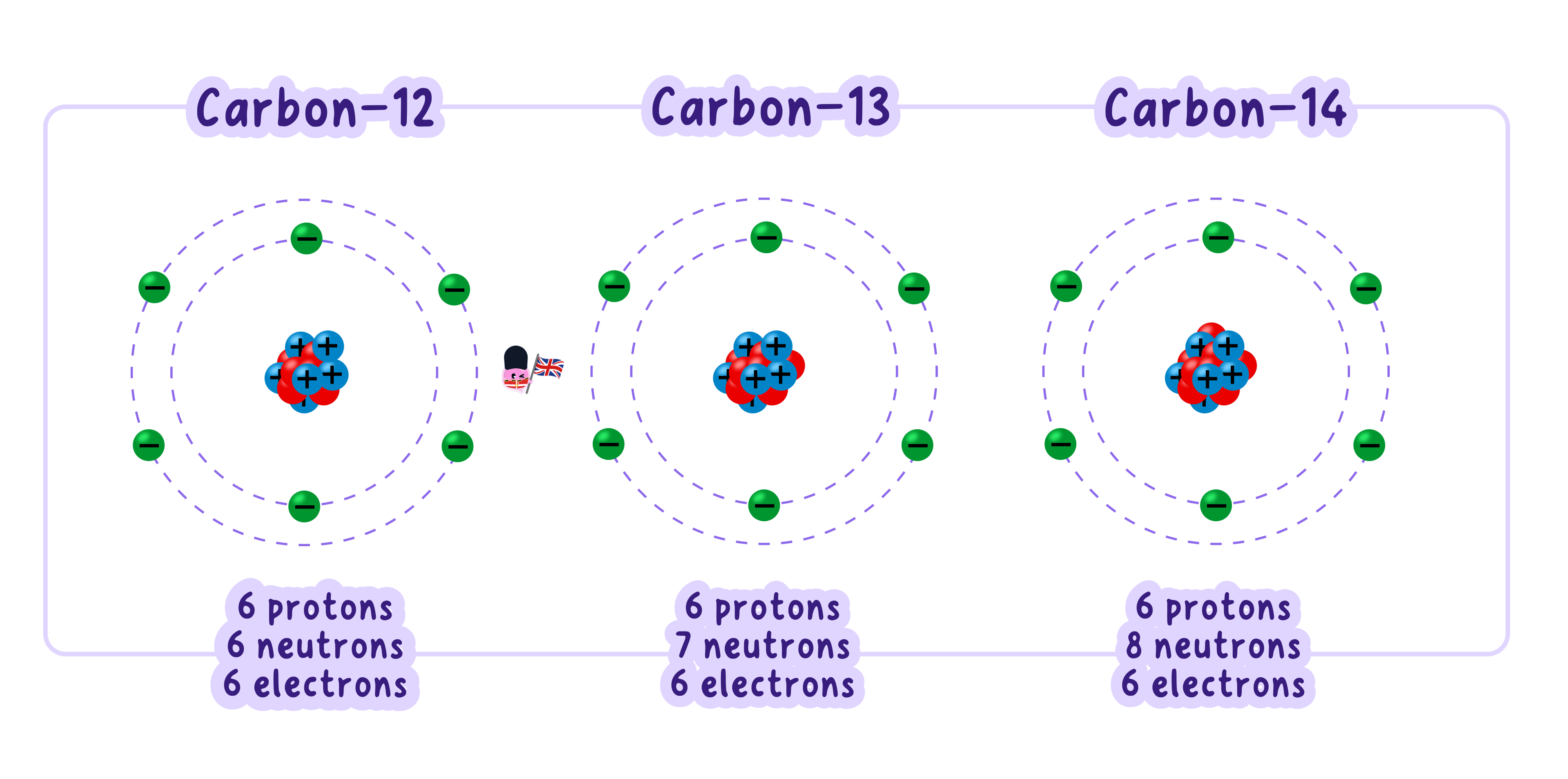
To understand relative atomic mass, we first need to remember what an isotope is. Isotopes are atoms of the same element that have the same number of protons but a different number of neutrons. Because neutrons carry mass, different isotopes of the exact same element will weigh different amounts.

Most elements occur in nature as a mixture of these isotopes. For example, if you collect a sample of naturally occurring chlorine gas, you won't just find one single type of atom. You will find a mixture: mostly atoms of chlorine-35, but with a significant amount of heavier chlorine-37 atoms mixed in.

alt text

Because a random sample of chlorine always contains this mixture, we cannot just pick one mass number to represent chlorine on the periodic table. We need a fair average.

What is Relative Atomic Mass?

If you look at a periodic table, you will notice that the mass number given for some elements is a decimal (like 35.5 for chlorine). This number is the relative atomic mass (given the symbol ArA_rAr​).

Definition

Relative atomic mass (Ar​)

The relative atomic mass of an element is an average value that takes account of the abundance of the isotopes of the element.

The word abundance simply means how common the isotope is in nature, usually given as a percentage.

Key Idea

The higher the abundance, the closer the average

The relative atomic mass is a "weighted" average. This means the final average is always closer to the mass of the most abundant isotope. Because naturally occurring chlorine is 75% chlorine-35, the average mass (35.5) is much closer to 35 than it is to 37.

Calculating Relative Atomic Mass

To find the relative atomic mass, we can't just add the mass numbers of the isotopes together and divide by two. That would assume there is exactly a 50/50 split of both isotopes, which is almost never true!

Instead, we use a formula that factors in the percentage abundance. You multiply the mass of each isotope by its percentage, add those all together, and divide by the total percentage (which is always 100):

Ar=(mass1×abundance1)+(mass2×abundance2)100 A_r = \frac{(\text{mass}_1 \times \text{abundance}_1) + (\text{mass}_2 \times \text{abundance}_2)}{100} Ar​=100(mass1​×abundance1​)+(mass2​×abundance2​)​

Let's look at how to use this step-by-step with our chlorine example.

Example

Calculating the relative atomic mass of chlorine

Chlorine has two main isotopes: chlorine-35 (which has a 75% abundance) and chlorine-37 (which has a 25% abundance).

  1. Multiply the mass of each isotope by its percentage abundance.
    • For chlorine-35: 35×75=262535 \times 75 = 262535×75=2625
    • For chlorine-37: 37×25=92537 \times 25 = 92537×25=925
  2. Add these values together to find the total mass of 100 atoms.
    • 2625+925=35502625 + 925 = 35502625+925=3550
  3. Divide the total by 100 to find the average mass of a single atom.
    • 3550÷100=35.53550 \div 100 = 35.53550÷100=35.5
    • The relative atomic mass (ArA_rAr​) of chlorine is 35.5.
Common Mistake

Dividing by the number of isotopes

A very common error in exams is to ignore the abundance percentages entirely and just average the two mass numbers (for example, doing (35+37)÷2=36(35 + 37) \div 2 = 36(35+37)÷2=36). This is incorrect! Always use the abundances and divide by 100.

Sometimes, exam questions will give you more complicated decimal percentages. Don't panic — the method remains exactly the same.

Example

Calculating with decimal percentages

A naturally occurring sample of copper contains 69.2% copper-63 and 30.8% copper-65. Calculate the relative atomic mass of copper to 1 decimal place.

  1. Multiply the mass of each isotope by its percentage abundance.
    • For copper-63: 63×69.2=4359.663 \times 69.2 = 4359.663×69.2=4359.6
    • For copper-65: 65×30.8=2002.065 \times 30.8 = 2002.065×30.8=2002.0
  2. Add the results together.
    • 4359.6+2002.0=6361.64359.6 + 2002.0 = 6361.64359.6+2002.0=6361.6
  3. Divide by the total percentage abundance (100).
    • 6361.6÷100=63.6166361.6 \div 100 = 63.6166361.6÷100=63.616
  4. Round the final answer to 1 decimal place as requested in the question.
    • The relative atomic mass (ArA_rAr​) of copper is 63.6.
Tip

Does your answer make sense?

You can always do a quick sanity check on your final answer. The relative atomic mass must always be a number between the smallest and largest isotope masses. In the copper example above, the answer (63.6) falls safely between 63 and 65. If you had calculated 72, or 40, you would instantly know a mistake had been made!

Exam technique

In the exam

  1. Show your working: Always write down the multiplication and addition steps before you divide by 100. If you type it all into your calculator at once and make a typo, you will score zero. If you show the working, you will usually pick up partial marks even if your final answer is slightly off.
  2. Read the rounding instructions: Frequently, these calculation questions will end with "Give your answer to 1 decimal place" or "to 3 significant figures". You will lose the final mark if you leave a long string of decimals on the answer line.
  3. Check the total abundance: Almost all questions will give you percentages that add up to 100. Very occasionally, a tricky question might give you abundances as whole numbers (e.g. "3 atoms of chlorine-35 for every 1 atom of chlorine-37"). If this happens, your total abundance isn't 100 — it's the total number of parts (in this case, 4). You would divide by 4 instead.
Self review

Check yourself

  • What two pieces of information about an element's isotopes do you need to calculate its relative atomic mass?
  • Why is the relative atomic mass of chlorine given as a decimal (35.5) on the periodic table, rather than a whole number?
  • If an element has an isotope with mass 10 (20% abundance) and an isotope with mass 11 (80% abundance), without doing any maths, will the relative atomic mass be closer to 10 or 11?
PreviousNext

How was this guide?

Relative atomic mass Revision Guide

  1. GCSE
  2. /Chemistry
  3. /Relative atomic mass