x

Electronic structure

What you'll learn

  • What electron shells, or energy levels, are in the GCSE model of the atom.
  • How to use atomic number to find the number of electrons in an atom.
  • How to write electronic structures such as 2,8,1.
  • How to draw shell diagrams for the first 20 elements.

Starting point: the atom

An atom has a tiny central nucleus containing protons and neutrons. Electrons are found around the nucleus. In this topic, we focus on where the electrons are arranged.

Electrons have negative charge, while protons have positive charge. A normal atom is neutral, meaning it has no overall charge.

Definition

Atomic number

The atomic number is the number of protons in the nucleus of an atom. In a neutral atom, the number of electrons is equal to the number of protons.

So, for a neutral atom:

  • atomic number = number of protons
  • number of protons = number of electrons
Example

Finding the number of electrons in argon

  1. Argon has atomic number 18, so an argon atom has 18 protons.

  2. A neutral atom has equal numbers of protons and electrons, so argon has 18 electrons.

  3. Those 18 electrons are the particles you must arrange into shells.

What is electronic structure?

Definition

Electronic structure

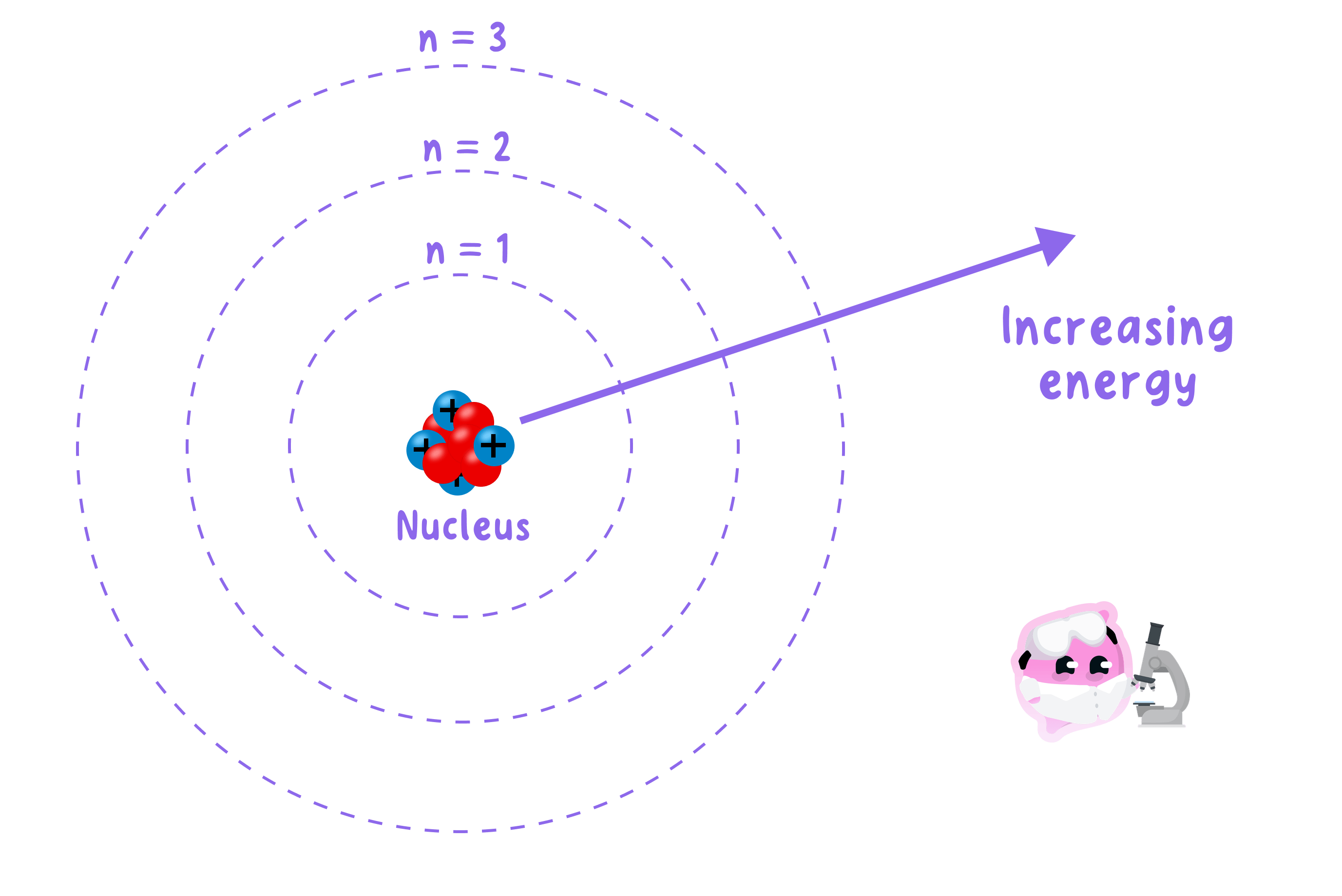
The electronic structure of an atom is the arrangement of its electrons in shells, also called energy levels, around the nucleus.

At GCSE, you can use the words shells and energy levels for the same idea. The innermost shell is the lowest energy level. Electrons occupy the lowest available energy levels first, so you fill shells from the inside out.

This diagram shows the shell-filling idea and the electronic structure of sodium.

Diagram showing electron shells, the filling rule, and sodium with electronic structure 2,8,1

Key Idea

Fill from the inside out

Electrons go into the lowest available energy level first: fill the first shell before the second, and the second before the third.

Shell capacities for the first 20 elements

For the first 20 elements, use this GCSE filling pattern:

ShellMaximum electrons for this topic
First shell2
Second shell8
Third shell8
Fourth shellUsed by potassium and calcium

So the pattern is:

2, then 8, then 8, then 2 for elements up to calcium.

Common Mistake

Stay within the GCSE model

For this topic, you only need to represent the first 20 elements. Do not apply the simple 2,8,8 pattern blindly to all elements in the periodic table; later elements need a more advanced model.

Writing electronic structure using numbers

The quickest way to represent electronic structure is with numbers separated by commas.

For example, sodium has 11 electrons. Its electronic structure is:

2,8,1

This means:

  • 2 electrons in the first shell
  • 8 electrons in the second shell
  • 1 electron in the third shell

The numbers always start from the shell nearest the nucleus and move outwards.

Example

Writing the electronic structure of chlorine

  1. Chlorine has atomic number 17, so a neutral chlorine atom has 17 electrons.

  2. Fill the first shell with 2 electrons: 17−2=1517 - 2 = 1517−2=15 electrons left.

  3. Fill the second shell with 8 electrons: 15−8=715 - 8 = 715−8=7 electrons left.

  4. Put the remaining 7 electrons in the third shell, so chlorine is 2,8,7.

Tip

Check the total

Add the numbers in the electronic structure. For a neutral atom, the total should equal the atomic number.

Drawing electronic structure diagrams

You may also be asked to draw electronic structure as a diagram.

A shell diagram usually has:

  • the nucleus in the centre, often labelled with the element symbol
  • circles around the nucleus to show shells
  • dots or crosses on the circles to show electrons

The exact position of electrons around a shell does not matter at GCSE. What matters is the number of electrons in each shell.

Example

Drawing the electronic structure of magnesium

  1. Magnesium has atomic number 12, so a neutral magnesium atom has 12 electrons.

  2. Fill the shells from the inside out: first shell 2 electrons, second shell 8 electrons, leaving 12−2−8=212 - 2 - 8 = 212−2−8=2 electrons.

  3. Magnesium’s electronic structure is 2,8,2, so draw three shells with 2 electrons on the first, 8 on the second, and 2 on the third.

Common Mistake

Using mass number instead of atomic number

Use the atomic number to find electrons in an atom, not the mass number or relative atomic mass. Sodium has 11 electrons, so its electronic structure is 2,8,1, even though its mass number is often 23.

Quick reference: the first 20 elements

You should be able to represent the electronic structures of the first 20 elements.

ElementAtomic numberElectronic structure
Hydrogen11
Helium22
Lithium32,1
Beryllium42,2
Boron52,3
Carbon62,4
Nitrogen72,5
Oxygen82,6
Fluorine92,7
Neon102,8
Sodium112,8,1
Magnesium122,8,2
Aluminium132,8,3
Silicon142,8,4
Phosphorus152,8,5
Sulfur162,8,6
Chlorine172,8,7
Argon182,8,8
Potassium192,8,8,1
Calcium202,8,8,2

Useful periodic table checks

The periodic table can help you check your answer.

A period is a horizontal row in the periodic table. For the first 20 elements, the period number tells you how many occupied shells the atom has.

A group is a vertical column in the periodic table. For many GCSE examples, the group number tells you the number of electrons in the outer shell. Group 0 elements have full outer shells. Helium is the special one: it has only 2 electrons, but its first shell is full.

Definition

Outer shell

The outer shell is the occupied shell furthest from the nucleus. The electrons in it are called outer-shell electrons.

Example

Using the periodic table to check sodium

  1. Sodium is in Period 3, so it should have three occupied shells.

  2. Sodium is in Group 1, so it should have one electron in its outer shell.

  3. Sodium has atomic number 11, so the full electronic structure is 2,8,1, which matches both checks.

Remember: shell diagrams are simplified two-dimensional pictures of atoms. The circles represent energy levels, not flat paths that electrons physically travel around like planets.

Exam technique

In the exam

  1. Start by finding the atomic number; this gives the number of electrons in a neutral atom.

  2. Fill shells in order using the GCSE pattern for the first 20 elements: 2, 8, 8, then 2.

  3. If drawing a diagram, count the electrons on each shell carefully and check that the total matches the atomic number.

Self review

Check yourself

  • What is the electronic structure of oxygen?

  • Why is potassium written as 2,8,8,1 rather than 2,8,9?

  • Draw the electronic structure of calcium as a shell diagram.

PreviousNext

How was this guide?

Electronic structure Revision Guide

  1. GCSE
  2. /Chemistry
  3. /Electronic structure