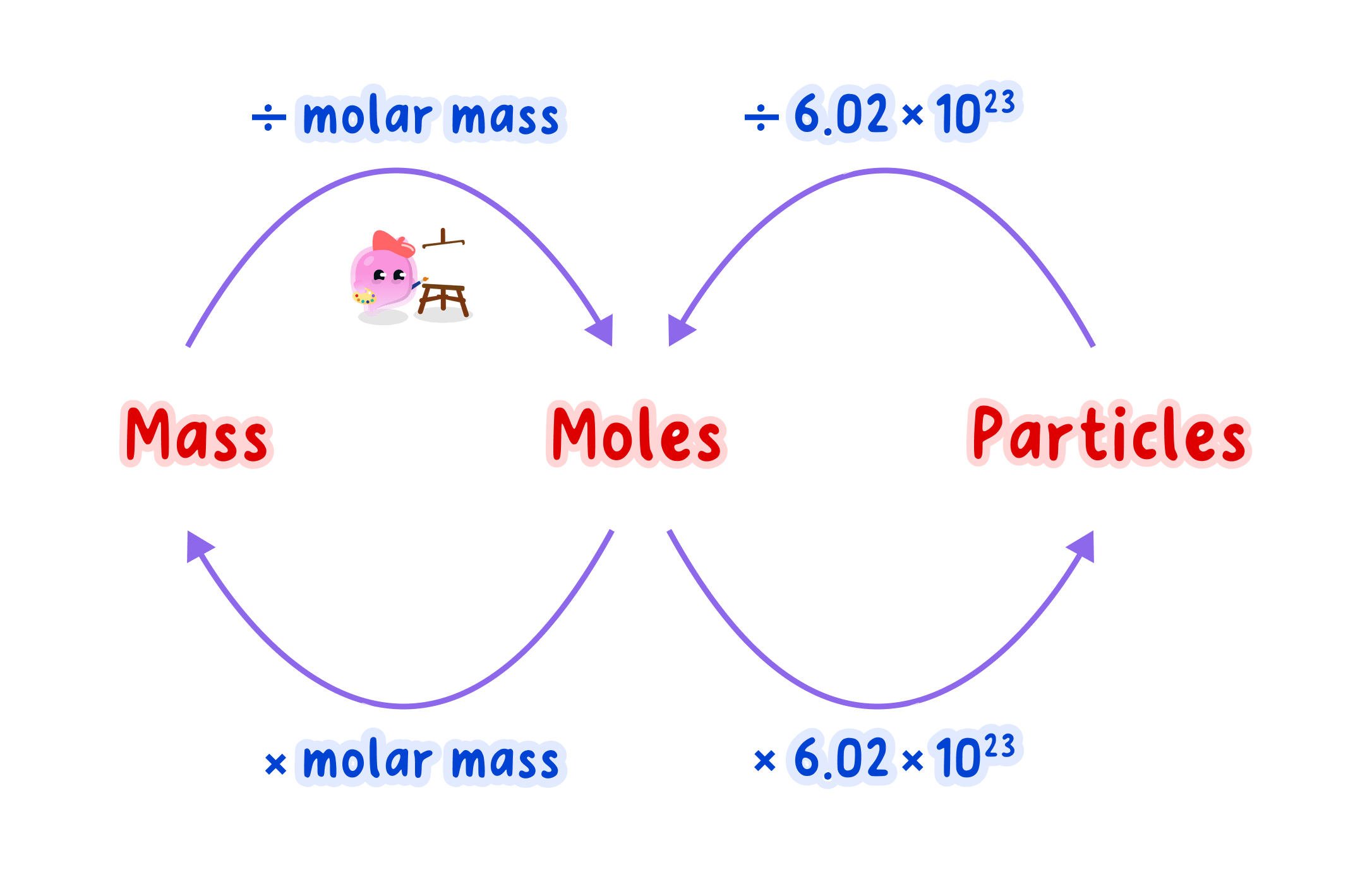
- What a mole is: a unit for measuring chemical amount.
- How the Avogadro constant links moles to numbers of atoms, molecules or ions.
- Why one mole has a mass in grams equal to the substance’s relative formula mass.
- How to calculate moles from mass, and mass from moles.
Atoms, molecules and ions are far too tiny to count one at a time in the lab. Even a small spatula of powder contains an enormous number of particles.
This Higher Tier idea lets you count particles by weighing substances. It is similar to using “a dozen” to mean 12 items, except a mole is much, much bigger.
Amount of substance
Amount of substance means how many particles of a substance you have. In chemistry, it is measured in moles, and the unit symbol is mol.
The word particle depends on the substance:
- An atom is a single particle of an element, such as C or Mg.
- A molecule is a group of atoms bonded together, such as O₂ or CO₂.
- An ion is a charged particle, such as Na⁺ or Cl⁻.
- A formula unit is the simplest whole-number ratio of ions in an ionic compound, such as NaCl.
- An electron is a negatively charged subatomic particle; moles can be used for electrons too.
Stated particles matter
One mole always means the same number of stated particles. So 1 mol of carbon contains carbon atoms, while 1 mol of carbon dioxide contains CO₂ molecules.
Before you can link mass to moles, you need formula masses.
A relative atomic mass, ArA_rAr, is the mass number for an element from the periodic table, compared with carbon-12. At GCSE, you normally use the rounded values given in the exam.
Relative formula mass
The relative formula mass, MrM_rMr, is the total of the relative atomic masses, ArA_rAr, of all the atoms shown in a formula. It has no units.
A subscript is the small lower number in a formula. For example, in CO₂, the ₂ means there are 2 oxygen atoms in each molecule.
Finding relative formula mass
Calculate MrM_rMr for calcium carbonate, CaCO₃. Use ArA_rAr: Ca = 40, C = 12, O = 16.
- Count the atoms in the formula: CaCO₃ contains 1 calcium atom, 1 carbon atom and 3 oxygen atoms.
- Multiply each ArA_rAr by the number of that atom and add them: Mr=40+12+(3×16)M_r = 40 + 12 + (3 \times 16)Mr=40+12+(3×16).
- Calculate the total: Mr=100M_r = 100Mr=100, so calcium carbonate has relative formula mass 100.
Forgetting the subscript
In CaCO₃, the ₃ applies only to oxygen, not to calcium or carbon. Always multiply only the element directly before the subscript.
Avogadro constant
The Avogadro constant, NAN_ANA, is the number of atoms, molecules or ions in one mole of a substance: NA=6.02×10²³ mol−1N_A = 6.02 \times 10^{23}\ \text{mol}^{-1}NA=6.02×10²³ mol−1.
That means:
- 1 mol of carbon atoms contains 6.02×10236.02 \times 10^{23}6.02×10²³ carbon atoms.
- 1 mol of CO₂ molecules contains 6.02×10236.02 \times 10^{23}6.02×10²³ CO₂ molecules.
- 1 mol of NaCl formula units contains 6.02×10236.02 \times 10^{23}6.02×10²³ NaCl formula units.
They contain the same number of stated particles, but their masses are different because their formula masses are different.

Use:
N=nNAN = nN_AN=nNA
where NNN is the number of particles and nnn is the amount in moles.
Calculating molecules from moles
How many CO₂ molecules are in 0.250 mol of carbon dioxide?
- Choose the particle type: the formula CO₂ represents molecules, so the answer should be in CO₂ molecules.
- Substitute into N=nNAN = nN_AN=nNA: N=0.250×6.02×1023N = 0.250 \times 6.02 \times 10^{23}N=0.250×6.02×1023.
- Calculate and round suitably: N=1.505×10²³≈1.51×10²³N = 1.505 \times 10^{23} \approx 1.51 \times 10^{23}N=1.505×10²³≈1.51×10²³ CO₂ molecules.
Molecules are not the same as atoms
1 mol of CO₂ means 6.02×10236.02 \times 10^{23}6.02×10²³ CO₂ molecules. Because each CO₂ molecule has 3 atoms, it contains 3 times as many atoms in total.
The key GCSE fact is:
Mass of one mole
The mass of one mole of a substance in grams is numerically equal to its MrM_rMr.
So if CO₂ has Mr=44M_r = 44Mr=44, then 1 mol of CO₂ has a mass of 44 g.
Molar mass
Molar mass, MMM, is the mass of 1 mol of a substance, measured in grams per mole (g/mol). Its number is the same as the substance’s MrM_rMr.
For a known pure substance, use:
n=mMm=nMM=mn\begin{aligned}
n &= \frac{m}{M} \\
m &= nM \\
M &= \frac{m}{n}
\end{aligned}nmM=Mm=nM=nm
where nnn is amount in mol, mmm is mass in g, and MMM is molar mass in g/mol.
At GCSE, you will often see this written as:
moles=mass in gMr\text{moles} = \frac{\text{mass in g}}{M_r}moles=Mrmass in g
Unit check
Use mass in grams, not kilograms, when using MrM_rMr directly. If the question gives kg, convert first: 1 kg = 1000 g.
Calculating moles from mass
Calculate the amount, in moles, in 8.80 g of carbon dioxide, CO₂. Use ArA_rAr: C = 12, O = 16.
- Find the formula mass: Mr=12+(2×16)=44M_r = 12 + (2 \times 16) = 44Mr=12+(2×16)=44, so M=44 g mol−1M = 44\ \text{g mol}^{-1}M=44 g mol−1.
- Use the moles equation: n=mMn = \frac{m}{M}n=Mm.
- Substitute and calculate: n=8.80 g44 g mol−1=0.200 moln = \frac{8.80\ \text{g}}{44\ \text{g mol}^{-1}} = 0.200\ \text{mol}n=44 g mol−18.80 g=0.200 mol.
Calculating mass from moles
Calculate the mass of 0.150 mol of magnesium chloride, MgCl₂. Use ArA_rAr: Mg = 24, Cl = 35.5.
- Find the formula mass: Mr=24+(2×35.5)=95M_r = 24 + (2 \times 35.5) = 95Mr=24+(2×35.5)=95, so M=95 g mol−1M = 95\ \text{g mol}^{-1}M=95 g mol−1.
- Rearrange the equation to make mass the subject: m=nMm = nMm=nM.
- Substitute and calculate: m=0.150 mol×95 g mol−1=14.25 gm = 0.150\ \text{mol} \times 95\ \text{g mol}^{-1} = 14.25\ \text{g}m=0.150 mol×95 g mol−1=14.25 g, which is 14.3 g to 3 significant figures.
Balanced chemical equations can be read in particles or in moles.
For example:
2Mg(s) + O₂(g) → 2MgO(s)
This means:
- 2 magnesium atoms react with 1 oxygen molecule to form 2 magnesium oxide formula units.
- 2 mol of magnesium react with 1 mol of oxygen to form 2 mol of magnesium oxide.
Reading a mole ratio
For 2Mg(s) + O₂(g) → 2MgO(s), how many moles of O₂ are needed to react with 0.600 mol of Mg?
- Use the coefficients in the equation: 2 mol Mg react with 1 mol O₂.
- Scale the ratio down from 2 mol Mg to 0.600 mol Mg: n(O2)=0.600÷2n(\text{O}_2) = 0.600 \div 2n(O2)=0.600÷2.
- Calculate the amount of oxygen: n(O2)=0.300 moln(\text{O}_2) = 0.300\ \text{mol}n(O2)=0.300 mol.
In the exam
- Identify what the question asks for: mass, moles, or number of particles.
- Calculate MrM_rMr carefully from the formula before using the mass–moles equation.
- Keep units with your working: g for mass, mol for amount, and standard form for huge particle numbers.
Check yourself
- How many molecules are in 2.00 mol of oxygen, O₂?
- Calculate the amount in moles in 5.00 g of calcium carbonate, CaCO₃.
- What mass of sodium chloride, NaCl, is present in 0.250 mol?