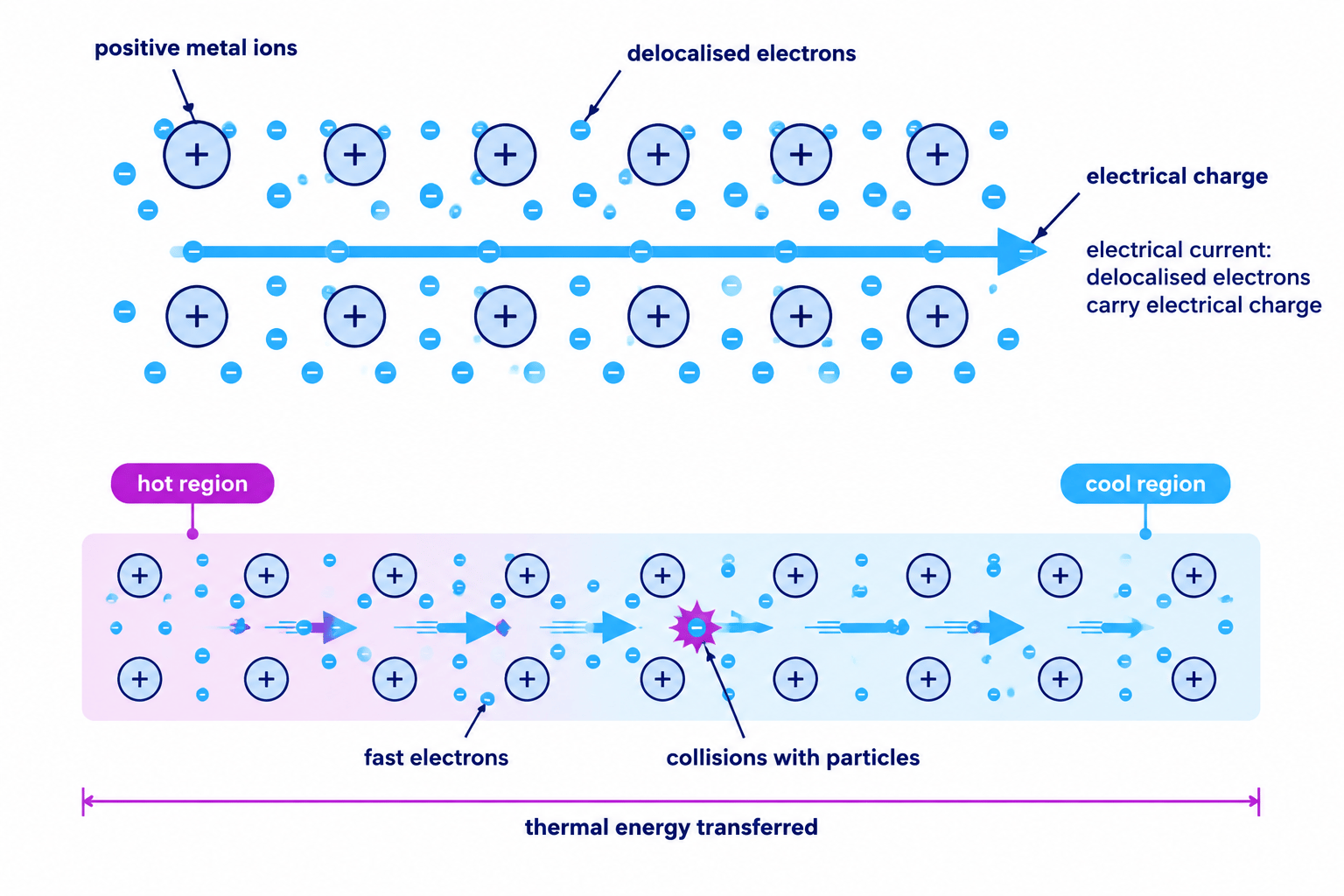
- What a metallic structure looks like at particle level.
- Why delocalised electrons let metals conduct electricity.
- Why the same electrons help metals conduct thermal energy.
- How to write clear GCSE explanations linking structure to properties.
In GCSE Chemistry, a big idea is:
The way particles are arranged and bonded explains the properties of a substance.
For metals, the key structure is not made from separate molecules. Instead, a metal has a giant metallic structure: a large, repeating arrangement of metal ions with electrons spread through it.
Giant metallic structure
A giant metallic structure is a regular arrangement of positive metal ions surrounded by delocalised electrons.
This structure explains why metals are usually:
- good conductors of electricity
- good conductors of thermal energy
- malleable, meaning they can be hammered or bent into shape
In this topic, we focus on the first two.
Metal atoms lose their outer-shell electrons into a shared “sea” of electrons. The metal atoms become positive metal ions because they have lost negative electrons.
The electrons are not attached to one particular ion. They can move throughout the whole metal structure.
Delocalised electrons
Delocalised electrons are electrons that are not fixed to one atom or ion. In metals, they can move through the structure.
The metal is held together by metallic bonding.
Metallic bonding
Metallic bonding is the strong electrostatic attraction between positive metal ions and delocalised electrons.
Here is the particle-level picture you should imagine when explaining metallic conduction.

The particles that matter
In a solid metal, the positive metal ions are held in fixed positions, but the delocalised electrons can move through the metal.
A substance conducts electricity if it contains charged particles that can move.
In metals, the moving charged particles are the delocalised electrons. Electrons are negatively charged, so when they move through the metal, they carry electrical charge.
Electrical conductor
An electrical conductor is a material that allows electrical charge to flow through it.
When a metal wire is connected in a circuit, the delocalised electrons move through the metal. This movement of charge is an electric current.
For GCSE, your explanation should include both parts:
- metals contain delocalised electrons
- these electrons can move and carry electrical charge through the metal
Explaining why copper is used for electrical wires
Copper is commonly used in electrical wires. Explain why copper conducts electricity well.
-
Identify the structure: copper is a metal, so it has a giant metallic structure with positive copper ions and delocalised electrons.
-
Decide which charged particles can move: the positive copper ions are held in fixed positions in the solid, but the delocalised electrons can move throughout the metal.
-
Link movement to conduction: the moving delocalised electrons carry electrical charge through the copper wire, so copper is a good electrical conductor.
The positive metal ions are charged, but in a solid metal they are not free to move from place to place. They can vibrate, but they stay in their positions in the lattice.
So, in a solid metal:
- electrons carry the charge
- ions do not flow through the metal
Saying the metal ions move
Do not write that positive metal ions move through a solid metal to carry charge. In a solid metal, the delocalised electrons move; the positive ions stay in fixed positions.
Metals are also good conductors of thermal energy. This means heat energy can pass through them quickly.
Thermal conductor
A thermal conductor is a material that transfers thermal energy through itself easily.
If one end of a metal rod is heated, the particles at that end gain energy. In a metal, the delocalised electrons can move through the structure and transfer energy from the hot region to colder regions.
At GCSE, the key sentence is:
Metals conduct thermal energy because energy is transferred by the delocalised electrons.
Same electrons, two jobs
Delocalised electrons explain both electrical conduction and thermal conduction in metals: they carry electrical charge and transfer thermal energy.
Explaining why a metal pan handle gets hot
A metal pan handle becomes hot when the pan is heated. Explain this using metallic structure.
-
Identify the relevant particles: the handle is made of metal, so it contains delocalised electrons that can move through the structure.
-
Apply heating: electrons near the hot part gain energy.
-
Link to energy transfer: these delocalised electrons move and transfer energy to colder parts of the metal handle, so thermal energy passes along the handle.
The two types of conduction are similar, but not identical.
Electrical conduction is about the movement of charge.
In metals:
- the charge carriers are delocalised electrons
- the electrons move through the metal
- this allows an electric current to flow
Thermal conduction is about the transfer of energy.
In metals:
- delocalised electrons gain energy in hotter regions
- they move through the metal
- they transfer energy to other particles in cooler regions
One phrase to remember
For electricity, write “delocalised electrons carry charge”. For thermal energy, write “delocalised electrons transfer energy”.
Many non-metals do not conduct electricity because their electrons are held in fixed positions in covalent bonds or in electron shells. They do not usually have delocalised electrons that can move through the whole structure.
So the key difference is not just “having electrons”. All atoms have electrons. The important point is whether there are mobile charged particles.
Thinking all electrons can conduct
A substance only conducts electricity if it has charged particles that are free to move. Electrons that are fixed in bonds cannot carry charge through the substance.
Some substances are exceptions, such as graphite, which is a non-metal form of carbon with delocalised electrons. But for ordinary metals, delocalised electrons are the reason for good conductivity.
When a question asks why a metal conducts electricity, avoid vague answers like:
- “because it is a metal”
- “because it has free particles”
- “because electrons are present”
Instead, make the structure-property link clear.
A strong answer for electrical conduction is:
Metals contain delocalised electrons that can move through the structure and carry electrical charge.
A strong answer for thermal conduction is:
Metals contain delocalised electrons that move through the structure and transfer thermal energy.
Choosing the better explanation
Question: Explain why aluminium is a good conductor of electricity.
Answer A: Aluminium conducts because it has electrons.
Answer B: Aluminium conducts because it has delocalised electrons that can move through the metal and carry electrical charge.
-
Compare the particle detail: Answer A mentions electrons, but it does not say whether they can move.
-
Apply the conduction rule: electrical conduction needs charged particles that are free to move.
-
Choose the stronger answer: Answer B is better because it names the delocalised electrons, says they can move, and links this to carrying electrical charge.
Metals are used in many places because of their conductivity.
For example:
- copper wires conduct electricity in circuits
- aluminium power cables conduct electricity and are relatively low density
- steel pans transfer thermal energy from the hob to the food
- metal radiators transfer thermal energy to the surrounding air
In exam answers, do not just state the use. Link the use to the property, then link the property to the structure.
For example:
Copper is used for wiring because it is a good electrical conductor. It contains delocalised electrons that can move through the copper and carry charge.
Metals conduct because of their metallic structure.
The structure contains:
- positive metal ions
- delocalised electrons
- strong electrostatic attractions between them
The properties come from the mobile electrons:
- electrical conduction: delocalised electrons carry charge
- thermal conduction: delocalised electrons transfer energy
In the exam
-
For electrical conduction, always mention delocalised electrons and that they carry charge through the metal.
-
For thermal conduction, mention that delocalised electrons transfer energy through the metal.
-
Do not say the positive metal ions move through a solid metal; they are held in fixed positions and only vibrate.
Check yourself
- What does “delocalised” mean when describing electrons in a metal?
- Why can copper conduct electricity but many simple covalent substances cannot?
- In a metal, what is being transferred during thermal conduction?