Revision notes for AQA GCSE Chemistry Diamond. Open the guide for explanations and worked examples. Written against the AQA GCSE Chemistry (8462) specification, so the content matches what's examinable rather than general Chemistry background.
Carbon is a non-metal element. Each carbon atom has four electrons in its outer shell, so carbon atoms can form four covalent bonds.
Covalent bond
A covalent bond is a strong bond formed when two atoms share a pair of electrons.
In diamond, carbon atoms do not join up in small separate molecules. Instead, each carbon atom bonds to other carbon atoms, and this repeats again and again through the whole structure.
Giant covalent structure
A giant covalent structure is a very large network of atoms joined together by covalent bonds throughout the structure.
The word giant does not mean “large enough to see with your eyes”. It means the bonding pattern continues for huge numbers of atoms. There are no small diamond molecules.
You may also see the word lattice.
Lattice
A lattice is a regular repeating arrangement of particles, such as atoms, ions, or molecules.
In diamond, the particles in the lattice are carbon atoms. The bonds between them are covalent bonds.
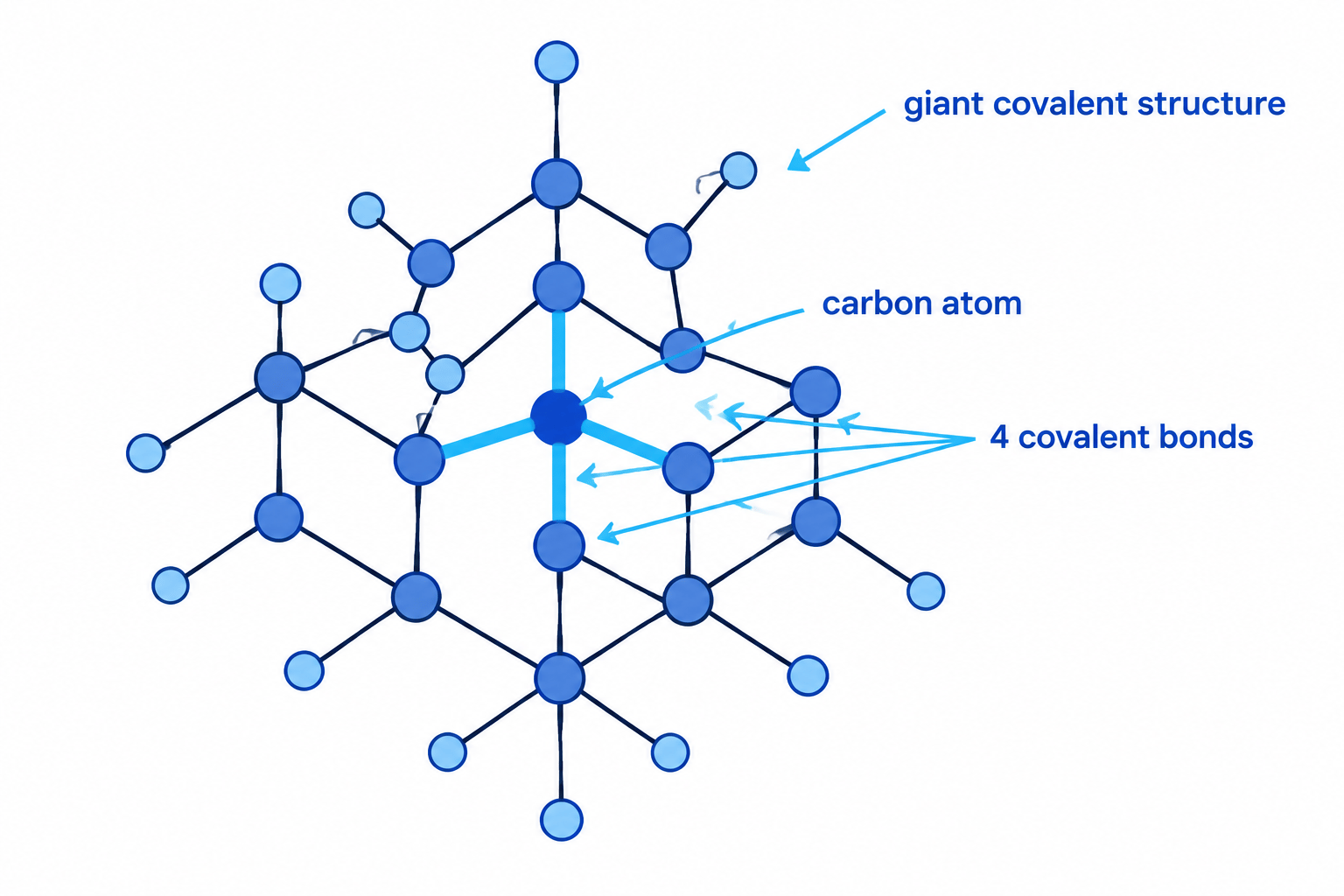
In diamond, each carbon atom forms four covalent bonds with four other carbon atoms. This makes a three-dimensional network. The bonds point in different directions, so the structure is not a flat sheet.

Diamond's structure
Diamond is a giant covalent structure where each carbon atom forms four covalent bonds to other carbon atoms in a three-dimensional lattice.
Because every carbon atom is strongly bonded into the network, diamond has very different properties from simple molecular substances such as methane or carbon dioxide.
Diamond diagrams are often drawn on a flat page, but they represent a three-dimensional structure. Lines usually represent covalent bonds, and circles or labelled points represent carbon atoms.
Do not worry if atoms at the edge of a diagram seem to have fewer than four bonds. The diagram is only showing a small part of a much bigger lattice. In the real structure, the network continues beyond the edge of the drawing.
Reading diamond diagrams
For diamond, check the bonding around atoms in the middle of the diagram: each carbon should be joined to four other carbon atoms. Edge atoms may look incomplete because the structure continues beyond the part shown.
Interpreting a carbon structure diagram
Suppose a diagram shows carbon atoms joined in a three-dimensional network. A central carbon atom is connected to four other carbon atoms.
Identify the particles: the diagram shows carbon atoms joined to other carbon atoms, not ions or separate molecules.
Count the bonds around a central atom: the central carbon has four covalent bonds to four neighbouring carbon atoms.
Use the bonding pattern to classify the structure: carbon atoms joined by covalent bonds in a repeating three-dimensional network means it is a giant covalent structure.
Match it to the carbon allotrope: a giant covalent carbon structure with each carbon bonded to four others is diamond.
Diamond is very hard because the carbon atoms are held in fixed positions by many strong covalent bonds. These bonds go throughout the three-dimensional lattice.
To scratch or cut a substance, particles need to be moved out of place. In diamond, moving atoms out of place would mean overcoming strong covalent bonds in the giant structure. That is very difficult, so diamond is extremely hard.
This is why diamond can be used in cutting tools and drill tips.
Hardness explanation
Do not just write “diamond is hard because it is strong”. Explain what is strong: the many covalent bonds between carbon atoms throughout the giant structure.
The melting point is the temperature at which a solid changes into a liquid.
Diamond has a very high melting point because a lot of energy is needed to break the many strong covalent bonds in the giant lattice. These bonds are not just between a few atoms — they extend throughout the whole structure.
High melting point
Giant covalent structures have high melting points because many strong covalent bonds must be overcome.
Avoid saying diamond has “strong intermolecular forces”. That is the explanation for some simple molecular substances. Diamond does not contain small separate molecules, so “intermolecular forces” is not the right idea here.
Intermolecular forces in diamond
Diamond is not made of small molecules, so do not explain its high melting point using intermolecular forces. Use strong covalent bonds in a giant lattice instead.
For a substance to conduct electricity, it needs charged particles that can move through the structure.
Delocalised electrons
Delocalised electrons are electrons that are not fixed between two particular atoms and can move through a structure.
Diamond does not conduct electricity because it has no delocalised electrons. Each carbon atom uses its four outer-shell electrons to form four covalent bonds. The electrons are held in these bonds, so they cannot move through the lattice and carry charge.
Diamond also does not contain ions that are free to move. So there are no mobile charged particles.
Conductivity
Diamond does not conduct electricity because all the outer-shell electrons are used in covalent bonds, so there are no delocalised electrons to carry charge.
This is an important difference between diamond and graphite. Both are made of carbon, but their structures are different, so their properties are different.
Allotrope
An allotrope is a different structural form of the same element. Diamond and graphite are allotropes of carbon.
The key exam skill is connecting the property to the bonding and structure. You should avoid giving isolated facts. Instead, use a chain of reasoning.
For diamond, the structure-property links are:
Linking diamond's structure to its properties
A student says: “Diamond has a high melting point and does not conduct electricity because it is made of carbon.” Improve this explanation.
Replace the vague reason with the structure: diamond is a giant covalent structure where each carbon atom forms four covalent bonds with other carbon atoms.
Link the melting point to the bonding: many strong covalent bonds extend throughout the lattice, so a large amount of energy is needed to overcome them.
Link conductivity to charged particles: electricity requires mobile charged particles, such as delocalised electrons or moving ions.
Apply this to diamond: all the outer-shell electrons are used in covalent bonds, so diamond has no delocalised electrons and does not conduct electricity.
A strong answer about diamond usually sounds like this:
Diamond is a giant covalent structure. Each carbon atom forms four covalent bonds with other carbon atoms in a three-dimensional lattice. The many strong covalent bonds make diamond very hard and give it a very high melting point. Diamond does not conduct electricity because all the outer-shell electrons are used in covalent bonds, so there are no delocalised electrons or mobile ions to carry charge.
Best wording
When explaining properties, include both parts: structure and bonding. For example, “giant covalent structure” plus “many strong covalent bonds”.
In the exam
For hardness or melting point, write about many strong covalent bonds in a giant three-dimensional lattice.
For electrical conductivity, write about no delocalised electrons and no mobile charged particles.
Do not describe diamond as having molecules or strong intermolecular forces; it is a giant covalent structure.
Check yourself
Structure and bonding of carbon
Guide 1 of 3
Test yourself on this topic, or move on to the next guide.
How was this guide?