- What metallic bonding is and how it holds metals together.
- Why most metals have high melting and boiling points.
- Why pure metals can be bent and shaped.
- Why alloys are usually harder than pure metals.
Many substances you meet in GCSE Chemistry are made from simple molecules, like oxygen, O₂, or water, H₂O. Metals are different.
A metal is made from a huge, repeating arrangement of particles. The particles are packed closely together in a regular pattern.
Giant structure
A giant structure is a structure containing a very large number of particles joined together in a repeating arrangement.
For metals, this giant structure is often described as a giant metallic lattice. A lattice is a regular arrangement of particles in rows or layers.
Do not say metals are molecules
Metals do not usually exist as small molecules. In exam answers, write about metal atoms, positive metal ions, layers, and delocalised electrons instead.
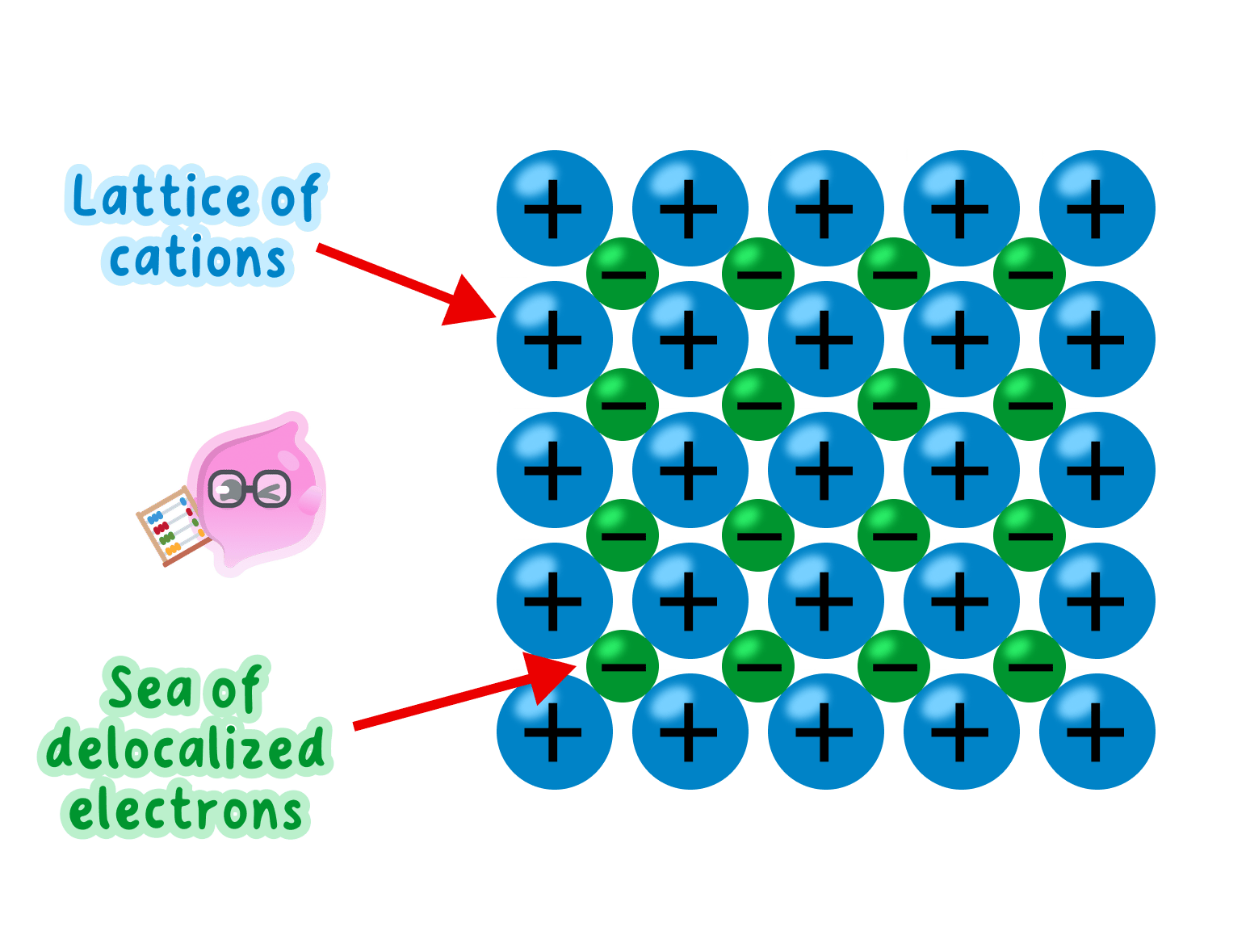
In a metal, the outer electrons of the metal atoms become delocalised. This means they are no longer attached to one particular atom and can move throughout the whole structure.
The metal atoms become positive metal ions because they have lost some negatively charged outer electrons.
Metallic bonding
Metallic bonding is the strong electrostatic attraction between positive metal ions and delocalised electrons.
An electrostatic attraction is a force of attraction between opposite charges. Here, the positive ions are attracted to the negative electrons.
The diagram below shows the metallic structure and how pure metals compare with alloys.

The big picture
Metals have giant structures with strong metallic bonding. This explains why most metals have high melting and boiling points.
To melt a solid metal, the particles must gain enough energy to move out of their fixed positions. To boil a metal, the particles must be separated even more.
Because metallic bonding is strong, a lot of energy is needed to overcome the attraction between the positive metal ions and the delocalised electrons. This means most metals have high melting points and high boiling points.
For example, iron, copper and aluminium are solids at room temperature because their metallic bonding is strong enough to keep the particles in a fixed solid structure.
Most, not all
The GCSE statement says most metals have high melting and boiling points. Mercury is a well-known exception because it is liquid at room temperature.
Linking metallic bonding to melting point
A student is asked: “Explain why copper has a high melting point.”
-
Start from the structure: copper has a giant metallic structure containing positive copper ions and delocalised electrons.
-
Identify the force that must be overcome: there are strong electrostatic attractions between the positive ions and the delocalised electrons.
-
Link this force to energy: a large amount of energy is needed to overcome these attractions, so copper has a high melting point.
In a pure metal, all the atoms are the same type and roughly the same size. This means they can pack into regular layers.
Pure metal
A pure metal contains only one type of metal atom.
Because the layers are regular, they can slide over each other when a force is applied. This is why many pure metals can be bent, hammered into shape, or stretched into wires.
Two useful words are:
- Malleable — can be hammered or pressed into shape.
- Ductile — can be drawn out into wires.
This is useful for some jobs. For example, copper can be drawn into wires, and aluminium can be rolled into sheets.
Why metals can be shaped
Pure metals can be bent and shaped because their regular layers of atoms can slide over each other.
Explaining why a pure metal bends
A student is asked: “Explain why pure aluminium can be rolled into sheets.”
-
Pure aluminium contains aluminium atoms arranged in regular layers.
-
When a force is applied by the rollers, the layers can slide over each other.
-
Because the layers can slide without the metallic bonding completely breaking, the aluminium can be flattened into sheets.
Being able to bend and shape a metal is sometimes useful, but it can also be a problem.
A pure metal may be too soft for uses where it must resist dents, scratches or changes in shape. For example, pure gold is attractive and does not corrode easily, but it is too soft for everyday jewellery on its own.
So, metals are often mixed with other elements to make them more useful.
An alloy is a mixture containing a metal and at least one other element. The added element is often another metal, but it does not have to be.
Alloy
An alloy is a mixture of two or more elements, where at least one of the elements is a metal.
Common examples include:
- Steel — mainly iron with carbon and sometimes other elements.
- Brass — copper and zinc.
- Bronze — copper and tin.
- Gold jewellery alloys — gold mixed with metals such as copper, silver or palladium.
Alloys are not compounds. The atoms are mixed together, but they have not chemically reacted in a fixed ratio to form a new compound.
Alloy does not mean compound
An alloy is a mixture, not a compound. For GCSE, the key idea is that different-sized atoms disturb the regular layers in the metal structure.
In an alloy, atoms of different elements are different sizes. When these different-sized atoms are mixed into the metal lattice, they distort the regular layers.
Distort means to change the shape or arrangement. The layers are no longer perfectly regular, so they cannot slide over each other as easily.
That means more force is needed to change the shape of the alloy. So the alloy is harder than the pure metal.
Alloy hardness
Alloys are harder than pure metals because different-sized atoms distort the layers, making it harder for the layers to slide over each other.
Explaining why bronze is harder than copper
Bronze is an alloy of copper and tin. A student is asked: “Explain why bronze is harder than pure copper.”
-
Pure copper has copper atoms arranged in regular layers, so the layers can slide over each other fairly easily.
-
Bronze contains copper atoms mixed with tin atoms, which are a different size from copper atoms.
-
The tin atoms distort the layers in the structure, so the layers cannot slide over each other as easily.
-
Because the layers are harder to move, bronze is harder than pure copper.
A strong GCSE answer usually links three things:
- Structure — what the particles are like and how they are arranged.
- Bonding or forces — what holds the particles together.
- Property — what the substance is like, such as hard, soft, high melting point, or malleable.
For this topic, your explanations often follow one of these chains:
Metal has a giant metallic structure → strong metallic bonding between positive ions and delocalised electrons → lots of energy needed to overcome the attractions → high melting point.
Pure metal atoms are in regular layers → layers can slide over each other → metal can be bent and shaped.
Alloy contains different-sized atoms → layers are distorted → layers cannot slide over each other easily → alloy is harder.
Use the word because
If your answer has no “because”, it may only be describing the property, not explaining it. Aim for sentences like: “Alloys are harder because different-sized atoms distort the layers.”
Pure metals contain one type of atom. Their atoms are arranged in regular layers. These layers can slide over each other, so pure metals are often softer and easier to shape.
Alloys contain atoms of different elements. These atoms are different sizes, which distorts the layers. The layers cannot slide as easily, so alloys are usually harder.
In the exam
-
For high melting or boiling points, mention giant metallic structure, strong metallic bonding, and lots of energy needed.
-
For pure metals being bendy or shapeable, mention regular layers of atoms sliding over each other.
-
For alloys being harder, mention different-sized atoms, distorted layers, and layers cannot slide easily.
Check yourself
- Why do most metals have high melting points?
- Why can layers of atoms slide in a pure metal?
- Why is an alloy usually harder than the pure metal it is made from?