Covalent bonding: Shared electron pairs join atoms strongly
Definition
Covalent bond
A covalent bond is a strong electrostatic attraction between a shared pair of electrons and the nuclei of the bonded atoms.
Definition
Outer shell
The highest occupied electron shell of an atom, containing the electrons involved when the atom forms an ion.
- A covalent bond forms when two atoms share a pair of electrons.
- The bond between two covalently bonded atoms is strong.
- In the molecules studied here, each atom contributes one electron to each shared pair.
- Sharing electrons gives each hydrogen atom two electrons in its outer shell, and can give carbon, nitrogen, oxygen and chlorine eight outer-shell electrons.
- Atoms can share one, two or three pairs of electrons, forming single, double or triple covalent bonds.
Key Idea
- One covalent bond is made of one shared pair of electrons.
- Covalent bonds are strong in small molecules, polymers and giant covalent structures.
Small molecules: Formulae show the atoms in each separate particle
- Many covalently bonded substances exist as small molecules, which are separate groups holding a fixed number of atoms.
- A molecular formula gives the actual number of atoms of each element in one molecule.
- Hydrogen, chlorine, oxygen and nitrogen exist as the diatomic molecules H2\text{H}_2H2, Cl2\text{Cl}_2Cl2, O2\text{O}_2O2 and N2\text{N}_2N2.
- Other common small molecules include hydrogen chloride, HCl\text{HCl}HCl, water, H2O\text{H}_2\text{O}H2O, ammonia, NH3\text{NH}_3NH3, methane, CH4\text{CH}_4CH4, and carbon dioxide, CO2\text{CO}_2CO2.
- A subscript applies only to the element symbol immediately before it, so H2O\text{H}_2\text{O}H2O contains two hydrogen atoms and one oxygen atom.
- A formula made of covalently bonded atoms does not always mean a small molecule, because diamond and silicon dioxide form giant structures.
Example
- A model of one carbon atom bonded to four hydrogen atoms has the molecular formula CH4\text{CH}_4CH4.
- A model of two bonded oxygen atoms has the molecular formula O2\text{O}_2O2, not O\text{O}O.
Dot and cross diagrams: Electron counts reveal every shared pair
Definition
Dot and cross diagram
A diagram that uses different symbols to show the outer-shell electrons from different atoms, including shared pairs and lone pairs.
- A dot and cross diagram shows the outer-shell electrons involved in covalent bonding.
- Use dots for the electrons from one atom and crosses for the electrons from the other atom.
- For a molecule with several identical outer atoms, such as methane, use one symbol for the central atom's electrons and the other symbol for the hydrogen electrons.
- Place one dot and one cross together between two atoms for each shared pair.
- Add every unshared outer-shell electron around the correct atom.
- Check that each hydrogen has two electrons around it and that each carbon, nitrogen, oxygen or chlorine has eight.
- Hydrogen, H2\text{H}_2H2
- Each hydrogen gives one electron to one shared pair, so the molecule has one single bond and no lone pairs.
- Chlorine, Cl2\text{Cl}_2Cl2
- Each chlorine gives one electron to one shared pair, so the molecule has one single bond.
- Each chlorine also has three lone pairs.
- Oxygen, O2\text{O}_2O2
- Each oxygen gives two electrons to two shared pairs, so the molecule has a double bond.
- Each oxygen also has two lone pairs.
- Nitrogen, N2\text{N}_2N2
- Each nitrogen gives three electrons to three shared pairs, so the molecule has a triple bond.
- Each nitrogen also has one lone pair.
- Hydrogen chloride, HCl\text{HCl}HCl
- Hydrogen and chlorine each give one electron to one shared pair, so the molecule has one single bond.
- Chlorine also has three lone pairs.
- Water, H2O\text{H}_2\text{O}H2O
- Oxygen shares one pair with each hydrogen, so the molecule has two single bonds.
- Oxygen also has two lone pairs.
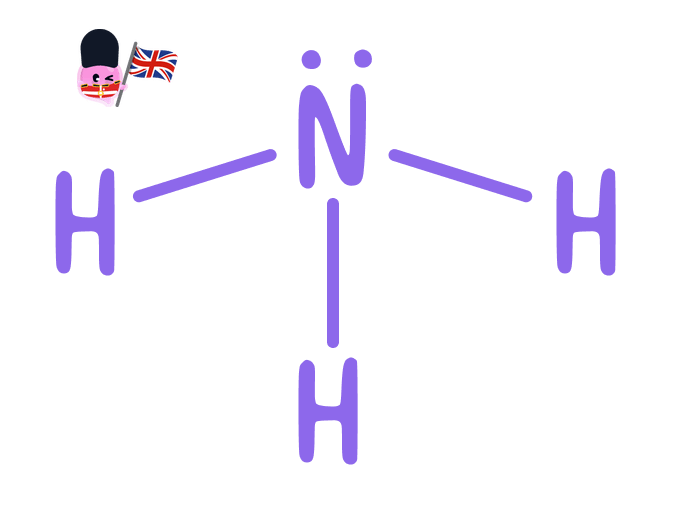
- Ammonia, NH3\text{NH}_3NH3
- Nitrogen shares one pair with each of three hydrogen atoms, so the molecule has three single bonds.
- Nitrogen also has one lone pair.
- Methane, CH4\text{CH}_4CH4
- Carbon shares one pair with each of four hydrogen atoms, so the molecule has four single bonds and no lone pairs.
Common Mistake
- Do not draw both electrons of a shared pair with the same symbol, because one electron comes from each bonded atom in these molecules.
- Dots and crosses only record where the electrons came from; the electrons are identical once the bond has formed.
- Do not leave out lone pairs, because every outer-shell electron must appear in a complete diagram.
Line diagrams: One line stands for one shared pair
Definition
Lone pair
A pair of outer-shell electrons on an atom that is not shared in a covalent bond.
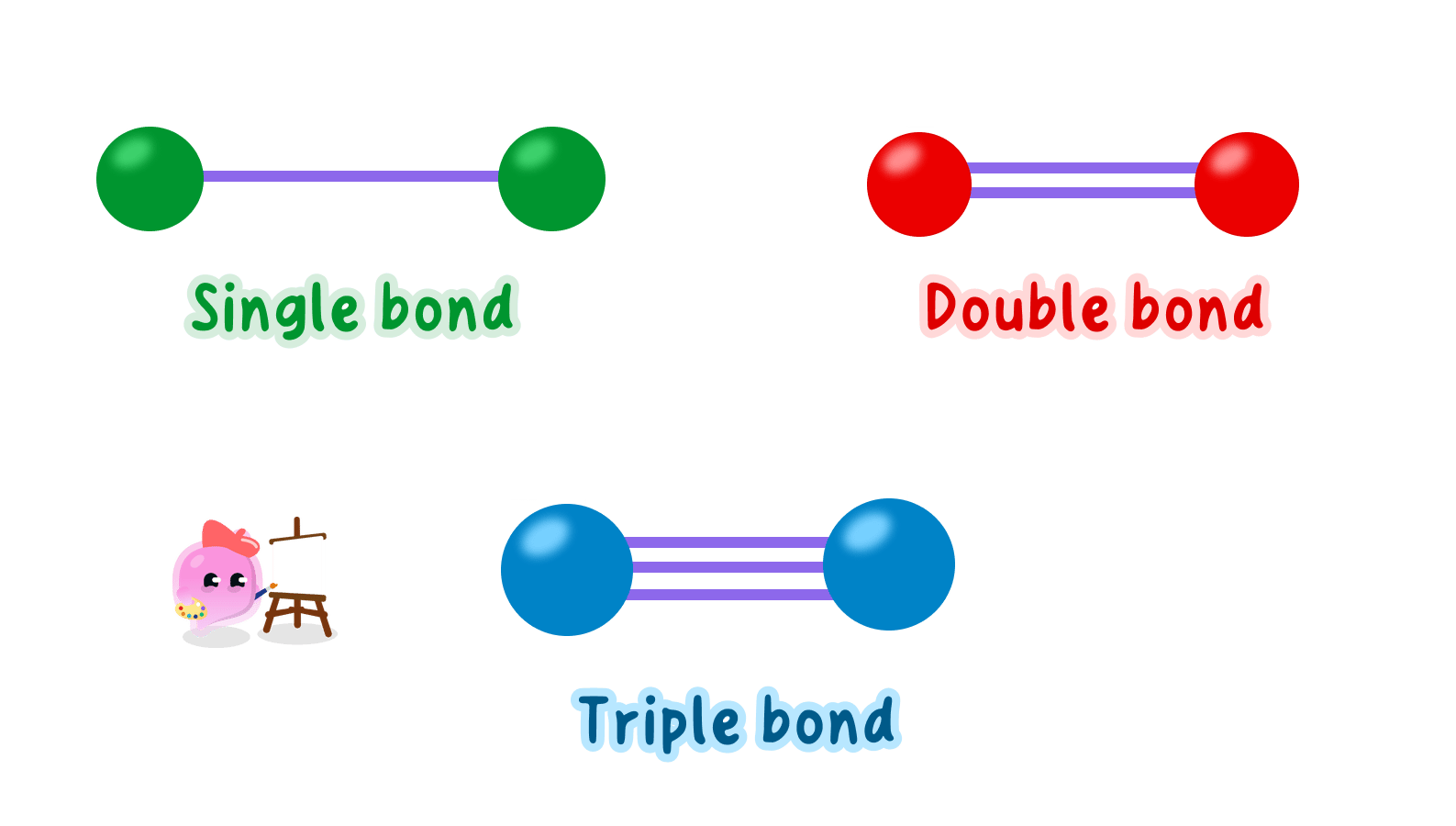
- A line between two atom symbols represents one shared pair of electrons, and therefore one single covalent bond.
- Two lines represent two shared pairs in a double bond.
- Three lines represent three shared pairs in a triple bond.
- Hydrogen, chlorine and hydrogen chloride can be drawn as H-H\text{H-H}H-H, Cl-Cl\text{Cl-Cl}Cl-Cl and H-Cl\text{H-Cl}H-Cl.
- Oxygen is drawn as O=O\text{O=O}O=O because its atoms share two pairs of electrons.
- Nitrogen is drawn as N≡N\text{N}\equiv\text{N}N≡N because its atoms share three pairs of electrons.
- Water is drawn as H-O-H\text{H-O-H}H-O-H because oxygen forms one single bond with each hydrogen.
- Ammonia has three N-H\text{N-H}N-H bonds around nitrogen, while methane has four C-H\text{C-H}C-H bonds around carbon.
- A line diagram usually leaves out lone pairs, so it shows less electron detail than a dot and cross diagram.
Note
- Count the shared pairs before drawing bond lines, because one shared pair needs one line.
- Keep every chemical formula unchanged when drawing bonds, because changing a subscript changes the substance.
Polymers and giant structures: Covalent bonding can continue across huge structures
Definition
Giant covalent structure
A giant covalent structure is a large network of atoms joined by many strong covalent bonds.
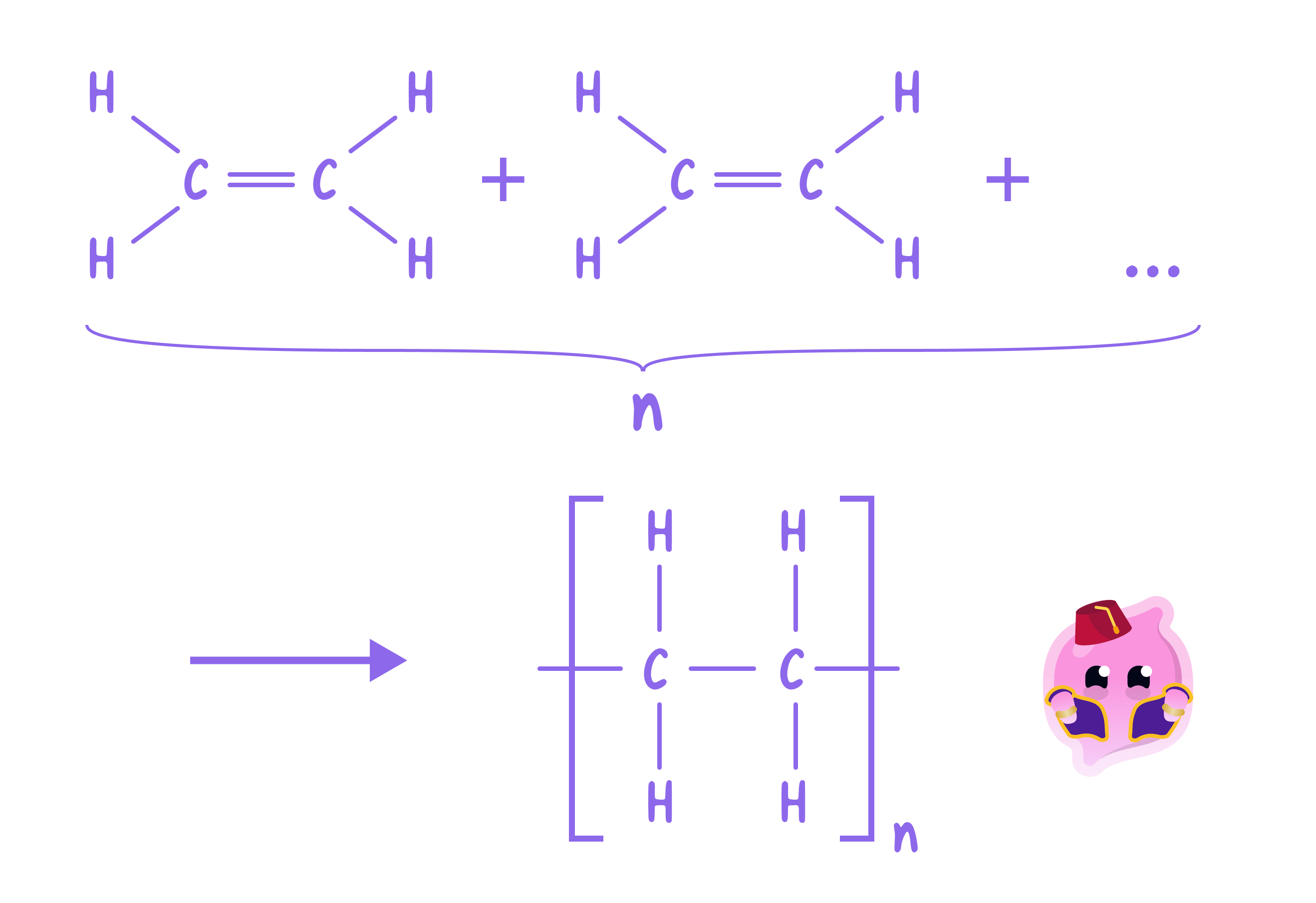
- A polymer is a very large covalent molecule made of many repeated sections joined together.
- The repeating unit is the smallest section of the polymer that repeats along the chain.
- A polymer is represented by placing one repeating unit inside square brackets with nnn written outside.
- The letter nnn represents a large number of repeating units, not one fixed value.
- Part of poly(ethene) can be written as [ −CH2−CH2− ]n\left[\!-\text{CH}_2-\text{CH}_2-\!\right]_n[−CH2−CH2−]n.
- In a drawn repeating unit, the bond lines at both ends must pass through the brackets to show that the chain continues.
- A giant covalent structure is a continuous network of atoms joined by many covalent bonds, rather than a set of separate molecules.
- Diamond is a giant covalent structure in which each carbon atom forms four single covalent bonds to other carbon atoms.
- Silicon dioxide is a giant covalent structure in which each silicon atom bonds to four oxygen atoms and each oxygen atom bonds to two silicon atoms.
- The formula SiO2\text{SiO}_2SiO2 gives the ratio of one silicon atom to two oxygen atoms in the giant structure.
- A diagram of a giant covalent structure shows only a small section, because the bonded network continues beyond the part drawn.
Common Mistake
- Do not treat nnn as an atom or as the exact number of repeating units in a polymer molecule.
- Do not place brackets and nnn around a fragment of diamond or silicon dioxide, because these are giant networks, not polymer chains.
- Do not describe diamond or silicon dioxide as collections of small molecules.
Models: Each representation shows some features and hides others
Definition
Ball-and-stick model
A model that represents atoms as balls and covalent bonds as sticks to show how the atoms are arranged.
- Every model simplifies a covalently bonded substance, so you must state both what it shows and what it leaves out.
- Dot and cross diagrams
- They show outer-shell electrons, shared pairs and lone pairs.
- They do not show accurate atom sizes, bond lengths, bond angles or the full three-dimensional shape.
- The different dots and crosses do not represent different types of electron.
- Displayed (line) diagrams
- They show which atoms are bonded and whether each bond is single, double or triple.
- They usually omit lone pairs and do not show accurate sizes or distances.
- Ball-and-stick models
- They show how the atoms are arranged and can show the three-dimensional shape.
- The balls and sticks are usually not drawn to scale.
- The sticks are not physical rods, and the gaps between the balls are exaggerated.
- Two-dimensional diagrams
- They make atoms and bonds easy to count on a flat page.
- They can give a misleading impression of the real three-dimensional arrangement.
- Three-dimensional diagrams
- They show the arrangement of atoms in space more clearly.
- Perspective can hide atoms or bonds behind other parts of the structure.
- They still do not show the true movement, size or scale of the particles.
Note
- In a question on limitations, name a specific feature that the model fails to show accurately.
- An answer such as “the model is not accurate” needs a stated reason, such as wrong relative sizes or missing three-dimensional shape.
Molecular formulae: Count atoms, not bonds
- First find the boundary of one complete molecule in the model or diagram.
- Use the labels or colour key to identify the element shown by each atom.
- Count every atom of each element, including any atom partly hidden in a three-dimensional model.
- Write each element symbol followed by a subscript showing how many atoms of that element are present.
- Leave out the subscript when only one atom of an element is present.
- Count atoms, not bond lines, because a double or triple bond adds no extra atoms.
- A model with one nitrogen atom and three hydrogen atoms has the molecular formula NH3\text{NH}_3NH3.
- A model with two nitrogen atoms joined by three bond lines has the molecular formula N2\text{N}_2N2.
- A fragment of a giant covalent structure is not one molecule, because the bonded network continues beyond the fragment.
Self review
- What is shared between two atoms when a covalent bond forms?
- How many bonding pairs and lone pairs surround the oxygen atom in a molecule of H2O\text{H}_2\text{O}H2O?
- What does the letter nnn outside a polymer's repeating unit represent?
- What molecular formula and bond type are shown by two nitrogen atoms joined by three lines?
- State one limitation of using a ball-and-stick model to represent a molecule.
