x

Revision notes for AQA GCSE Chemistry How carbon dioxide decreased. Open the guide for explanations and worked examples. Written against the AQA GCSE Chemistry (8462) specification, so the content matches what's examinable rather than general Chemistry background.

How carbon dioxide decreased

What you'll learn

  • Why Earth’s early atmosphere had much more carbon dioxide than today.
  • How algae and plants removed carbon dioxide by photosynthesis.
  • How carbon became “locked away” in limestone, coal, crude oil and natural gas.
  • How to explain the main atmospheric changes over geological time.

Starting point: Earth’s changing atmosphere

The atmosphere is the layer of gases surrounding a planet. Earth’s atmosphere has not always been like it is today.

In the very early atmosphere, volcanoes released large amounts of gases. Scientists think there was lots of carbon dioxide, water vapour and nitrogen, but little or no oxygen.

Over billions of years, the percentage of carbon dioxide decreased, while oxygen increased. Today, carbon dioxide is only a tiny percentage of the atmosphere, about 0.04%.

Definition

Geological time

Geological time means very long time periods in Earth’s history — millions or billions of years. The changes in the atmosphere happened extremely slowly compared with a human lifetime.

The big question for this topic is: where did all the carbon dioxide go?

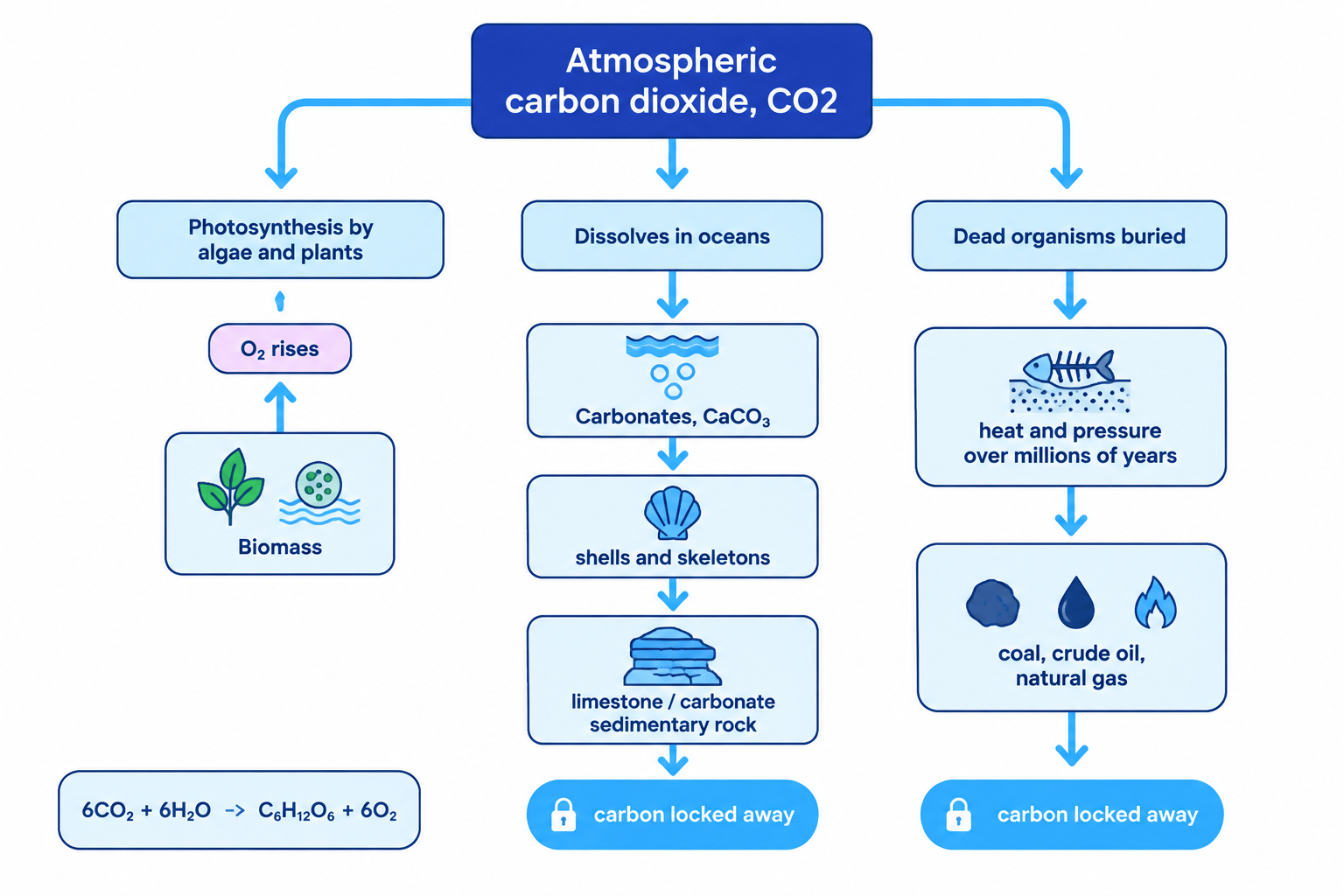
Flow diagram showing carbon dioxide decreasing through photosynthesis, limestone formation, coal formation, and crude oil/natural gas formation

Key Idea

The big picture

Carbon dioxide decreased because carbon was moved out of the atmosphere and stored in living things, sedimentary rocks and fossil fuels.

Carbon dioxide dissolving in the oceans

When Earth cooled enough, water vapour in the atmosphere condensed to form oceans. Some carbon dioxide dissolved in this seawater.

Definition

Dissolve

A substance dissolves when its particles spread out among the particles of a liquid, forming a solution.

This mattered because dissolved carbon dioxide could later become part of compounds in the sea, especially carbonate compounds such as calcium carbonate.

Carbon dioxide dissolving in oceans did not remove all the carbon dioxide, but it was an important first step in moving carbon out of the air.

Example

Explaining why oceans helped carbon dioxide decrease

A student says: “When oceans formed, carbon dioxide in the atmosphere decreased.” Explain why this is reasonable.

  1. The early atmosphere contained a lot of carbon dioxide, so there was a high concentration of carbon dioxide in the air.
  2. Once oceans formed, carbon dioxide could dissolve into the water, transferring some carbon dioxide from the atmosphere into the oceans.
  3. Because some carbon dioxide particles were no longer in the air, the percentage of carbon dioxide in the atmosphere decreased.

Photosynthesis by algae and plants

The most important biological process in this topic is photosynthesis.

Definition

Photosynthesis

Photosynthesis is the process by which green plants and algae use light energy to convert carbon dioxide and water into glucose and oxygen.

The word equation is:

carbon dioxide + water → glucose + oxygen

The balanced symbol equation is:

6CO2(g)+6H2O(l)→C6H12O6(aq)+6O2(g)6\text{CO}_2\text{(g)} + 6\text{H}_2\text{O(l)} \to \text{C}_6\text{H}_{12}\text{O}_6\text{(aq)} + 6\text{O}_2\text{(g)}6CO2​(g)+6H2​O(l)→C6​H12​O6​(aq)+6O2​(g)

This equation shows two key atmospheric effects:

  • Carbon dioxide is a reactant, so it is removed from the atmosphere.
  • Oxygen is a product, so it is released into the atmosphere.

Algae came before large plants

Algae are simple photosynthetic organisms that often live in water. They evolved before complex land plants.

For a very long time, algae in the oceans carried out photosynthesis. Later, plants also spread and photosynthesised on land. Together, algae and plants gradually decreased the percentage of carbon dioxide and increased the percentage of oxygen.

Key Idea

Photosynthesis changes two gases

Photosynthesis decreases carbon dioxide because carbon dioxide is used up, and it increases oxygen because oxygen is made.

Example

Linking photosynthesis to gas changes

A graph shows that, over a long period of Earth’s history, carbon dioxide decreased and oxygen increased. Explain how algae could have caused both changes.

  1. In photosynthesis, algae take in carbon dioxide from the surroundings, so carbon dioxide is removed from the atmosphere-ocean system.
  2. The carbon from carbon dioxide is used to make glucose and other biological molecules in the algae.
  3. Oxygen is produced during photosynthesis and released, so the percentage of oxygen in the atmosphere increases over time.
Common Mistake

Saying plants breathe in carbon dioxide

Plants and algae do respire as well as photosynthesise. In daylight, however, photosynthesis can remove more carbon dioxide than respiration releases, causing an overall decrease in atmospheric carbon dioxide over long periods.

Carbon became locked up in sedimentary rocks

Some of the carbon dioxide dissolved in oceans eventually became part of carbonate materials, especially calcium carbonate.

Definition

Sedimentary rock

A sedimentary rock is a rock formed from layers of sediment that are compacted and cemented together over time.

Definition

Limestone

Limestone is a sedimentary rock mainly made from calcium carbonate, CaCO₃(s).

Many marine organisms, such as shellfish and coral-like organisms, use calcium carbonate to make shells or skeletons. When these organisms die, their remains can fall to the seabed.

Over millions of years:

  1. Shells and skeletons build up in layers.
  2. More sediment piles on top.
  3. Pressure compacts the layers.
  4. The sediment eventually forms limestone.

This stores carbon in a solid rock instead of leaving it in the atmosphere as carbon dioxide.

Example

Tracing carbon into limestone

Explain how a carbon atom in atmospheric carbon dioxide could end up in limestone.

  1. Carbon dioxide from the atmosphere dissolves in seawater, moving the carbon atom from the air into the ocean.
  2. Marine organisms use dissolved carbon compounds to make calcium carbonate shells or skeletons.
  3. When these organisms die, their calcium carbonate remains collect as sediment on the seabed.
  4. Over millions of years, the sediment is compacted and cemented to form limestone, so the carbon atom is stored in rock.
Tip

Use the word stored

In exam answers, phrases like “carbon is stored in limestone” or “carbon is locked up in fossil fuels” are stronger than just saying carbon dioxide “disappeared”.

Carbon became locked up in fossil fuels

Carbon dioxide was also decreased by the formation of fossil fuels.

Definition

Fossil fuel

A fossil fuel is a fuel formed from the remains of ancient living organisms over millions of years. Fossil fuels contain carbon.

The three fossil fuels you need here are:

  • Coal
  • Crude oil
  • Natural gas

They all contain carbon because they formed from organisms that once took in carbon, directly or indirectly, from carbon dioxide in the atmosphere.

Formation of coal

Coal formed mainly from dead plants in ancient swampy forests.

The basic process was:

  1. Plants photosynthesised, taking carbon dioxide from the atmosphere.
  2. The plants died and were buried in swampy ground.
  3. Low oxygen conditions meant the plant material did not fully decay.
  4. Over millions of years, layers of sediment compressed the plant material.
  5. Heat and pressure changed it into coal.

So, coal is a carbon store made from ancient plant material.

Definition

Decay

Decay is the breakdown of dead material by microorganisms. Decay is much slower when there is little oxygen.

Common Mistake

Coal does not form from sea creatures

At GCSE, remember: coal forms from dead plants, especially in swampy conditions. Crude oil and natural gas form mainly from dead plankton buried under the sea.

Formation of crude oil and natural gas

Crude oil and natural gas formed mainly from plankton.

Definition

Plankton

Plankton are tiny organisms that live in water. Some plankton photosynthesise, and others feed on organisms that photosynthesise.

The process was:

  1. Plankton lived in ancient seas.
  2. When they died, they sank and were buried in mud on the seabed.
  3. There was little oxygen, so they did not fully decay.
  4. Over millions of years, heat and pressure changed the remains.
  5. Crude oil and natural gas formed.

Crude oil is a mixture of liquid hydrocarbons. Natural gas is mostly methane, CH₄(g). Both contain carbon that originally came from living things and, ultimately, from carbon dioxide.

Example

Choosing the correct fossil fuel formation route

A deposit is found in rock that formed from ancient seabed mud containing tiny dead organisms. Decide whether it is more likely to be coal or crude oil/natural gas.

  1. The material formed on an ancient seabed, so it is linked to marine organisms rather than swamp plants.
  2. The dead organisms are described as tiny, which matches plankton.
  3. Dead plankton buried in mud under low oxygen conditions forms crude oil and natural gas, so the deposit is more likely to be crude oil or natural gas than coal.

Putting the atmosphere changes together

You need to be able to describe the main changes and likely causes, not just list isolated facts.

A good GCSE explanation might sound like this:

Early Earth had a high percentage of carbon dioxide because of volcanic activity. As Earth cooled, oceans formed and some carbon dioxide dissolved in the water. Algae evolved and photosynthesised, removing carbon dioxide and releasing oxygen. Later, plants also photosynthesised, causing further decreases in carbon dioxide and increases in oxygen. Some carbon was stored in limestone made from marine shells and skeletons, and some was stored in fossil fuels such as coal, crude oil and natural gas.

Common Mistake

These are likely explanations

Scientists cannot directly sample the atmosphere from billions of years ago. The explanations are based on evidence, such as rocks and fossils, so exam questions often use wording like “likely causes”.

Quick comparison table

Carbon storeFormed fromHow it decreased carbon dioxide
LimestoneCalcium carbonate shells and skeletons of marine organismsCarbon from carbon dioxide became stored in carbonate rock
CoalDead plants in swampy conditionsPlants photosynthesised, then their carbon-rich remains were buried and compressed
Crude oilDead plankton buried in seabed mudCarbon-rich remains were changed by heat and pressure over millions of years
Natural gasDead plankton buried in seabed mudCarbon-rich remains formed gas, mostly methane
Exam technique

In the exam

  1. If asked how carbon dioxide decreased, give at least two mechanisms: photosynthesis and formation of carbon stores such as limestone or fossil fuels.
  2. If asked to explain photosynthesis, mention both gas changes: carbon dioxide is used up and oxygen is released.
  3. If asked about fossil fuel formation, match the organism to the fuel: dead plants form coal; dead plankton form crude oil and natural gas.
Self review

Check yourself

  • Why did photosynthesis decrease carbon dioxide but increase oxygen?
  • How does limestone formation store carbon from the atmosphere?
  • What is the difference between the formation of coal and the formation of crude oil/natural gas?

The composition and evolution of the Earth's atmosphere

Guide 4 of 4

You've reached the end

Test yourself on this topic, or move on to the next guide.

Next guideGreenhouse gasesStart

How was this guide?

How carbon dioxide decreased Revision Guide

  1. GCSE
  2. /Chemistry
  3. /How carbon dioxide decreased